
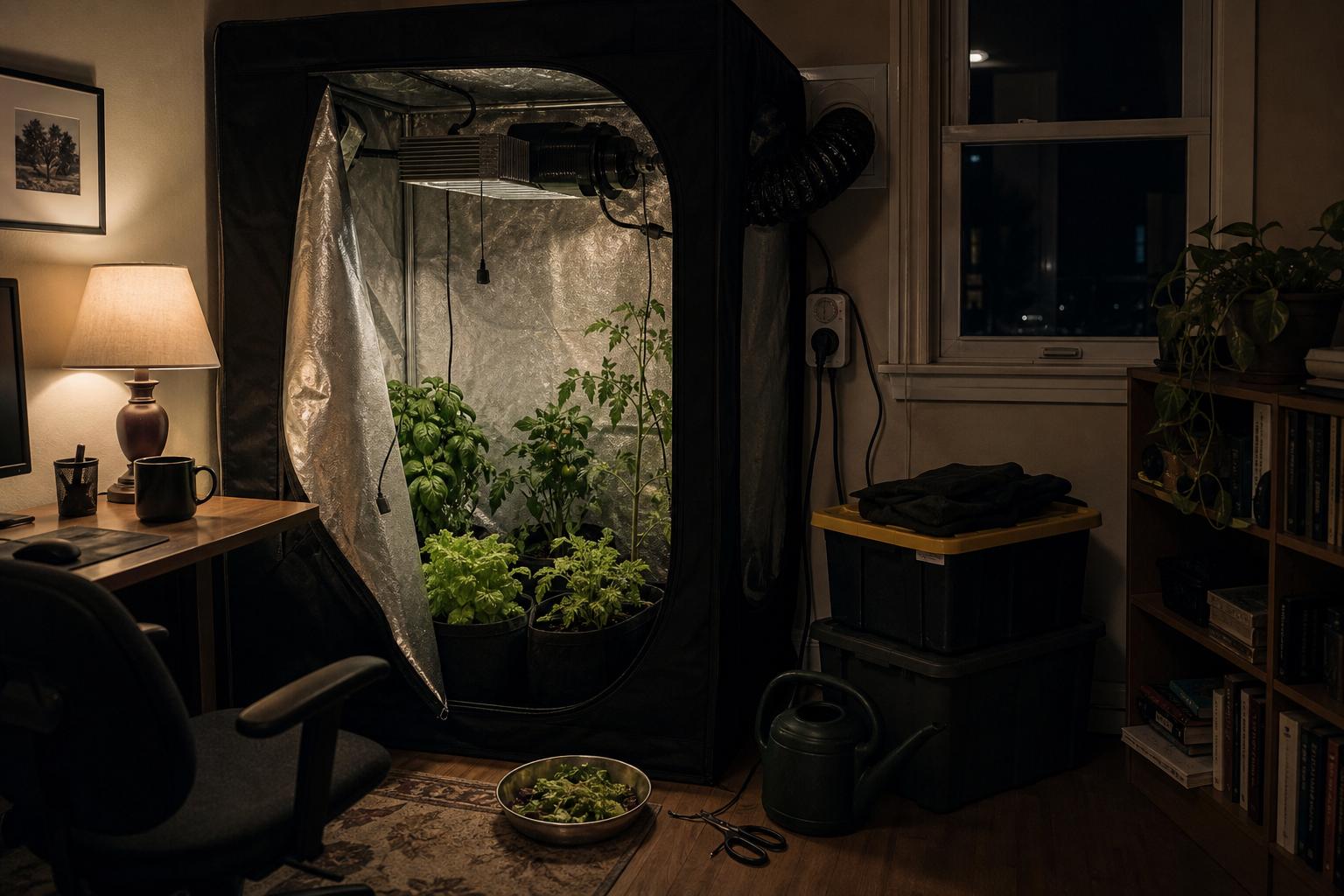
A grow tent should cool down when the lights turn off. That is what most of us expect, so seeing the nighttime temperature climb can make it seem as if something is wrong with the light timer or exhaust system.
In practice, a grow tent does not experience night in isolation. It is connected to the room around it, and that room often changes after bedtime. Air conditioning schedules shift, doors close, exhaust fans slow down, and dehumidifiers begin running. Before buying more cooling equipment, it helps to find out which of those changes is actually warming the tent.
Why Temperatures Can Rise After the Grow Lights Turn Off
The grow lights may be the largest heat source during the day, but they are not the only one. Shelving, containers, water reservoirs, light fixtures, and the tent walls all absorb heat while the lights are running. When the lights turn off, some of that stored heat returns to the air.
Stored heat usually causes a slow cooldown or a brief rebound. It rarely explains a tent that keeps getting warmer for hours. If the temperature continues rising well into the dark period, I look outside the grow tent for the main cause.
I have noticed this most often in smaller rooms where the tent shares space with a computer, television, freezer, or dehumidifier. The lights turn off, but another appliance warms the room. Since the grow tent pulls its replacement air from that room, the intake air becomes warmer too.
A grow tent cannot become cooler than its intake air through ventilation alone.
Nighttime humidity can also play a part. Vegetables and leafy greens continue releasing moisture after the lights go out, while cooler leaves cause relative humidity to rise. If a room dehumidifier responds by switching on, it removes moisture but releases heat. In a small apartment room, that heat can return to the grow tent surprisingly quickly.
Check the Room Before Blaming the Grow Tent
The first useful comparison is simple: measure the room and the tent at the same time. Place one sensor near the tent intake and another around canopy height inside the grow tent. Do not place the room sensor directly in front of an air conditioner vent or against a cold wall.
Watch both readings for at least the first two hours after the grow lights turn off. You are looking for one of three patterns:
- Both temperatures rise together, which points to warmer room air.
- Only the grow tent rises, which suggests reduced exhaust, poor circulation, or sensor placement.
- The tent stays warm but slowly falls, which is usually stored heat combined with modest ventilation.
In apartments and townhomes, the room often gets warmer because the main thermostat is located elsewhere. The living room may feel comfortable while the closed room containing the grow tent steadily heats up. Closing the room door for quiet or privacy can make this worse.
Check the room with the door in its normal nighttime position. Testing with every door open may give you a result that never occurs while you are asleep.
Make Sure the Exhaust Fan Is Actually Helping at Night
One mistake I made early on was putting the exhaust fan on the same timer as the grow light. It seemed sensible because the light was the obvious heat source. Instead, warm air collected near the top of the grow tent, humidity climbed, and the temperature sensor recorded a small increase after lights out.
What worked better for me was keeping the exhaust fan running continuously at a lower speed. This uses some electricity and creates a little background noise, but it gives vegetables and herbs a much more stable environment.
For most home growers, low continuous exhaust is more practical than aggressive cycling. It avoids repeated temperature and humidity swings, and a modern speed controlled fan on a low setting is usually quieter than a fan repeatedly starting at full power.
Check these nighttime ventilation details:
- The exhaust fan remains on after the light timer switches off.
- The intake opening is not blocked by a curtain, box, or closed vent flap.
- Ducting is not crushed behind the grow tent.
- The carbon filter or intake screen is not clogged with dust.
- Circulation fans continue moving air through the plant canopy.
Circulation fans do not remove heat, but they prevent warm air from forming a pocket around the sensor or above dense lettuce, basil, and pepper foliage. I prefer to leave at least one small circulation fan running through the dark period, aimed past the plants rather than directly at tender leaves.
Your Temperature Sensor May Be Telling a Partial Story
Sensor placement causes more confusion than most growers expect. A sensor hanging near the top of a grow tent may sit in a warm air pocket once the circulation fan turns off. A sensor touching a tent wall can also follow the temperature of the wall rather than the air around the plants.
Place the sensor at canopy height in moving air, but keep it out of the direct path of the intake and away from humidifier mist. For leafy greens, move it upward as the canopy grows. A sensor that was correctly positioned above young seedlings can end up buried among mature leaves a few weeks later.
I also like to compare two sensors side by side for about thirty minutes before separating them. Inexpensive temperature sensors often disagree slightly. That does not make them useless, but it helps to know whether one regularly reads warmer.
Do not chase a one degree change with expensive equipment. A modest, brief rise is usually less harmful than constantly changing fan speeds and room settings. Lettuce and some tender greens prefer cooler nights, while basil, tomatoes, and peppers tolerate more warmth. A sustained rise paired with high humidity deserves attention because that combination can encourage weak growth and moisture problems inside a crowded grow tent.
Common Nighttime Settings That Trap Heat
Where do most growers go wrong? Usually, several small settings change at once.
- The exhaust fan switches to a temperature controller setting that is too high.
- The room air conditioner enters an energy saving schedule.
- The room door closes and reduces air exchange.
- A dehumidifier begins running as nighttime humidity rises.
- All circulation fans turn off with the grow lights.
- A heater has a thermostat placed in a cooler part of the room.
A controller can be especially misleading. If the exhaust fan runs only above a chosen temperature, it may stop as soon as the lights go out. The remaining heat then collects until the fan starts again. This creates a repeating warm and cool pattern.
I prefer a minimum fan speed instead of a complete shutoff. The tradeoff is slightly more noise and electricity use, but it is usually cheaper and easier than adding an air conditioner to solve a ventilation schedule problem.
A Simple Nighttime Temperature Check
Use this routine before changing equipment:
- Record the grow tent and room temperatures just before lights out.
- Check both readings again after thirty minutes, one hour, and two hours.
- Confirm that the exhaust and circulation fans are still running.
- Note whether the room door, air conditioning, or dehumidifier changed state.
- Move the tent sensor to canopy height and repeat the test the following night.
If the room warms first, improve room air exchange or adjust the home cooling schedule. If only the grow tent warms, keep the exhaust running at a low baseline speed and inspect the intake path. If readings change after moving the sensor, the original problem was measurement rather than actual plant temperature.
Do not buy another cooling device yet. Tonight, place one sensor beside the grow tent intake and one at canopy height, then leave the exhaust fan running on low. That single comparison will usually tell you whether the heat is coming from the room, the ventilation schedule, or simply the spot where you were measuring it.


