
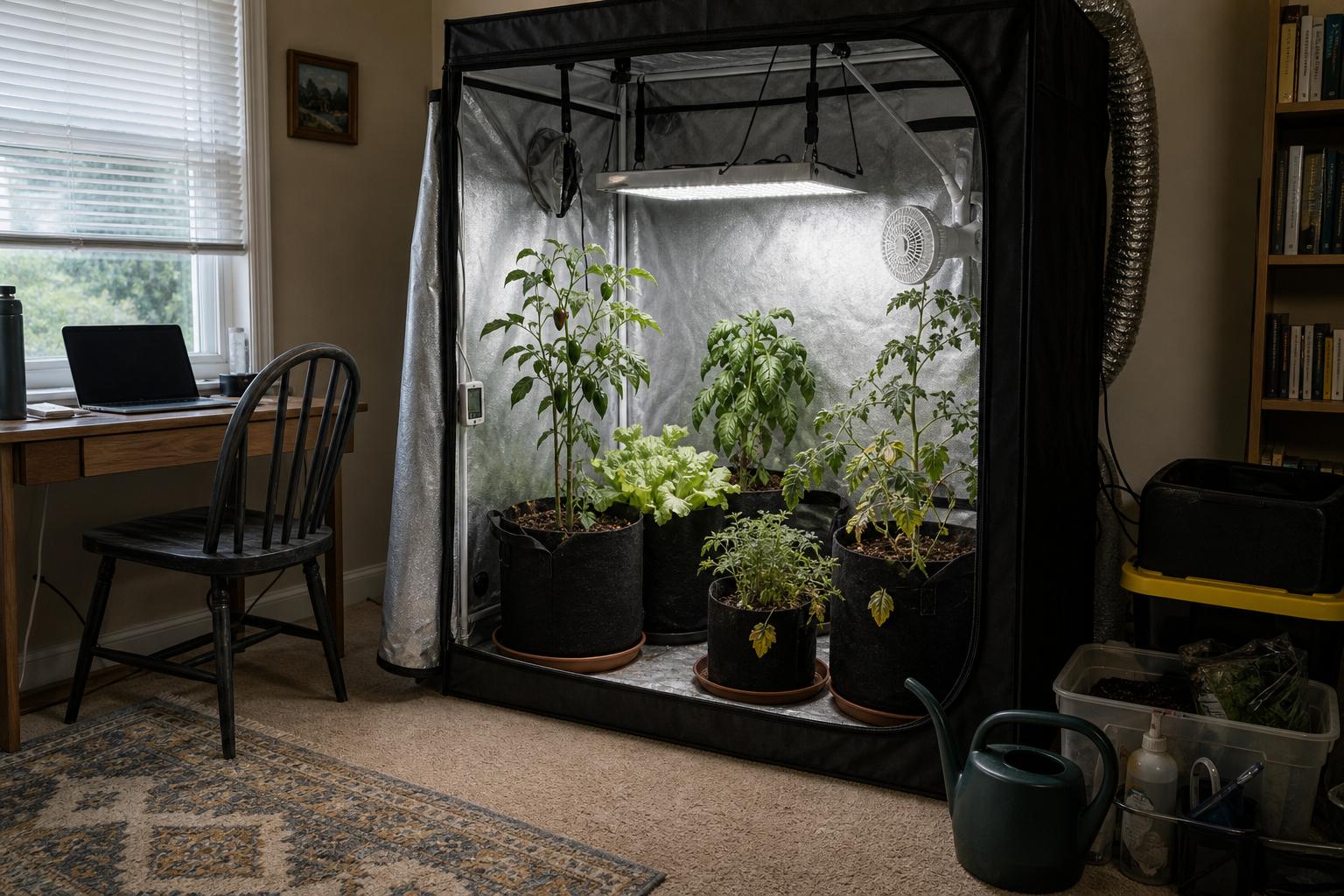
Plants usually show stress before they show serious damage. Inside a grow tent, the first clues are often small: a leaf edge lifting, basil leaning away from the light, lettuce losing its morning firmness, or one pepper plant growing more slowly than the others.
The difficult part is that several grow tent problems can look similar. Drooping may come from dry roots, wet roots, excessive heat, or weak airflow. Yellowing can point toward nutrition, but it can also begin when a pot stays wet too long. The goal is not to react faster. It is to observe more carefully before changing anything.
What Early Plant Stress Looks Like in a Grow Tent
Healthy plants are not perfectly still or perfectly symmetrical. Leaves rise and lower during the light cycle, and new growth may be lighter than mature growth. I become concerned when a change persists, spreads, or appears in a particular part of the grow tent.
These are the early signals I pay attention to:
- Leaf edges curling upward, especially near the center of the light
- Leaves hanging lower than usual even though the growing medium is not dry
- New growth becoming pale or unusually small
- Stems stretching toward one side of the grow tent
- Dry patches on leaves facing a circulation fan
- Slow growth in one pot while similar plants continue normally
- Persistent condensation around dense leaves or tent walls
One observation matters more than any single symptom: look for a pattern. If every lettuce plant has raised edges, the grow tent environment deserves attention. If only one lettuce plant is affected, inspect that plant, its pot, and its exact location first.
Match the Pattern to Light, Airflow, Watering, or Roots
Light stress usually starts at the top
When a grow light is too intense or too close, the highest leaves normally complain first. They may look pale, curl upward like a shallow bowl, or feel warmer than leaves lower on the plant. Peppers and tomatoes can also develop compact, slightly distorted growth directly beneath the brightest area.
Weak or poorly distributed light creates a different pattern. Herbs lean, stems lengthen, and plants near the tent edges reach toward the center. Lower leaves may remain healthy while the plant gradually becomes loose and lanky.
One mistake I made early on was raising or dimming the light whenever I saw curled leaves. Sometimes the real problem was a dry pocket in the pot or warm air trapped above the canopy. Before changing the light, compare top leaves with lower leaves and center plants with edge plants.
Airflow stress follows the fan or the dead zone
Good grow tent airflow should cause a gentle, occasional leaf movement. Leaves should not flap constantly. A fan blowing directly at basil, lettuce, or young pepper plants can dry one side faster than the roots can replace the moisture. The exposed leaves may curl, feel thin, or develop dry edges while sheltered leaves look normal.
I have noticed that direct fan stress often affects only two or three plants in a very obvious path. That is useful because it saves me from changing the exhaust system or adding another fan. Turn the circulation fan toward a tent wall or above the canopy so air mixes without pushing hard against one plant.
The opposite problem appears in crowded corners. Leaves overlap, moisture lingers, and the plants feel softer than those near the front. In a small grow tent, this can happen behind a tomato or pepper plant that blocks circulation to shorter greens.
Move leaves and plants before buying more equipment.
Watering stress affects posture, but timing tells you more
A dry plant often loses firmness throughout the canopy, and its pot feels noticeably lighter. After watering, lettuce and many herbs begin recovering fairly quickly. A plant sitting in wet growing medium can also droop, but the leaves often look heavy rather than thin, and recovery does not follow another watering.
One mistake I see often is watering every grow tent pot on the same schedule. Pots dry at different rates depending on plant size, airflow, container material, and distance from the light. A large basil plant may need water while a recently transplanted pepper beside it is still wet.
Lift each pot before watering. For an ordinary home grower, pot weight is more dependable than a rigid calendar and costs nothing. I prefer this over adding moisture meters to every container because inexpensive probes can be misleading, take up space, and create one more thing to maintain.
Root trouble looks slow and stubborn
Root stress inside a grow tent tends to produce symptoms that do not improve after a simple environmental adjustment. Growth slows, older leaves yellow, and the container remains wet longer than expected. You may also notice a sour smell near the drainage tray or roots circling densely around drainage openings.
Check whether runoff can actually leave the pot. A container sitting flat in a full saucer may reabsorb water and remain saturated. Raising it slightly on a simple pot stand can make a large difference without adding noise, electricity use, or heat to the room.
If roots have filled the container, moving to a larger pot may help, but space matters inside a grow tent. Do not automatically choose the biggest container available. I would rather use a modest increase in pot size and preserve access for watering, pruning, and airflow.
Read Plant Location Before Changing the Whole Grow Tent
Plant location is one of the best diagnostic tools you have. Before adjusting equipment, stand at the open tent and note exactly where the stressed plants are.
- Stress directly below the light suggests intensity or trapped heat.
- Stress along one narrow line suggests direct fan exposure.
- Stress in a back corner suggests weak air movement or difficult watering access.
- Stress near an intake opening may come from cooler or drier room air.
- Stress in one container suggests watering, drainage, roots, or growing medium.
I once spent too much time adjusting an entire grow tent because several leafy greens near the back looked limp. The front plants were fine. It took me a while to realize I was giving the back pots less water because they were awkward to reach around larger containers.
If the problem has a location, start with that location.
This matters in apartments and smaller homes because every equipment change has a cost. A stronger exhaust fan may add noise and pull more conditioned air from the room. More lighting adds heat and electricity use. Often, rotating a tray, spacing two pots, or redirecting a fan solves the actual problem more cleanly.
A Simple Grow Tent Stress Check in the Right Order
When I notice an early symptom, I use the same sequence. It keeps me from making several changes and then having no idea which one worked.
- Touch and lift the pot. Check whether the growing medium is dry, evenly moist, or still heavy and wet.
- Compare plant height and location. Look at top leaves, lower leaves, center plants, edge plants, and anything in the fan path.
- Feel the air around the leaves. Check for a strong breeze, a warm pocket, or damp stagnant air within dense growth.
- Inspect drainage and roots. Empty standing runoff and look for blocked holes, unpleasant odors, or severe root crowding.
- Make one small correction. Move a pot, redirect a fan, adjust watering, or slightly change light distance.
- Watch the newest growth. Damaged leaves may not return to normal, so judge improvement by plant posture and developing leaves.
Avoid changing the light, fan speed, watering volume, and nutrients all at once. That approach feels productive, but it removes the clues your plants were giving you.
My practical recommendation is to open your grow tent today and compare the healthiest plant with the most stressed one. Check pot weight first, then compare their positions relative to the light and fan. Make the smallest reasonable correction and give the plant time to respond before changing the whole grow tent.


