
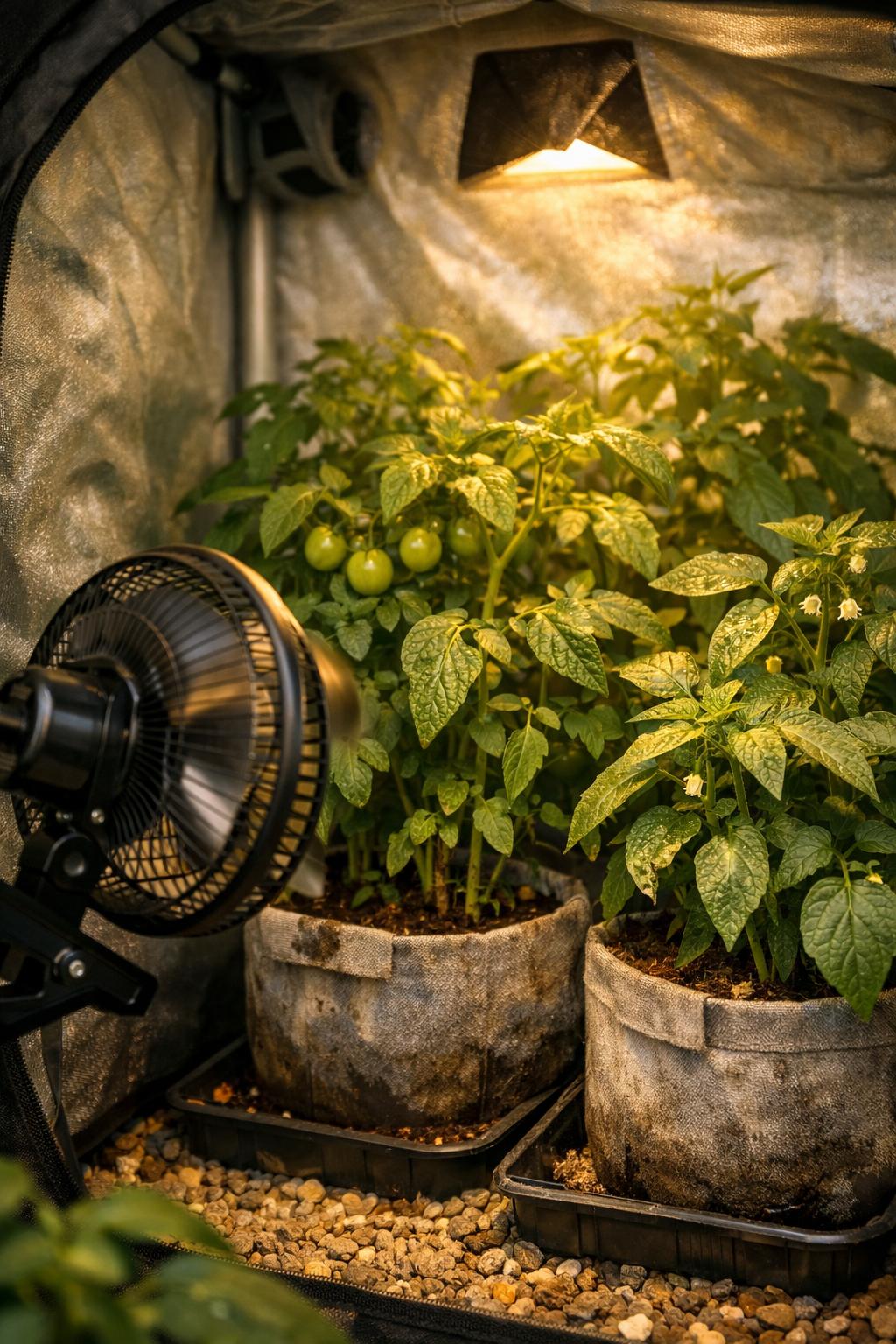
If your plants are growing unevenly inside your grow tent even though temperature and humidity look acceptable on your controller, you are likely dealing with air stratification. Grow tents create isolated microclimates, and without proper internal air mixing, layers of warm and cool air separate vertically. This directly affects canopy performance.
In a grow tent environment, vertical air layering can cause the top of the canopy to experience radically different conditions than the root zone. Because grow tents use artificial lighting, reflective walls, and controlled exhaust systems, poor circulation does not correct itself the way it sometimes can outdoors. You have to engineer it correctly.
What Air Stratification Looks Like Inside a Grow Tent
Stratification inside grow tents usually shows up in subtle but consistent ways. The top leaves may taco or show mild light stress, while lower growth appears soft and slow. You might notice that plants closest to oscillating fans are thriving, while those in corners lag behind.
Another sign is inconsistent internode spacing across the same plant. The upper canopy stretches less while lower growth stretches more. This is not simply light intensity. It is uneven leaf surface temperature caused by stagnant air layers.
Because grow tents are sealed systems with strong overhead lighting, heat accumulates near the top. Exhaust fans typically pull hot air from the ceiling area, but if intake and circulation are poorly arranged, pockets of dense, cooler air remain below the canopy. This prevents proper vapor pressure interaction at leaf level.
Why Exhaust Alone Does Not Solve It
Many growers assume that a strong inline fan solves all airflow problems in a grow tent. It does not. Exhaust handles air exchange. It does not guarantee internal air mixing.
In fact, high exhaust speeds can worsen stratification. When hot air rapidly exits through a top mounted filter, cooler intake air may slide directly across the floor toward that exit path. This creates a fast low channel and a slow high channel. The upper canopy becomes isolated in rising heat between light and exhaust port.
The result is a vertical temperature gradient that your single hanging probe will not accurately detect.
Step 1 Diagnose Vertical Temperature Variation
You need data at multiple levels inside your grow tent.
Measure Three Vertical Points
Place one sensor at canopy height, one ten inches below canopy, and one near the floor under the plant container height. Run lights at full intensity for at least one hour with the tent sealed as usual.
If the temperature difference between top and bottom exceeds three degrees, you have significant stratification. In high intensity lighting setups, five degrees is common when airflow is poorly structured.
Check Leaf Surface Temperature
If you have an infrared thermometer, compare upper canopy leaves with mid canopy leaves. A difference of more than three degrees indicates poor mixing. Inside a grow tent, uniform leaf temperature is essential because airflow is entirely mechanical.
Step 2 Reposition Circulation Fans for Mixing Not Blasting
Most grow tent setups use clip fans aimed directly at plants. This creates micro wind zones and dead zones. Instead, focus on circular mixing.
Create a Horizontal Air Loop
Mount one oscillating fan slightly below canopy height aimed across the tent wall, not directly at leaves. The goal is to push air along the wall so it wraps around the space.
Add a Vertical Disruption Fan
Place a second fan under the canopy aimed upward at a slight angle. This breaks the boundary between warm ceiling air and cooler lower air. You are not cooling plants. You are blending layers.
In small grow tents, two fans are often enough. In four by four and larger grow tents, four smaller fans placed strategically mix better than one powerful unit.
Step 3 Adjust Exhaust and Intake Balance
Your exhaust should maintain negative pressure, but not create a vacuum. When tent walls suck inward excessively, intake air accelerates toward the exhaust path. This encourages channeling instead of mixing.
Reduce Exhaust Speed Slightly
Lower fan speed ten percent and observe canopy temperature consistency. Often this slows the ceiling heat extraction just enough to allow circulation fans to blend air before it exits.
Improve Passive Intake Distribution
If using passive intake flaps, open more than one vent. This disperses incoming air across a wider base rather than a single concentrated stream.
In grow tents with active intake fans, reduce direct alignment between intake and exhaust ports. Diagonal placement improves mixing.
Step 4 Manage Light Driven Heat Pockets
LED fixtures inside grow tents emit less ambient heat than older systems, but they still create a hot plane directly above the diode array. Without upward deflection, that heat pool can hover above the canopy.
Raise the Fixture Slightly
Even a two inch increase can improve convective flow if space allows. This creates a larger chamber for air mixing between light and exhaust zone.
Angle Crop Steering Practices Toward Airflow
If your canopy is extremely dense, thin interior leaf clusters that block upward airflow. Inside a grow tent, airflow must travel through the canopy, not around it.
Troubleshooting Common Grow Tent Stratification Problems
Problem: Top Leaves Canoe Despite Good Temperature Reading
Likely cause is localized heat between light and canopy. Add an upward angled fan below canopy and confirm multiple sensor readings. Single probe data is misleading inside grow tents.
Problem: Uneven Growth Between Front and Back of Tent
Check circulation pattern. Air often travels from intake directly to exhaust on one side. Install a cross current fan pointed at the opposite wall to force a loop.
Problem: Floor Feels Cool and Damp
This suggests cool air pooling. Increase lower canopy airflow and slightly decrease exhaust pull. Cold air accumulation slows root zone evaporation in container systems inside grow tents.
Problem: Strong Negative Pressure Collapsing Tent Walls
Reduce exhaust speed and open additional intake vents. Excessive suction increases straight line airflow and prevents layered mixing.
How Long Until Growth Normalizes
Inside a grow tent, improvements from proper air mixing can be visible within forty eight hours. Leaf posture becomes more horizontal. New growth becomes more symmetrical across the canopy. Internode spacing evens out.
If no improvement occurs after airflow correction, re measure vertical temperature spread. In controlled grow tents, air structure directly influences plant metabolism. When mixing is correct, canopy behavior reflects it quickly.
Air stratification is one of the most overlooked mechanical issues in grow tents. It is not solved by increasing fan power. It is solved by intentional air architecture. When you design airflow to circulate in loops rather than lines, your entire grow tent stabilizes at canopy level where it actually matters.


