
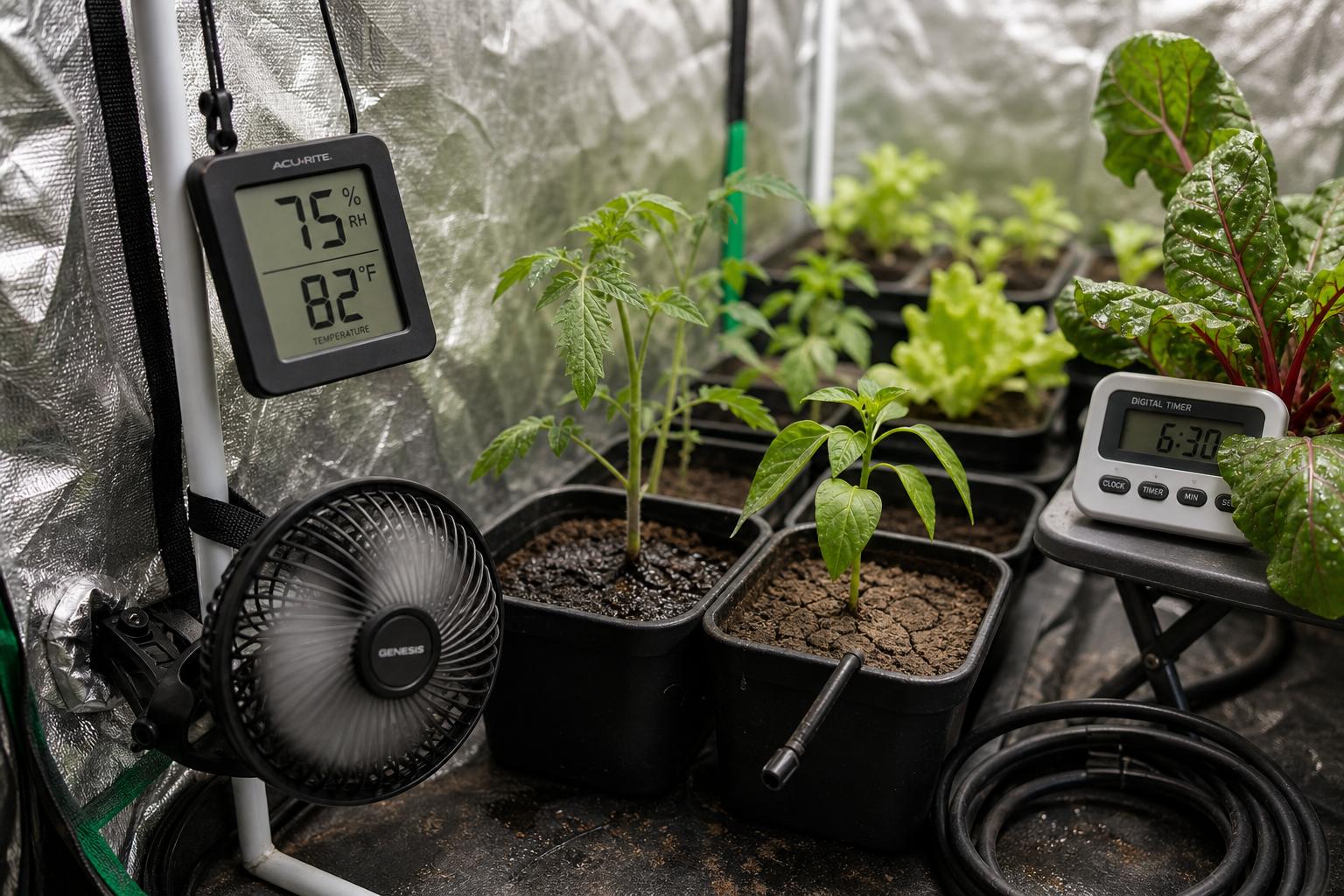
If your grow tent never seems to settle down after you make an adjustment, you are not alone. I have lost count of how many times I have watched a grow tent drift from 74 to 81 degrees, then down to 72, all because I kept touching the controls every time the display shifted.
Inside grow tents, every change stacks on top of the last one. You raise the inline fan speed. Then humidity drops. So you turn up the humidifier. Then temperature rises. So you open a vent. An hour later nothing looks like it did before. The real reason your grow tent never stabilizes is not weak equipment. It is reactive adjustments piling up and creating overlapping feedback loops.
Why Constant Adjustments Make Your Grow Tent Less Stable
A grow tent is a closed environment with artificial airflow, artificial light, and controlled moisture. That means every dial you touch affects at least two other variables.
In my experience, the biggest mistake growers make inside a grow tent is chasing the number they see in the moment. Digital controllers update fast. Your environment does not. When you increase exhaust fan speed, the tent volume may take ten to twenty minutes to fully equalize. If you adjust again during that window, you are no longer correcting the original issue. You are correcting a transition state.
I learned this after running a four by four grow tent where I adjusted fan speed five times in one evening. The readings looked unstable for hours. The next day I forced myself to make a single adjustment and wait. The tent stabilized within thirty minutes and stayed there.
Grow tents are small thermal systems. Small spaces react quickly but they also overshoot quickly. Continuous tweaking causes oscillation. You end up creating instability while trying to fix it.
The Three Hidden Feedback Loops That Keep Conditions Swinging
When a grow tent fails to stabilize, it is usually because of one or more of these system loops working against each other.
1. Exhaust Fan and Temperature Loop
Your grow light adds heat. Your inline fan removes heat. When you increase fan speed inside your grow tent, temperature drops. But stronger exhaust also increases negative pressure, which pulls in cooler room air faster. That can drop temperature too far, especially during lights off cycles.
Then growers slow the fan down because it looks too cool. Heat builds again. The loop repeats.
What surprised me most is how often the room outside the grow tent is the real variable. If the lung room swings three degrees, your tent will amplify it when exhaust is high.
2. Humidity and Air Exchange Loop
Every time you raise exhaust speed in a grow tent, you reduce humidity because you are exchanging moist tent air with drier room air. Many growers respond by increasing humidifier output.
The problem is that when you later slow the fan back down, that humidifier is still running at full output. Humidity spikes. Then you turn it down. Meanwhile, plant transpiration has changed because temperature shifted earlier.
One mistake I see often is placing a humidifier directly under an intake vent inside the grow tent. The moisture gets pulled straight out before it mixes, so growers keep increasing output unnecessarily.
3. Negative Pressure and Passive Intake Loop
Most grow tents rely on passive intake flaps. When you increase exhaust, negative pressure increases. That changes how much fresh air enters and how it moves across the canopy.
Airflow patterns shift. One area may cool faster. Another may trap humidity. If your sensor sits in a high airflow corner, readings will exaggerate swings compared to canopy level in the center of the grow tent.
Inconsistent sensor placement can make a stable tent look unstable.
A Step by Step Reset Plan to Bring Your Grow Tent Back to Baseline
If your grow tent feels chaotic, the best solution is a full reset rather than another micro adjustment.
Step 1: Return Everything to Neutral
Set your inline fan to a moderate consistent speed. Not maximum. Not minimum. Turn your humidifier to a medium output. Close any partially open vents and standardize their position. Remove recent temporary fixes.
You are creating a baseline configuration inside your grow tent.
Step 2: Verify Sensor Placement
Place your temperature and humidity sensor at canopy height in the center of the grow tent, away from direct fan airflow and not directly under the light. If needed, hang it using string so it stays fixed.
Many stability issues disappear when measurements become consistent.
Step 3: Let the Tent Run Untouched
This is the hardest part. Let your grow tent run for at least thirty minutes without adjusting anything. During flower under strong lighting, I prefer one full hour.
Observe the range, not the instant number. Does temperature drift continuously or level out? Does humidity spike and fall or slowly settle?
Step 4: Make One Single Adjustment
If temperature is high, slightly increase exhaust. If humidity is low, slightly increase humidifier output. Only change one device. Then wait again.
I recommend adjusting inline fan speed in increments of ten percent at most. Large jumps lead to overshoot. Small moves inside a grow tent are easier to predict.
Step 5: Lock It In
Once stable, resist the urge to fine tune further unless readings move outside your acceptable range for more than twenty minutes. Grow tents do not need to hold a single perfect number. They need to stay within a controlled band.
How to Make Small Measured Changes That Actually Hold
In my experience, stability inside grow tents comes from system hierarchy. Decide what controls what.
I strongly prefer using exhaust fan speed as the primary temperature control and humidifier output as secondary humidity control. I avoid constantly adjusting intake vents once they are set. Too many moving parts create too many loops.
The tradeoff is that you may not hit an exact textbook vapor pressure deficit number every minute. But the environment will be steady, which plants respond to far better than precision with constant swings.
Alternating between fan adjustments and vent adjustments is something I no longer recommend. I used to treat vents like another temperature knob. In reality, they destabilized airflow patterns in my grow tent more than they helped.
Troubleshooting Quick Checks for an Unstable Grow Tent
If Temperature Jumps After Lights Turn On
Pre set a slightly higher exhaust speed ten minutes before lights on. Anticipate the heat load instead of reacting to it.
If Humidity Swings Wildly After Watering
Temporarily increase exhaust for one hour after watering inside the grow tent, then return to baseline. Do not permanently change humidifier settings because of a short event.
If Readings Change Every Time Room Door Opens
Your grow tent is too dependent on lung room conditions. Either stabilize the room or reduce maximum exhaust speed so tent conditions are less exposed to sudden external shifts.
The Real Fix Is Patience and Structure
Most unstable grow tents are not underpowered. They are over managed. I eventually realized that discipline matters more than equipment upgrades.
Make one change. Wait. Observe trends, not seconds. Inside a grow tent, small deliberate corrections hold. Stacked reactive corrections create chaos.
Once you treat your grow tent like a system instead of a set of independent devices, stabilization stops feeling random. It becomes predictable. And when your environment stays predictable, everything else in that tent gets easier.


