
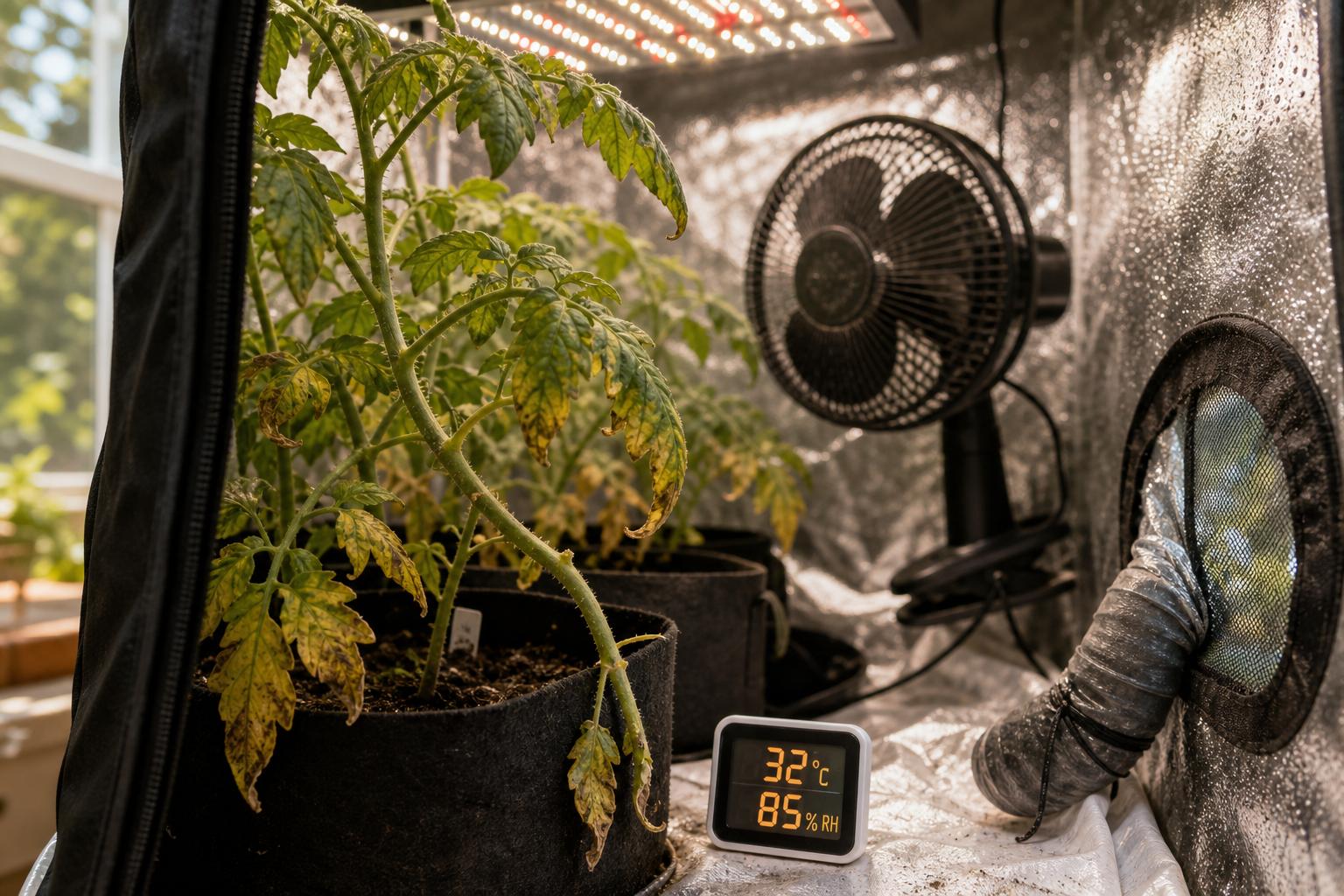
You check your numbers. Temperature is steady. Humidity looks fine. Light schedule has not changed. And yet, inside your grow tent, your plants start to droop, yellow, stall, or claw almost overnight.
I have been there more than once. In a controlled grow tent environment, we expect stability. So when a plant suddenly declines inside a grow tent that appears stable, most growers blame nutrients or disease. In my experience, that is rarely the real cause. More often, the issue is a subtle environmental shift inside the grow tent that sensors did not immediately reveal.
When a Stable Grow Tent Suddenly Is Not Stable
A grow tent is a closed system. That is its biggest advantage and its biggest weakness. Small changes compound quickly.
One of the most common patterns I see inside grow tents is this: everything looks perfect for weeks, then growth slows or leaves begin to curl or fade with no obvious trigger. The grower reacts by adjusting feed schedules or adding supplements. The plant declines further.
I eventually realized that most sudden decline inside a grow tent is not about what you added. It is about what shifted.
Inside grow tents, environmental equilibrium depends on moving parts. Inline fans, oscillating fans, carbon filters, light drivers, ducting, timers, and even zipper seals all influence the plant environment. When one of them drifts slightly out of balance, your sensors may not tell the full story.
The Three Hidden Shifts Most Growers Miss Inside a Grow Tent
1. Airflow Pattern Changes
This is the most overlooked issue I see in grow tents. Not airflow strength. Airflow pattern.
I once had a tent that suddenly showed mild leaf edge burn and droop. Temperature and humidity were perfect at canopy level. The real cause was that one oscillating fan had stopped rotating. It was still blowing, but constantly in one direction.
Half the canopy was receiving constant direct airflow. The other half had stagnant air. The stress showed up unevenly and looked like a nutrient issue.
Inside a grow tent, airflow creates microclimates. If a fan tilts, gets bumped, or stops oscillation, parts of the canopy can experience high transpiration stress without a measurable room level change.
2. Exhaust Efficiency Drift
Carbon filters clog gradually. Ducting shifts. Inline fan speeds are adjusted slightly for noise reduction. These small changes alter negative pressure inside the grow tent.
What surprised me most is how often gradual filter saturation impacts plant vigor before humidity numbers change dramatically. Reduced exhaust changes how quickly plants transpire and how roots function.
In several grow tents I manage, plants began to look overwatered even though irrigation did not change. The real issue was reduced vapor movement due to weaker exhaust pull. Root oxygen dynamics shifted because the environment above the soil changed.
3. Light Intensity Creep
LED systems inside grow tents often get dimmed or raised gradually. Then weeks later, someone lowers the light slightly as plants stretch.
Small reductions in distance can cause a meaningful increase in canopy intensity. Plants suddenly demand more water and nutrients. If root capacity does not keep pace, deficiency symptoms appear.
Many growers respond by increasing nutrients when the fix was adjusting light intensity inside the grow tent.
A Step by Step Diagnostic Process Inside Your Grow Tent
When plants decline in an otherwise stable grow tent, I use a structured process. I do not touch nutrients until I complete this checklist.
Step 1: Freeze All Inputs
Do not change feed strength. Do not add supplements. Do not flush. Stability helps you identify cause.
Step 2: Inspect Airflow Physically
- Confirm every oscillating fan is rotating fully.
- Check that no canopy section gets constant direct airflow.
- Look for leaves pressed against tent walls blocking movement.
- Stand inside the grow tent and feel for dead air zones.
I physically step inside the grow tent and feel variations. Sensors do not measure canopy micro movement.
Step 3: Reevaluate Exhaust and Negative Pressure
- Zip the grow tent fully and observe wall tension.
- Confirm consistent inward pull indicating proper negative pressure.
- Check ducting bends and carbon filter buildup.
- Listen for fan speed fluctuations.
If the tent walls look less tight than usual, exhaust efficiency likely changed.
Step 4: Measure Actual Canopy Light Intensity
Do not rely on memory. Inside grow tents, even two inches of light height change matters.
- Confirm fixture distance from canopy.
- Review dimmer settings.
- Look for uneven canopy height creating hotspots.
I prefer slightly lower intensity with consistent plant health over pushing maximum light. The trade off is marginally slower peak growth for far greater system stability. Inside a grow tent, stability wins.
Step 5: Verify Root Zone Temperature
This is rarely discussed in grow tents. Tent air temperature may read perfect while container temperature is several degrees higher due to light radiation and tray insulation.
I learned this after chasing a phantom nutrient issue for a week. The root zone inside fabric pots was overheating because air movement under the canopy had decreased.
Measure container surface temperature. If it is significantly higher than ambient air, airflow adjustments are needed.
Common Mistakes Growers Make Inside Grow Tents
- Reacting to leaf symptoms with nutrients before checking airflow.
- Assuming stable temperature equals stable plant environment.
- Ignoring equipment drift because it looks operational.
- Changing multiple variables at once.
One mistake I see often is growers making three corrections in a single day inside a grow tent. Then they cannot identify what actually helped or hurt.
How to Prevent Sudden Decline From Happening Again
Conduct Weekly Mechanical Checks
Inside grow tents, I treat fans and filters like part of irrigation infrastructure. Every week I:
- Inspect fan oscillation range.
- Check duct alignment.
- Confirm negative pressure strength.
- Clean intake screens.
This five minute routine has prevented more issues than any nutrient brand ever could.
Track Equipment Age
Carbon filters and inline fans inside grow tents lose efficiency gradually. I log installation dates and replace before failure instead of after problems appear.
Use Layered Monitoring Instead of Single Readings
Rather than one canopy sensor, I occasionally move my probe to different areas of the grow tent. Corners behave differently than the center. Under canopy behaves differently than top canopy.
In my opinion, a cheap second sensor moved periodically around the grow tent is more valuable than overreacting to a single fixed reading.
Quick Troubleshooting Reference
- Sudden droop with normal moisture likely airflow or exhaust change.
- Leaf edges burning across top canopy only often light intensity shift.
- Lower growth yellowing while tops look fine often stagnant lower canopy airflow.
- Plants acting overwatered with unchanged irrigation often reduced vapor movement.
The key insight is this: inside a grow tent, plants are responding to the system, not just the soil. Subtle shifts in air movement, exhaust strength, or light intensity can mimic nutrient problems almost perfectly.
I have learned to trust the mechanical explanation first. Nutrient issues are usually gradual. Environmental instability inside a grow tent is what causes sudden change.
If your plants decline overnight in what looks like a stable grow tent, assume the system drifted. Start with airflow, exhaust, and light position before you ever touch the feed chart.


