
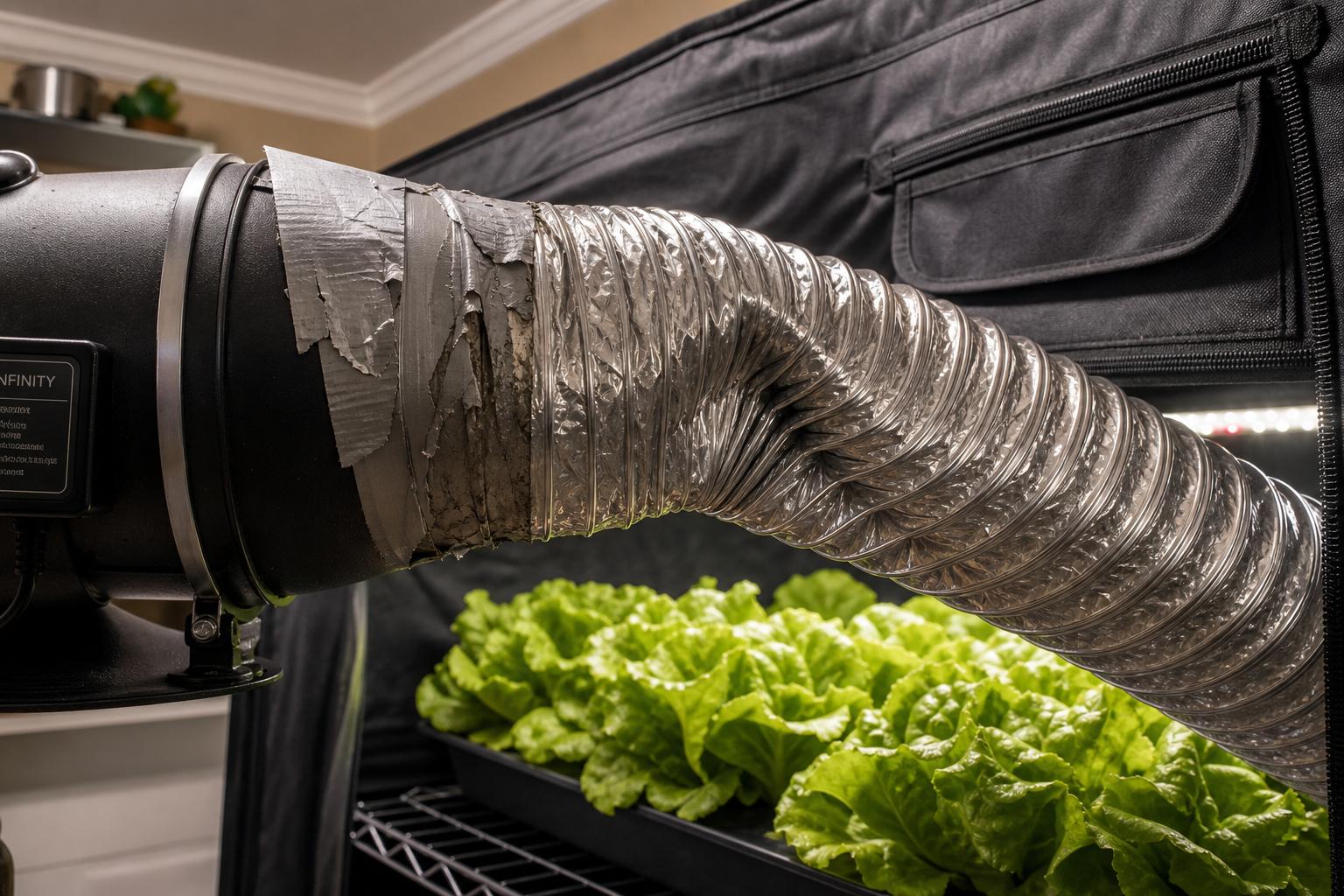
If your grow tent feels like it has plenty of airflow but your temperatures and humidity do not respond the way they should, your ducting layout inside the grow tent may be restricting performance. I have seen many growers replace fans, upgrade filters, and even add intake boosters when the real problem was just poor duct routing.
In grow tents, airflow is a closed system. The fan, carbon filter, ducting, and tent pressure all depend on each other. When ducting is poorly configured inside a grow tent, you create resistance that silently reduces efficiency. The fan still runs at full speed, but the actual air exchange drops. This leads to weak negative pressure, microclimates under the canopy, and heat buildup near lights.
Why Your Grow Tent Airflow Looks Strong but Performs Weak
One thing that surprised me most early on was how loud airflow can sound while still moving less air than expected. A high speed inline fan inside a grow tent can make plenty of noise even when it is fighting resistance.
In my experience, the biggest airflow losses inside grow tents come from friction inside the ducting. Every bend, sag, compression ridge, and unnecessary length adds static pressure. Inline fans in small grow tents are not high pressure industrial units. They lose real performance when duct resistance climbs.
I learned this after installing a larger fan in a four by four grow tent and seeing almost no improvement. The problem was not the fan. The problem was two aggressive 90 degree bends and excess duct length coiled above the tent frame.
Seven Signs Your Ducting Is Choking Your Ventilation System
1. Weak or inconsistent negative pressure inside the grow tent
Your grow tent walls should gently pull inward when the exhaust is running. If the tent only barely contracts or pressure fluctuates, duct resistance may be limiting airflow.
2. Louder fan with no environmental improvement
If you increase fan speed but temperature and humidity barely change inside the grow tent, airflow is likely restricted downstream of the fan.
3. Excess duct length coiled above the tent
One mistake I see often is leaving extra ducting attached just in case. Coiled duct inside or on top of a grow tent increases friction and turbulence. Every unnecessary foot reduces efficiency.
4. Sharp bends directly off the fan or filter
If ducting turns sharply right after leaving the carbon filter or inline fan inside the grow tent, you choke airflow at the most critical transition point.
5. Sagging flexible duct sections
Flexible duct inside a grow tent tends to sag between support bars. Those low points collect condensation and create air resistance pockets.
6. Compressed inner duct liner
Flexible aluminum duct has ridges. When compressed, those ridges become tighter and airflow slows dramatically. Fully extending ducting inside a grow tent reduces internal turbulence.
7. Excess vibration transferred to the tent frame
If your tent frame vibrates heavily, it can indicate that the fan is straining against resistance rather than moving smooth airflow through the duct path.
A Simple Pressure and Airflow Checklist You Can Run in 15 Minutes
This diagnostic routine has helped me more than upgrading equipment ever did. You can run it in any grow tent without special tools.
Step 1. Check wall tension
Close all passive intake flaps in your grow tent except the intended intake path. Turn the fan to medium speed. The tent walls should pull inward steadily. If not, airflow may be limited by duct restriction rather than insufficient fan power.
Step 2. Straighten the duct temporarily
If possible, detach sections and lay the duct as straight as you can inside and outside the grow tent. Remove sharp turns. Run the fan again and observe changes in wall suction and environmental readings. Even a temporary straight test often reveals hidden losses.
Step 3. Shorten duct length
Disconnect excess length and reduce the run to the absolute minimum needed to exit the grow tent. I have seen temperature drop two to three degrees just by trimming unnecessary duct.
Step 4. Feel for strong exhaust output
Place your hand at the exit point outside the grow tent. Airflow should feel strong and consistent. If it feels weak relative to fan size, resistance inside the tent is likely high.
Step 5. Listen for pitch changes
When a duct restriction is relieved, fan pitch often changes slightly. In my experience, smoother airflow actually sounds steadier and less strained.
How to Reconfigure Ducting for Smooth Exhaust Without Adding More Fans
I eventually realized that reconfiguring ducting inside a grow tent is usually better than installing more equipment. Adding booster fans or upsizing your inline fan increases noise and power consumption but does not solve friction problems.
Keep the carbon filter and fan aligned
Inside grow tents, I prefer mounting the carbon filter and inline fan in a straight line near the ceiling bars. Direct alignment reduces abrupt directional changes immediately after the filter.
Minimize total duct length
Use only the duct required to exit the grow tent and reach your exhaust destination. Cut excess instead of folding or coiling it.
Use gradual curves instead of tight bends
If a turn is necessary, create a large smooth curve rather than a tight corner. Gentle arcs allow airflow to stay laminar instead of turbulent.
Fully extend flexible ducting
Stretch flexible duct completely before installation in your grow tent. This reduces internal ridges from bunching together and lowers static pressure.
Support duct runs properly
Secure ducting along the grow tent frame to prevent sagging pockets. I use simple straps to keep runs supported and level.
In my opinion, simplifying the airflow path is almost always preferable to increasing fan strength. More power creates more noise and heat inside the grow tent. Cleaner routing improves efficiency without those tradeoffs.
Troubleshooting Common Grow Tent Duct Questions
Should I use insulated ducting inside my grow tent?
If condensation or heat loss is a problem, insulated duct can help. However, it is often bulkier and harder to route cleanly in small grow tents. I only use it when necessary for temperature control outside the tent.
Is rigid duct better than flexible duct inside a grow tent?
Rigid duct offers less internal resistance and smoother airflow. The downside is installation difficulty in compact grow tents. If your layout allows straight runs, rigid duct is excellent. In tight tents, properly extended flexible duct can perform nearly as well.
Should I add an intake fan if airflow feels weak?
Not immediately. First confirm that your exhaust ducting inside the grow tent is optimized. In many cases, fixing resistance restores proper negative pressure without adding intake fans.
How much bend is too much inside a grow tent?
One gentle bend is usually manageable. Multiple sharp turns severely reduce airflow, especially in smaller diameter ducting common in grow tents. If you count more than two directional changes, consider redesigning the route.
Most airflow problems inside a grow tent are not caused by weak fans. They are caused by friction that quietly accumulates in the duct path. Before upgrading equipment, simplify your system. Straighten, shorten, and smooth the airflow route inside your grow tent. The difference is often immediate and costs nothing but a little time.


