
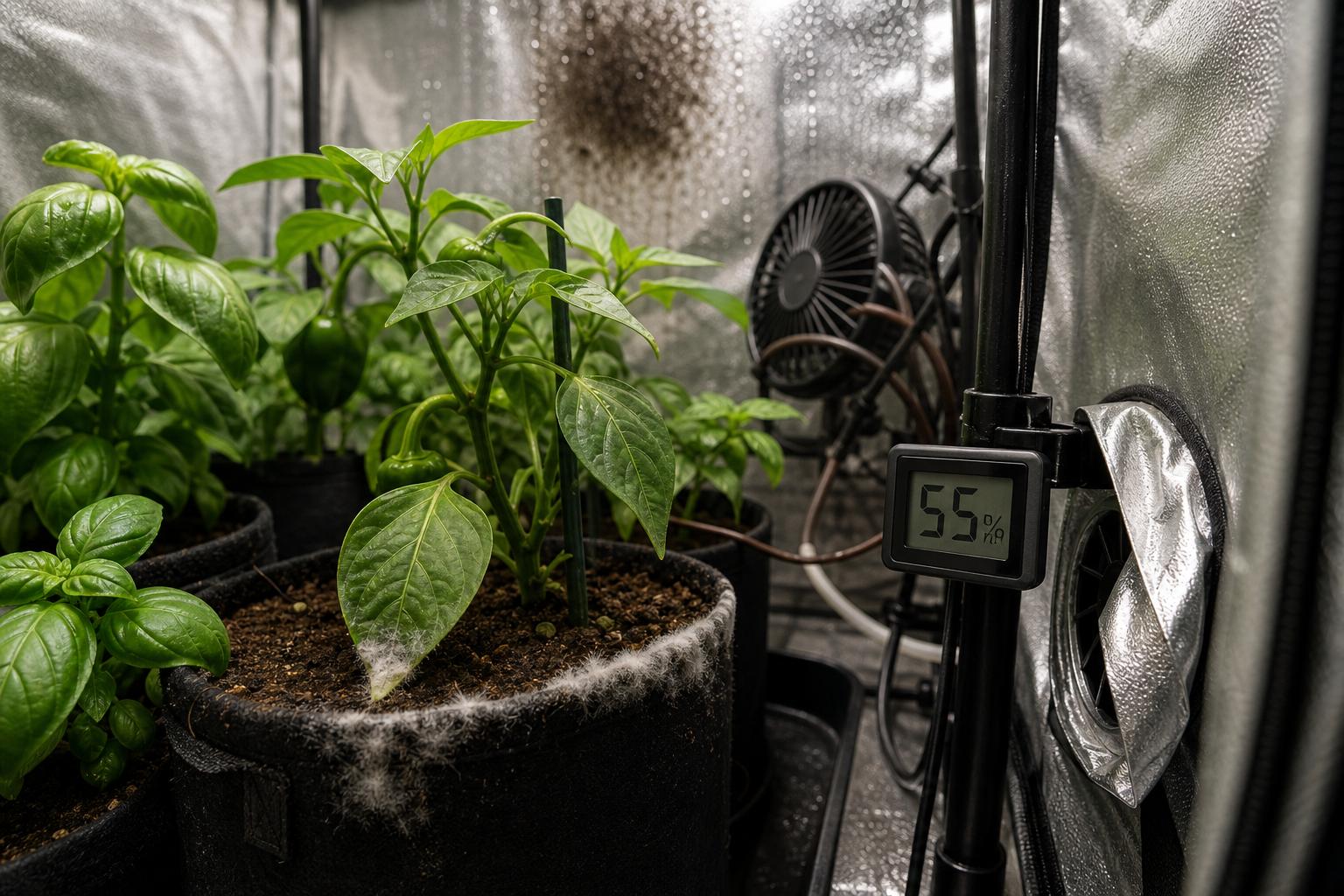
One of the most frustrating things about running a grow tent is seeing mold show up when your humidity monitor says everything is fine. You check the display and it reads 52 percent. Temperature looks stable. Exhaust fan is running. On paper, the grow tent is dialed in.
Yet there it is. Powdery spotting on a leaf, fuzzy growth on soil, or worse, bud rot buried inside dense canopy growth. I have been through this more than once, and what I eventually realized is that the number on your hygrometer does not represent the entire environment inside a grow tent. It represents one point in space. Mold forms in the other spaces.
When Humidity Numbers Look Right but Mold Shows Up Anyway
In my experience, most mold problems inside grow tents are caused by system imbalance rather than high average humidity. You can have a perfectly reasonable overall reading while pockets of stagnant, damp air exist only inches away.
Inside a grow tent, air moves in patterns, not evenly. The exhaust fan usually pulls air from the top. Passive intakes bring air from the bottom. Clip fans move air where they are pointed. But large leaves, thick canopy growth, and even tent walls disrupt that flow.
I have noticed this especially in tents packed to capacity. The hygrometer was hanging near the center pole at canopy height. It read 55 percent. But when I parted the foliage near the back wall, the air felt heavier and warmer. That back corner had limited airflow even though the tent as a whole seemed fine.
The lesson was simple. A grow tent does not have one climate. It has multiple small climates created by airflow and surface temperatures.
The Microclimate Problem Most Grow Tent Owners Miss
The microclimate issue inside grow tents usually comes down to three factors working together.
1. Airflow Patterns That Do Not Reach the Edges
Most growers aim fans across the top of the canopy. That keeps leaves gently moving and prevents stagnant air at the surface. But lower branches, back corners, and areas directly against tent walls often receive almost no continuous airflow.
One mistake I see often is assuming that because leaves are moving somewhere, air is moving everywhere. Inside a grow tent, walls are reflective and slightly cooler than the interior air. When warm humid air meets those surfaces, moisture can condense invisibly.
2. Surface Moisture Stability
Humidity readings measure airborne moisture, not surface wetness. Inside grow tents, soil, fabric pots, drip trays, and even tent poles hold moisture longer than the air does.
I learned this after battling persistent soil surface mold. My humidity was under control, yet the top layer of my medium stayed damp for days because airflow skimmed above it instead of across it. Mold did not care what the hygrometer said. It cared that the surface stayed moist.
3. Dense Canopy Transpiration
Plants inside a grow tent release moisture constantly. When the canopy is thick, transpired moisture becomes trapped between leaves. That space can sit several percent higher in humidity than the reading outside the canopy.
What surprised me most was measuring inside the canopy with a small probe. The tent reading was 50 percent. Inside the leaf mass it spiked to 63 percent. That difference is more than enough for mold spores to activate.
A Practical Diagnostic Walkthrough for Hidden Moisture Pockets
If mold appears in your grow tent and your humidity readings look normal, do not immediately buy a bigger dehumidifier. Diagnose the airflow system first.
Step 1: Check Air Movement at Multiple Heights
Place your hand at soil level, mid canopy, and above canopy. You should feel consistent gentle air movement at all three levels. If soil level feels still, you have identified a moisture pocket zone.
Step 2: Inspect Tent Corners and Wall Gaps
Look at the back corners of the grow tent where pots meet walls. These spaces often have minimal lateral airflow. If the wall feels cool and slightly damp to the touch during lights off periods, you have condensation risk.
Step 3: Measure Inside the Canopy
If possible, temporarily place a small sensor inside the densest part of the canopy for a few hours. Compare that reading to the main tent reading. A consistent gap above five percent is a warning sign.
Step 4: Observe After Lights Off
Mold in grow tents often forms during lights off cycles. Temperatures drop but moisture remains. If your exhaust fan slows or shuts off with lights, you may be trapping humidity overnight even if daytime numbers look perfect.
Step 5: Examine the Soil Surface
Look for areas where the soil stays dark and wet long after watering. Inside a grow tent, pots near walls dry slower because airflow is weaker there. Rotate pots regularly and note whether mold appears on the same side each time.
Simple System Adjustments That Prevent Mold Without Overcorrecting
Many growers respond to mold in grow tents by drastically lowering humidity. I think that is often the wrong move. Over drying the entire tent can stress plants and reduce growth. Instead, balance airflow.
Add Targeted Airflow, Not Just More Exhaust
I recommend adding an additional small clip fan at lower canopy height rather than increasing exhaust speed immediately. Increasing exhaust too much can create negative pressure swings and uneven intake flow.
Targeted airflow breaks up microclimates without destabilizing the entire grow tent environment. In my tents, adding one low angled fan reduced soil surface mold without changing average humidity at all.
Keep Air Moving During Lights Off
I prefer running exhaust and at least one circulation fan continuously inside a grow tent, even during dark cycles. Some growers cycle fans to save energy. I believe constant low speed movement is safer than aggressive cycling. Mold thrives in still air far more than slightly humid air.
Prune for Air Channels, Not Just Light
Inside grow tents, pruning is not only about light penetration. It is about creating ventilation corridors. I selectively remove interior leaves that block lateral airflow across the tent width. This reduces hidden moisture pockets between plants.
The tradeoff is slightly reduced leaf mass. I am comfortable with that because preventing mold saves more yield than preserving every leaf.
Rotate Pots and Reposition Plants
Grow tents create directional airflow patterns. Plants near intake vents dry differently than those in rear corners. Rotating pots weekly evens out moisture exposure and prevents one plant from living permanently in a stagnant zone.
Stabilize Watering Patterns
Inconsistent heavy watering inside a grow tent can spike localized humidity around pots. I aim for even watering volumes and avoid runoff pooling in trays. Standing water in a closed tent environment quietly increases local moisture even if the main sensor does not show it.
Troubleshooting Quick Answers
If my humidity reads 50 percent, can mold still form?
Yes. Inside a grow tent, canopy interiors and wall edges can sit several percent higher than the average reading. Mold develops in those pockets.
Should I buy a stronger dehumidifier?
Only if the whole tent consistently runs high. If mold is localized, adjust airflow first. In my experience, airflow corrections fix more problems than dehumidifier upgrades.
Is wall condensation normal in grow tents?
A small amount during lights off can happen, but visible moisture on tent walls means airflow is insufficient in that zone. Redirect circulation toward walls to keep surfaces dry.
Do oscillating fans solve everything?
No. Oscillation helps, but position matters more than motion. The goal inside a grow tent is complete spatial coverage, not just moving air in circles.
After years of running grow tents, I eventually realized that mold is rarely about the number on the screen. It is about how air, moisture, and surfaces interact within the enclosed tent system. When you treat your grow tent as a set of moving air channels instead of a single humidity box, mold problems become much easier to solve.


