
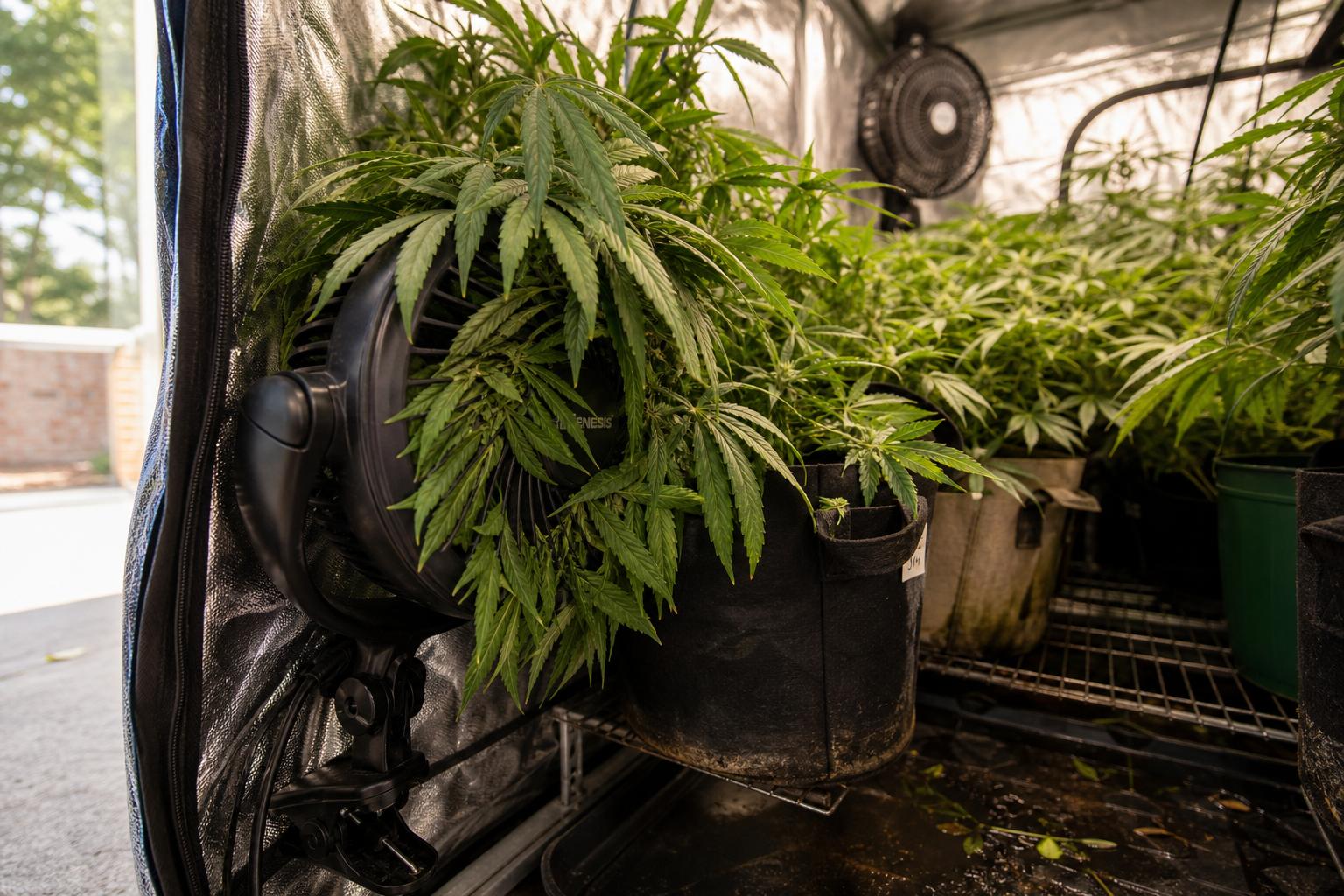
Most airflow problems inside a grow tent get blamed on the exhaust fan, the carbon filter, or the oscillating clip fans. I have lost count of how many growers upgrade fans when the real issue is sitting right in front of them. In grow tents, layout is often the hidden culprit.
In my experience, you can have a strong inline fan and still end up with stagnant pockets of air inside your grow tent. Leaves barely move. Humidity lingers under the canopy. Corners feel heavy. On paper everything looks correct. In reality, your internal positioning is quietly choking airflow before it ever reaches your plants.
Why Your Grow Tent Airflow Looks Fine but Still Fails
Here is what confuses most growers. The exhaust is pulling air. The negative pressure is obvious. The tent walls suck in slightly. So the assumption is that air must be circulating properly inside the grow tent.
But negative pressure does not guarantee distribution.
I eventually realized this after struggling with persistent humidity spikes during lights off in one of my 4×4 grow tents. The fan was more than powerful enough. The problem was that air was moving from intake to exhaust in a narrow invisible tunnel, bypassing much of the canopy.
Think of airflow inside a grow tent as a path of least resistance. If there is a clear, straight channel from passive intake to carbon filter, air will rush along that path and ignore blocked zones behind large plants, dense equipment, or poorly routed ducting.
What surprised me most was how small positioning changes completely altered movement patterns without touching the fan speed.
How Internal Layout Quietly Blocks Air Movement
There are four layout issues I see constantly in grow tents.
1. Plants Packed Wall to Wall
I get it. Tent space is valuable. But when containers are pushed tightly against the walls of a grow tent, you eliminate side airflow. Most grow tents rely on wall reflection and cross flow to circulate air back into the canopy. When foliage presses directly against tent fabric, you create dead zones behind the leaves.
One mistake I see often is growers rotating plants for light exposure but never pulling them a few inches off the tent walls. Even a small gap allows air to move behind the canopy instead of stopping at the fabric.
2. Carbon Filter and Light Blocking the Center Line
Another issue inside grow tents is stacking equipment directly above the canopy in a way that interrupts vertical movement. Large carbon filters mounted horizontally across the center of the tent create a ceiling barrier. Add thick ducting that droops downward and you have a stagnant layer forming just under the light.
In my own setup, switching from a centered filter to a slightly offset position along the back bar dramatically improved leaf movement across the entire canopy.
3. Intake and Exhaust Too Closely Aligned
This is the silent airflow killer in many grow tents.
If your passive intake vent is directly below or opposite your exhaust port, you create a short circuit. Air enters and exits quickly without washing across the whole interior. I learned this after mapping airflow with a bit of vapor from a humidifier. The air barely touched the rear corner of the tent before exiting.
In a grow tent, you want air to travel. Not teleport.
4. Clip Fans Aimed Randomly
Clip fans inside grow tents often get placed wherever there is a pole available. The result is chaotic turbulence instead of directional circulation. Blasting air straight into a dense plant wall does little. It needs a path to continue moving across the tent.
I prefer to aim fans slightly above or alongside the canopy so air skims and rolls rather than punches and stops.
A Simple Layout Audit You Can Do in 20 Minutes
Before buying new equipment for your grow tent, do this simple audit. I have used this process many times when something felt off.
Step 1: Create Visible Air
Use a small humidifier, vaporizer, or even incense to visualize airflow inside the grow tent. Watch where it travels. More importantly, watch where it stalls. This tells you far more than a spec sheet.
Step 2: Check Wall Gaps
Ensure there is space between plant containers and tent walls. Aim for at least a few inches of breathing room. In dense grows, this often means removing one plant. It is a tradeoff I now accept because fewer plants with proper airflow outperform crowded ones with trapped humidity.
Step 3: Trace the Straight Line
Stand at your intake. Visualize a straight path to your exhaust inside the grow tent. If that line is unobstructed while other zones look crowded, you likely have a short circuit airflow path.
Step 4: Check Under Canopy Movement
Place your hand under the canopy at soil level. If the air feels still compared to chest height, your layout is blocking lower circulation. This is common in grow tents with thick scrogged canopies.
Repositioning for Smooth Airflow Without Adding More Equipment
Once you identify blockages, corrections are usually simple.
Offset Instead of Center
Mount your carbon filter slightly toward the back or one side of the grow tent rather than centered. This encourages diagonal airflow patterns instead of straight vertical pull.
I recommend this over adding another fan because changing geometry is often more powerful than increasing force.
Create a Gentle Air Loop
Position one clip fan to push air across the top of the canopy toward the opposite wall. Position another lower fan to guide air back toward the intake side. Inside grow tents this creates a circular loop rather than scattered gusts.
I prefer controlled loops over high speed blasting. Too much direct airflow stresses leaves and dries edges while still missing stagnant pockets.
Lift and Tuck Ducting
Secure ducting tightly along tent poles. Sagging ducting inside a grow tent acts like an unintended baffle. Keeping it high and flush to the frame opens vertical space for rising warm air.
Stagger Plant Heights
If your grow tent has an even canopy wall from end to end, airflow hits and stops. Slight height variation allows air to tumble and roll. I learned this unintentionally when one shorter plant created surprisingly better movement across the back corner.
Troubleshooting Common Grow Tent Airflow Symptoms
Problem: Humidity stays high in one corner
Likely cause is a blocked lateral path. Pull plants away from that wall and redirect a clip fan to skim across that area rather than blowing straight at it.
Problem: Leaves barely move but exhaust is strong
You probably have a short circuit between intake and exhaust in your grow tent. Redirect intake airflow by partially closing the nearest vent and opening one farther from the exhaust port.
Problem: Strong airflow above canopy but powdery mildew below
This almost always means under canopy stagnation inside the grow tent. Add a low level fan that moves air horizontally beneath the leaf mass rather than increasing overall fan power.
The Real Fix Is Usually Geometry
After years of rearranging grow tents, I have become convinced that layout matters more than raw airflow numbers. Growers often chase bigger fans when they would get better results by moving a pot six inches or shifting a filter to the side.
If your grow tent airflow feels off, resist the urge to upgrade hardware immediately. Study the path. Watch the movement. Adjust the geometry. In most cases, smoother airflow is already available inside the tent. It just needs a clearer route.


