
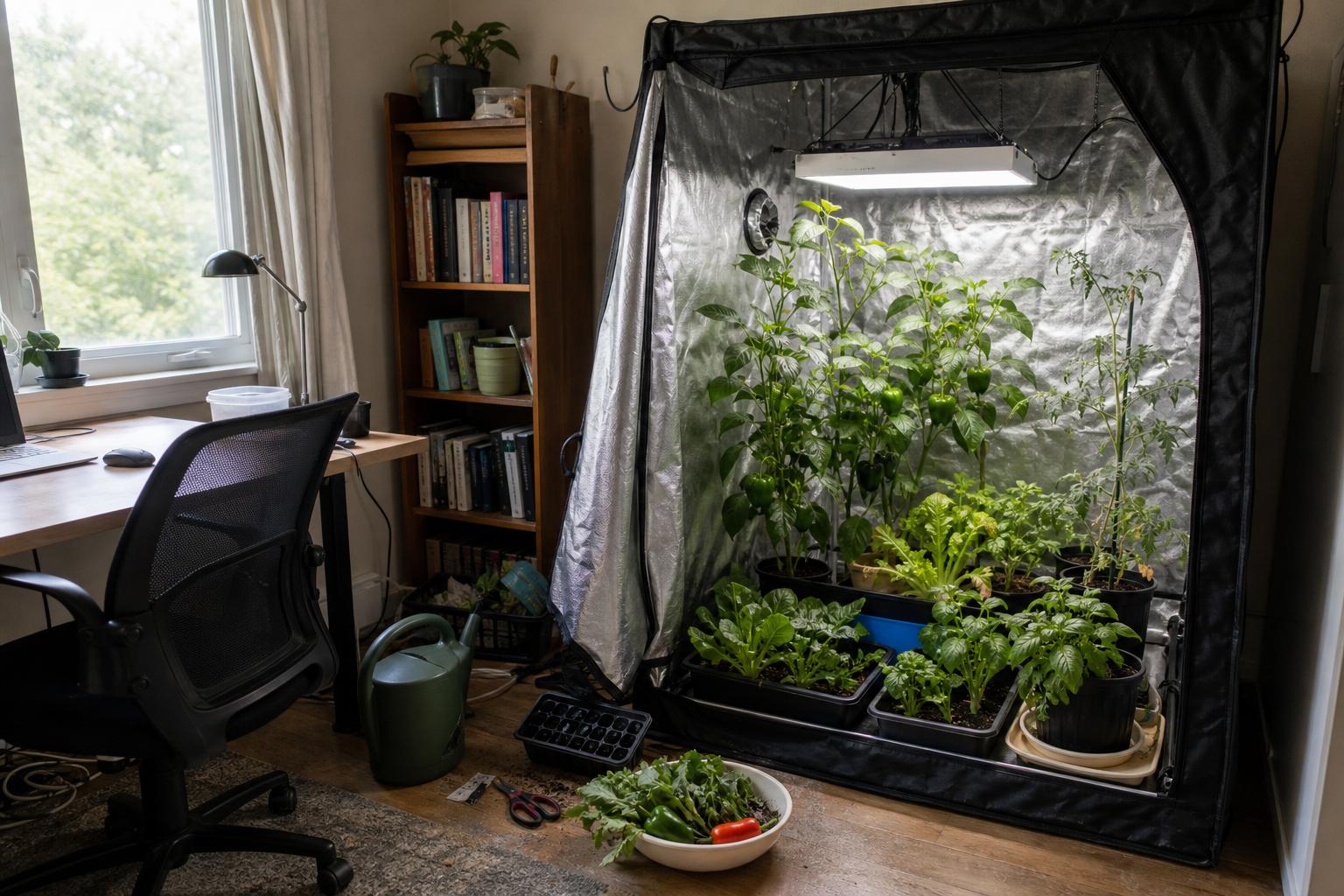
It is easy to assume that a powerful LED can make any vegetable productive inside a grow tent. I made that assumption early on, and it led to crowded plants, disappointing fruit, and a tent that released more heat into the room than the harvest justified.
A better approach is to choose vegetables that naturally fit the light intensity, vertical space, and controlled conditions of your grow tent. Crop choice often matters more than buying a stronger light. The right plants can produce useful food without forcing you to run equipment at full power all day.
Why Crop Choice Matters Under Grow Tent LED Lights
LED fixtures are efficient, but their light is not distributed evenly across a grow tent. The center of the canopy usually receives the most intensity. Corners, lower leaves, and plants shaded by their neighbors receive much less.
This is why a tomato plant can look healthy near the top while producing weak growth below. It is also why lettuce, bok choy, radishes, and beet greens often give a more satisfying return from the same fixture.
Moderate light crops use the entire tent more effectively. They can grow along the edges, tolerate minor differences in intensity, and remain productive without sitting dangerously close to the LED.
I have noticed that a tent filled with compact greens and root vegetables is also easier to manage. There is better access for watering, fewer hidden leaves holding moisture, and less need to constantly raise the light. In a small home, that convenience matters.
A demanding fruiting crop is not automatically a bad choice. Compact peppers and small tomatoes can work well under a capable LED. The tradeoff is that they need stronger light for longer, occupy the tent for months, and produce more heat and humidity before giving you much to eat.
For reliable harvests, I prefer crops that are edible at several stages.
Vegetables That Make Good Use of Moderate Light
Radishes
Radishes are one of the more useful surprises inside a grow tent. They stay short, mature quickly, and do not need the intense light demanded by peppers or tomatoes. Their leaves are edible too, so a small root is not always a complete loss.
Use a container deep enough for the variety and give each plant room to form a root. Crowded seedlings may produce plenty of leaves but little underneath. Keep the LED close enough to prevent stretched stems, while watching for pale or curled leaves directly below the fixture.
Choose round or short rooted radishes rather than long varieties that require deeper containers and more growing medium.
Baby Turnips and Beets
Turnips and beets are often treated as space hungry root crops, but they perform surprisingly well when harvested young inside a grow tent. Their greens provide an early harvest, and the roots can continue swelling afterward.
What worked better for me was sowing fewer plants and giving them proper spacing from the beginning. Heavy thinning wastes time and creates a dense, damp canopy near the soil surface. That is exactly where airflow is weakest inside many grow tents.
- Harvest outer greens lightly so the root still has enough leaf area to grow.
- Use loose growing medium that drains without becoming hard.
- Place the container near the middle of the LED footprint, not in a dim corner.
Bok Choy and Compact Asian Greens
Bok choy, tatsoi, and mizuna make excellent use of controlled grow tent conditions. They remain fairly compact, tolerate moderate LED intensity, and can be harvested as baby greens or allowed to form fuller plants.
The main limitation is heat. A closed grow tent can warm quickly even when the LED itself runs efficiently. Warm conditions encourage loose growth and early flowering. If the room outside the tent is already warm, smaller varieties are easier to finish before heat becomes a problem.
Compact Asian greens are more forgiving than head lettuce when light coverage is slightly uneven.
Swiss Chard
Swiss chard grows larger than lettuce, but it earns its space through repeated harvests. Removing the outside leaves allows the center to keep producing. It also handles minor watering mistakes better than many tender greens.
Give chard its own section of the grow tent. Mature leaves can spread over shorter plants and steal their light. One or two plants are often more practical than filling a whole tray.
Bush Beans
Bush beans need more light than leafy greens, yet compact varieties can perform well under a good LED. They are a sensible step between easy greens and demanding tomatoes.
One mistake I see often is assuming that the word bush means tiny. Some plants become surprisingly wide and can shade half a small grow tent. Check the expected height and spread, then allow room for air to move around the leaves.
Beans also increase humidity as their canopy fills in. Do not pack them tightly against the tent walls. The small increase in yield is rarely worth the damp leaves and awkward maintenance.
Match Plant Height to the Usable Tent Space
The listed height of a grow tent is not the same as its usable plant height. The LED, hangers, safe light distance, containers, and saucers all consume vertical space.
Before choosing crops, measure the distance from the top of the containers to the lowest safe position of the LED. That measurement is your real growing area.
So what does that mean in practice?
- Place taller bush beans, chard, or compact peppers toward the center where LED intensity is strongest.
- Arrange radishes, baby greens, and bok choy around them without allowing tall leaves to create shade.
- Use sturdy risers to lift short trays closer to the LED instead of lowering the entire fixture.
- Leave an open path so you can reach every container without dragging plants out of the grow tent.
Risers are one of the simplest ways to create an even canopy. I use them rather than forcing short seedlings to stretch toward a light positioned for taller plants.
A Practical Crop Plan for Reliable Harvests
For an ordinary home grower, I would not fill the entire grow tent with one slow fruiting crop. My preference is to use most of the space for dependable vegetables and reserve a smaller area for experimentation.
- Use about half the floor space for bok choy, lettuce, mizuna, or other cut greens.
- Use another section for radishes, baby turnips, beets, or Swiss chard.
- Reserve the brightest central area for bush beans, a compact pepper, or another higher light crop.
This arrangement provides something to harvest while the slower plants develop. It also lets you run the LED at a sensible level instead of increasing electricity use just to satisfy one demanding plant.
Start seeds in small groups rather than sowing every container at once. A second sowing made a couple of weeks later prevents the grow tent from producing more greens than you can use, followed by a long empty period.
Check These Signs Before Blaming the LED
If vegetables are not performing as expected, look at the whole grow tent before purchasing a larger fixture.
- Long stems and wide leaf spacing usually suggest insufficient light or excessive distance from the LED.
- Pale patches directly under the fixture can indicate too much intensity.
- Large leaves with poor radish roots often point to crowding, excessive feeding, or warm conditions.
- Wet leaves and slow drying containers suggest the canopy is too dense for the available airflow.
- Healthy plants with few flowers or pods may need stronger light than the rest of the crop plan.
Do not upgrade the light until you have checked spacing, canopy height, and plant choice.
If I were setting up a grow tent today, I would begin with radishes, compact bok choy, Swiss chard, and one small section of bush beans. That mix reveals how evenly the LED covers the tent without committing the entire space to demanding plants. Once those crops are growing compactly and evenly, I would add a compact pepper or tomato only in the brightest position.


