
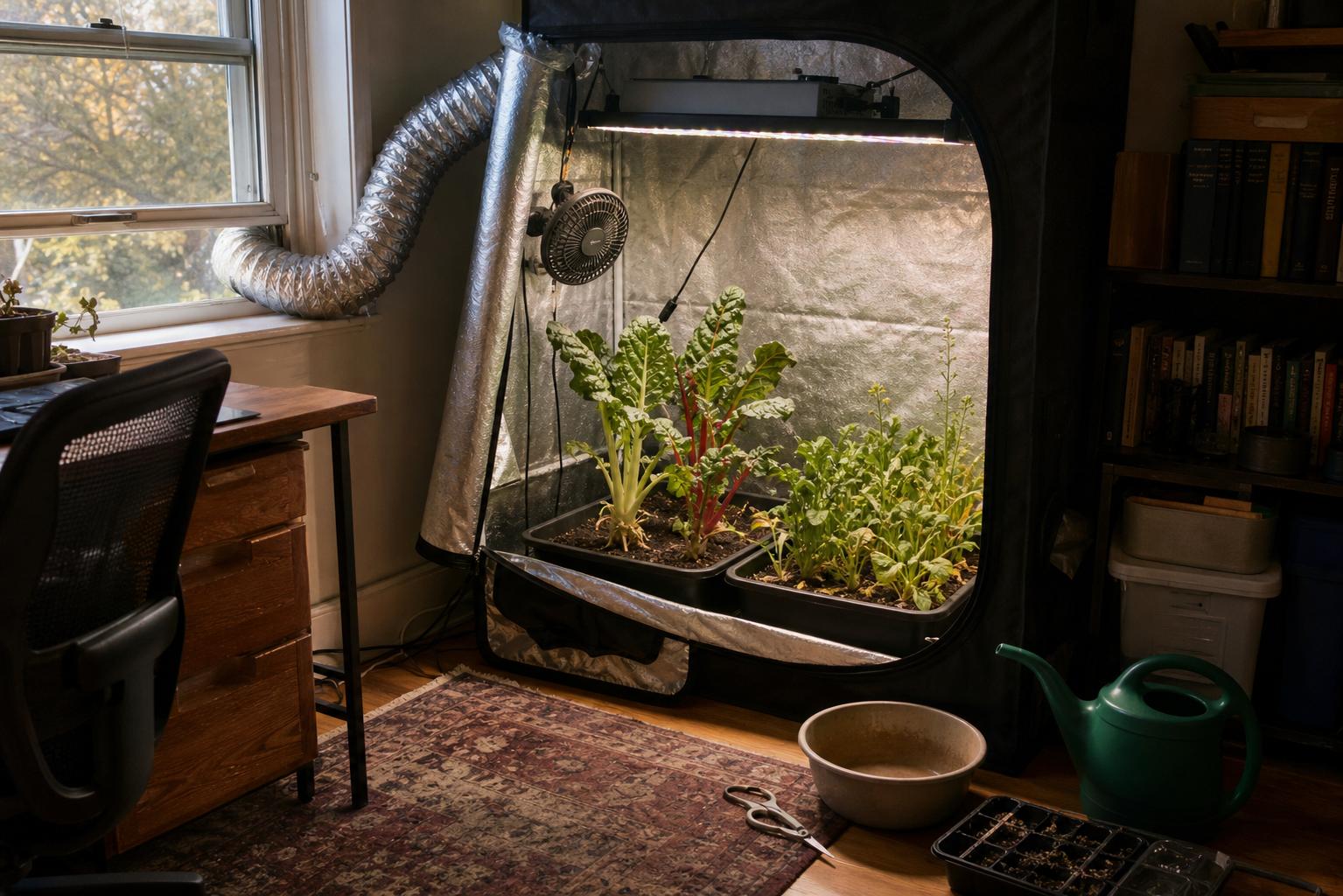
Spinach sounds like an obvious crop for a grow tent. It stays compact, grows quickly, and fits around larger vegetables. The trouble is that a small grow tent often runs warmer than the surrounding room, especially once the light and exhaust fan have been operating for several hours.
In a consistently warm grow tent, Swiss chard is usually the more reliable choice. It takes longer to reach its first harvest and occupies more canopy space, but it handles warmth without rushing into seed production. Spinach can still work, although keeping it productive may require more cooling effort than the harvest is worth.
Why Spinach Struggles in a Warm Grow Tent
Spinach prefers genuinely cool conditions. A grow tent canopy around 50°F to 65°F is comfortable for it. Once temperatures remain near 70°F or above, particularly during long light periods, many varieties begin shifting from leaf production toward flowering.
This is bolting. The center of the spinach plant stretches upward, new leaves become narrower, and the flavor often turns stronger or bitter. Once that process starts, changing the watering schedule or raising the light rarely reverses it.
Warm nights matter almost as much as warm days. A tent that reaches 76°F with the light on and only falls to 72°F after the light turns off gives spinach very little recovery time.
I have noticed spinach can look excellent for the first few weeks in a warm grow tent. Then several plants suddenly stretch at once. That delayed reaction makes it easy to blame the light, nutrients, or seed quality when the real issue is persistent warmth.
One mistake I made early on was treating the temperature near the tent floor as the temperature the spinach experienced. The canopy was several degrees warmer because it sat closer to the light and received less cool air. Measure temperature at leaf height, with the sensor shaded from direct light.
Why more exhaust may not solve it
An exhaust fan can remove heat produced inside a grow tent, but it cannot make the tent cooler than the room supplying its intake air. If an apartment is already 74°F, increasing fan speed may create more noise without giving spinach the cool environment it needs.
You could use room air conditioning, run the grow light at night, or choose a shorter light period. Those approaches can help, but they add electricity use, noise, or scheduling complications. In my experience, cooling an entire room mainly for spinach is rarely the practical choice for an ordinary home grower.
How Swiss Chard Handles Heat Differently
Swiss chard is much less eager to bolt when a grow tent stays warm. It grows comfortably around 60°F to 75°F and usually continues producing usable leaves when the canopy occasionally enters the low 80s.
That does not mean chard is unaffected by heat. Very warm roots can slow growth, large leaves may wilt near the end of the light period, and moisture use increases. Still, chard normally responds to warmth by drinking more rather than immediately sending up a flower stalk.
That difference makes chard forgiving. If the grow tent has a warm afternoon or the room heats up while you are away, the crop is unlikely to become unusable overnight.
What surprised me most was how quickly chard recovered after harvesting. Once the root system was established, the center kept producing leaves even when the grow tent conditions were not perfect. Spinach grown beside it often became less useful after only a few larger harvests.
For warm tents, I prefer green or pale stemmed chard when leaf tenderness matters most. Colorful varieties are attractive, but the individual variety matters less than giving the plants enough root space and keeping the growing medium evenly moist.
Compare Space, Light, and Harvest Potential
Swiss chard wins on heat tolerance, but it does not win every grow tent comparison. Spinach uses floor space more efficiently when conditions are cool enough to keep it vegetative.
- Spinach: Suitable for shallow containers and close spacing, especially when harvested as baby leaves.
- Swiss chard: Develops broader leaves, taller stems, and a larger root system.
- Spinach harvest: Often concentrated into a shorter productive window.
- Chard harvest: Better suited to removing a few outside leaves repeatedly.
In a crowded grow tent, mature chard can shade basil, lettuce, and smaller herbs. I leave roughly 8 to 12 inches between chard plants, depending on whether I want medium leaves or full plants. I also place it where its broad leaves will not block access to shorter crops.
Do not fill every open patch with chard seedlings. A packed tray looks productive at first, but mature leaves soon overlap, trap moisture, and make harvesting awkward. Fewer healthy plants are more useful than a dense canopy you cannot reach.
Which crop needs more light?
Both crops can grow under a modest LED fixture, but their useful lighting patterns differ. Spinach appreciates moderate light while temperatures remain cool. Intense light that warms the canopy can encourage stress and bolting without adding much useful growth.
Chard can make better use of moderately strong light because it keeps building larger leaves. However, the fixture should not be lowered simply to chase faster growth. Watch the leaf edges. Pale patches, curling, or midday wilting can indicate that light and heat are combining faster than the roots can supply water.
For either crop, I would first adjust fixture height or dimming rather than buy another fan. Reducing heat at the source is quieter and usually cheaper than trying to exhaust it after the canopy becomes too warm.
Choose the Right Crop for Your Grow Tent
Use this quick decision sequence before planting:
- Measure the grow tent at canopy height near the end of the light period.
- Check the lowest temperature reached during the dark period.
- Decide whether you want baby leaves quickly or repeated larger harvests.
- Look at the actual canopy space available once nearby herbs and vegetables mature.
If the tent remains below about 68°F for much of the day, spinach is worth growing. Choose a slower bolting variety, harvest young, and avoid letting the growing medium dry completely. Spinach is especially useful beneath a cool running light when you want tender salad leaves rather than a long lived plant.
If the grow tent spends much of its time from 70°F to the upper 70s, choose Swiss chard. Use a container with enough depth for a substantial root system, harvest the oldest outside leaves first, and keep the center intact.
If space is extremely limited, grow chard for medium leaves rather than waiting for huge stems. This gives you repeated harvests without allowing one plant to dominate the entire tent.
A final check before blaming temperature
Warmth is not the only reason these crops struggle inside a grow tent. Before making major equipment changes, check the following:
- The temperature sensor is positioned at canopy height.
- The growing medium is moist but not continuously saturated.
- Leaves are moving gently rather than being blasted by a circulation fan.
- The container drains freely and is not sitting in runoff.
- Large chard leaves are not shading every neighboring crop.
My practical choice for a warm room is Swiss chard.
I would only choose spinach if the measured canopy temperature confirms that the grow tent stays cool without running expensive room cooling. The best next step is simple: place a temperature sensor at leaf height for a complete light and dark cycle. If readings stay above 70°F, plant chard and use your cooling budget for crops that truly need it.


