
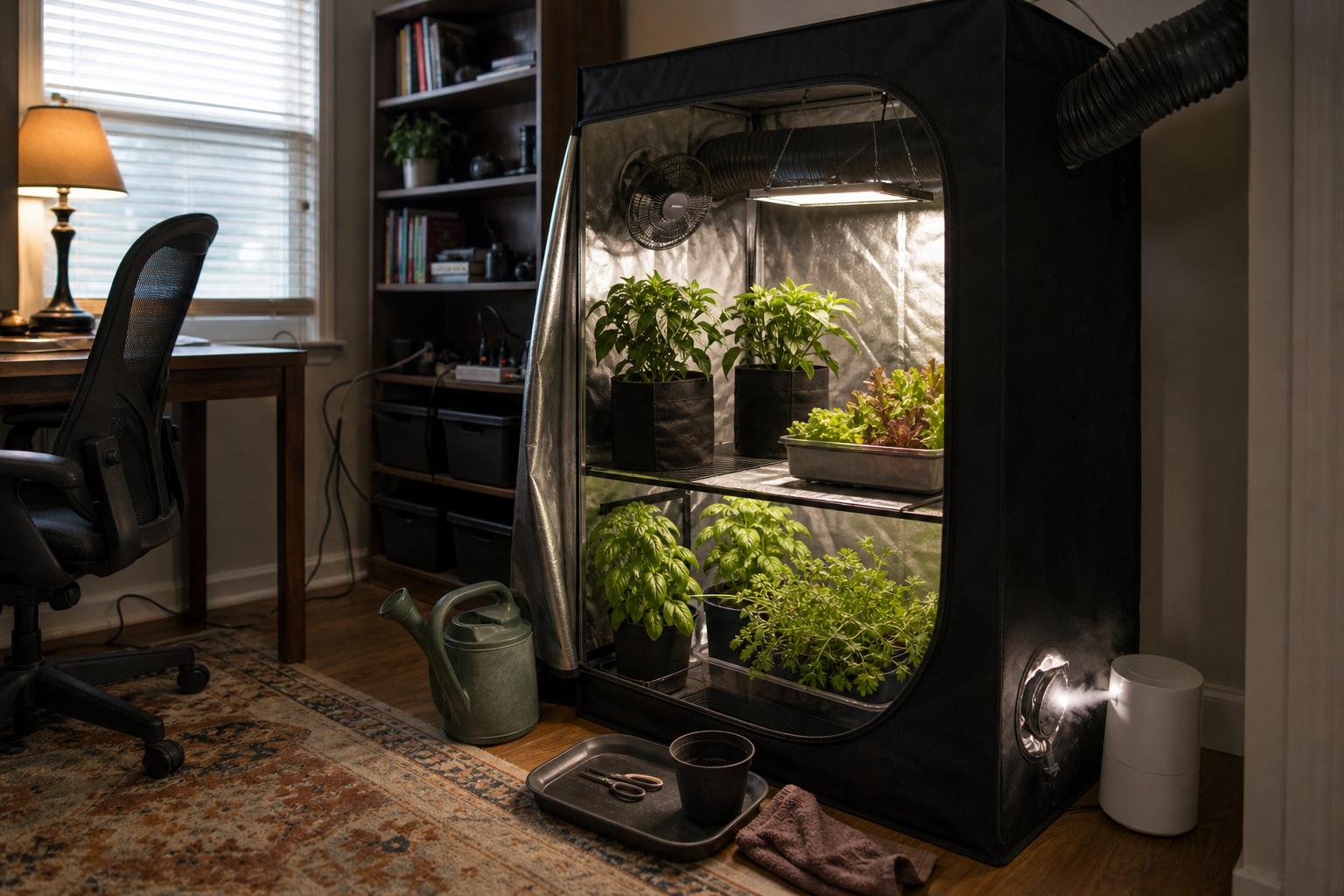
It is easy to turn a grow tent into a constant adjustment project. The temperature rises, so you increase the exhaust fan. Humidity falls, so you add a humidifier. A lettuce leaf curls, so you raise the light. Before long, the grow tent has changed four times in one afternoon.
I have done this myself, especially when watching new equipment readings too closely. What took me a while to realize was that plants experience the swings, not just the final numbers. A grow tent that stays slightly warmer or drier than ideal often produces healthier herbs and leafy greens than one that repeatedly jumps between supposedly perfect readings.
How constant adjustments create an unstable grow tent
Temperature, humidity, lighting, and ventilation are connected inside a grow tent. Changing one usually moves at least one of the others.
Turning up the exhaust fan may lower temperature, but it can also pull humid air out of the grow tent. Raising the light may reduce leaf stress, but it also changes how much light reaches the plants. Running a humidifier harder may improve humidity while adding moisture and a little heat to a small enclosed space.
The biggest mistake is correcting each reading separately. That creates a cycle in which one solution causes the next problem.
One mistake I made early on was reacting every time my hygrometer displayed a number I did not like. I would change the fan setting, wait a short time, and then change something else. My basil and lettuce did not suddenly fail, but their growth became uneven. New leaves looked good one day and slightly curled the next.
What worked better was leaving the grow tent alone long enough to see its actual pattern.
A stable reading that is acceptable beats a perfect reading that lasts twenty minutes.
Signs that environmental swings are stressing your plants
Environmental stress inside a grow tent does not always produce one obvious symptom. More often, the plants seem inconsistent.
- Leaves change position repeatedly during the light period, even though the growing medium is still moist.
- Leaf edges curl during the warmest part of the grow tent cycle and relax later.
- Tender lettuce or herb leaves feel soft at one check and unusually firm or dry at the next.
- Seedlings grow slowly despite receiving adequate light and water.
- Condensation appears on the grow tent walls, then disappears after the exhaust fan runs hard.
- The growing medium dries at noticeably different speeds from one day to another.
I have noticed that leafy greens show unstable grow tent conditions quickly. Lettuce may look slightly limp when the light and heat peak, while basil can develop cupped leaves when airflow and humidity keep changing. Fruiting plants such as peppers and compact tomatoes may tolerate short swings better, but repeated stress can still slow flowering and fruit development.
Before blaming the grow tent environment, check the growing medium. If the root zone is soaked or bone dry, solve that first. Environmental adjustments will not correct a watering problem.
Do not confuse consistency with ignoring extremes
Stable conditions are useful only when they remain within a reasonable range. Persistent condensation, severe heat, stagnant air, or leaves bleaching under the grow light still require action.
The goal is not to accept a harmful grow tent environment. The goal is to make one measured correction instead of several nervous ones.
Which grow tent conditions should be stabilized first
Trying to perfect everything at once is where many home growers get stuck. I prefer to stabilize the grow tent in an order that prevents one setting from undoing another.
- Lock in the light schedule. Use a timer and keep the lights turning on and off at the same times. Do not shorten the light period just because the grow tent feels warm one afternoon. Address the heat source or ventilation instead.
- Set steady baseline ventilation. In most small grow tents, I prefer an exhaust fan running continuously at a low or moderate speed. It is usually quieter and creates fewer humidity swings than a powerful fan repeatedly switching on and off.
- Watch temperature through a complete light cycle. Record the coolest reading before the light comes on and the warmest reading near the end of the light period. Those readings matter more than one convenient midday check.
- Adjust humidity after airflow is predictable. A humidifier cannot stabilize a grow tent if the exhaust fan keeps changing speed. Get the air exchange settled first, then use the lowest humidifier output that holds a reasonable level.
There is a practical tradeoff here. A slightly stronger exhaust setting may keep the grow tent cooler, but it can increase noise, electricity use, and humidity loss in an apartment. I would accept a modestly warmer but steady grow tent before running a loud fan at full power all day, provided the plants are not showing heat stress.
This is also why I rarely recommend buying another device as the first response. More equipment creates more interactions, more cords, and more maintenance. Often, the existing fan, light, and room temperature can produce stable conditions once their settings stop changing.
A simple routine for stabilizing your grow tent
When a grow tent feels difficult to control, use a short reset period. This gives you enough information to make a useful change without turning plant care into constant monitoring.
Start with one ordinary day
Set the light timer, choose one exhaust fan speed, place the circulation fan so leaves move gently, and stop adjusting equipment for the rest of the day unless conditions become unsafe.
Check the grow tent at three useful moments:
- Soon after the grow light turns on
- During the warmest part of the light period
- Shortly before the grow light turns off
Write down temperature and humidity at each check. Also note leaf posture, condensation, fan noise, and how quickly the growing medium is drying. Three useful checks are better than staring at the display every ten minutes.
Change only the setting causing the largest swing
If temperature climbs sharply, increase exhaust speed slightly or reduce heat entering the room around the grow tent. If humidity falls whenever ventilation starts, avoid cutting airflow completely. Lower the fan speed a little or place the humidifier intake where moisture can mix before being exhausted.
Then leave that change in place through another complete light cycle. This waiting period matters. The grow tent air may respond within minutes, but containers, foliage, and the surrounding room take longer to settle.
Judge the plants as well as the monitor
A digital monitor helps reveal patterns, but it does not grow the food. If lettuce is producing smooth new leaves, basil is standing comfortably, and pepper growth is steady, a small difference from an ideal chart is rarely worth creating another swing.
New growth is the most useful evidence. Older leaves may keep damage caused by earlier stress, so do not keep changing the grow tent while waiting for those leaves to become perfect again.
What I would change first
If your grow tent readings keep bouncing, resist buying another controller or adjusting every setting tonight. Put the lights on a reliable timer, choose one quiet exhaust speed, and record the high and low temperature and humidity through one full light cycle.
Tomorrow, correct only the largest swing. For most small grow tents, I would start with steady low speed exhaust ventilation because it makes temperature and humidity easier to understand without adding another piece of equipment. Give that single change a full cycle, then look at the newest leaves before touching anything else.


