
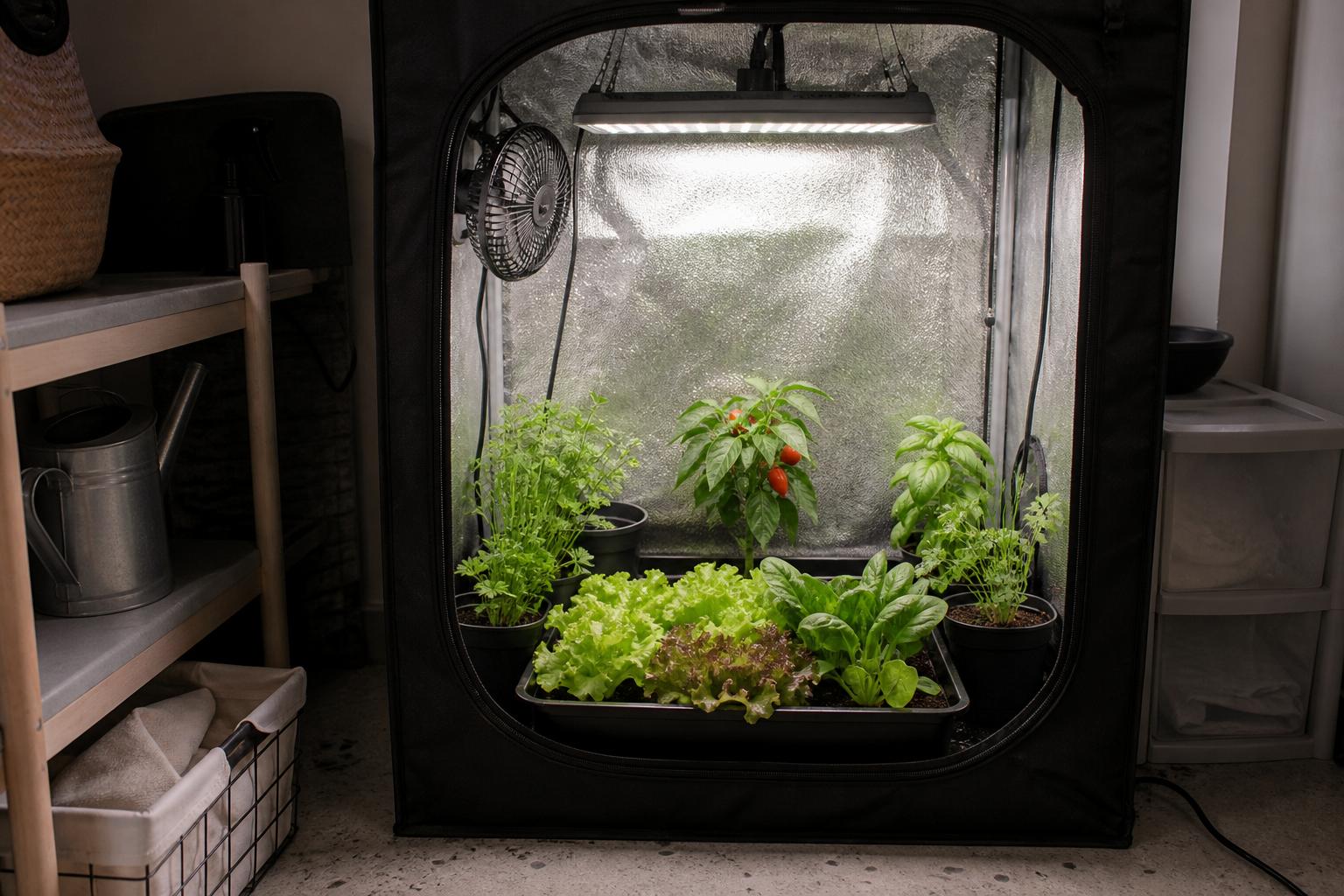
When you only have one small grow tent, the temptation is to fill every open spot with a different vegetable. I understand the urge. A packet of seeds takes up almost no room, so it feels as if the plants should fit just as easily.
Inside a grow tent, though, floor space is only part of the limit. Plants also compete for light height, airflow, root space, and easy access. A productive small grow tent usually contains fewer types of plants than people expect, but those plants are chosen to grow well together.
Why Crop Compatibility Matters More Than Plant Count
I learned this after trying to treat a small grow tent like a miniature backyard garden. I placed short lettuce near taller plants, tucked herbs into the corners, and assumed I was using the space efficiently. Within a few weeks, the taller plants blocked the light, the lettuce leaned toward the center, and watering anything in the back became awkward.
The real goal is not to fit the greatest number of pots inside the tent. It is to create one reasonably even canopy that the grow light can cover without wasting electricity or producing unnecessary heat.
Before combining crops, I compare four things:
- How tall the plants will become inside the grow tent
- How much light they need to produce a worthwhile harvest
- How quickly they grow and leave the space
- How much room their leaves and roots require
Plants do not have to match perfectly, but large differences create extra work. If one crop needs the light close while another needs more distance, one of them usually performs poorly.
The Vegetables That Use a Small Grow Tent Well
Leaf lettuce
Leaf lettuce is my first choice for a small grow tent because it stays short, grows quickly, and tolerates harvesting a few outer leaves at a time. Loose leaf varieties are usually more practical than large heading types. They let you keep a fairly level canopy and provide useful harvests without occupying the tent for months.
Lettuce also works well under a moderate light setting. That matters in an apartment or small home because the grow light produces less heat and uses less electricity than it would for fruiting peppers or tomatoes.
Bok choy and compact Asian greens
Baby bok choy, tatsoi, and mizuna make good grow tent crops when harvested young. Their growth is predictable, and several plants can share a shallow container if they have enough spacing for air to move between the leaves.
I have noticed that overcrowded bok choy creates a damp layer of leaves near the soil. Giving each plant a little more room often produces cleaner growth than squeezing in one extra row.
Arugula and baby kale
Arugula is useful when you want a quick crop between slower plantings. Baby kale takes a little longer, but it handles repeated leaf picking well inside a grow tent. Both can grow under the same light height as lettuce if you harvest them before they become large.
Full size kale is a different proposition. Its leaves spread widely and can shade half of a small tent. I prefer growing several plants for baby leaves instead of allowing one plant to dominate the space.
Radishes and green onions
Radishes use the space below the canopy, but their leaves still need room above it. Choose small round varieties and use a container deep enough for steady moisture. Radishes become disappointing when grow tent heat dries the container repeatedly, so place them where you can reach the soil easily.
Green onions are even easier to fit along the edge of a leafy green container. They stay narrow, handle moderate light, and do not create much shade. I would choose green onions over bulb onions in a small grow tent because the harvest arrives sooner and requires far less space.
Compact herbs
Parsley, cilantro, chives, and compact basil can share a grow tent with leafy greens, but I would not mix every herb together. Basil generally prefers warmer conditions and stronger light, while cilantro and lettuce are happier when the tent stays cooler.
If the room around the grow tent runs warm, basil is the easier partner. If the room stays cool, cilantro, parsley, and chives fit a salad focused tent better.
Crops That Create Lighting and Spacing Problems
Tomatoes, cucumbers, and vigorous peppers can grow inside a small grow tent, but they are not good companions for trays of short greens. Their demand for stronger light encourages you to raise power, which adds heat to the room. Their height also forces the light upward and leaves seedlings or lettuce in deep shade.
One mistake I see often is placing one tomato in the center and filling the remaining floor with lettuce. This works briefly. Once the tomato branches spread, the lettuce receives weak light and airflow becomes uneven. Reaching behind the tomato for watering or pruning also becomes frustrating.
If you want tomatoes or peppers, I recommend treating the grow tent as a fruiting crop tent. Choose one or two genuinely compact varieties, prune them for access, and avoid pretending the shaded floor will remain productive. A small pot of chives near the doorway may work, but a full second canopy usually does not.
Vining peas and pole beans cause similar problems. They use vertical space well in theory, but their leaves often reach the grow light and shade everything below. Bush beans are more manageable, although they still occupy more volume than lettuce for the amount of food produced.
A Simple Plan for Reliable Harvests
For an ordinary home grower, I prefer a salad focused grow tent. It is quieter, cooler, cheaper to light, and easier to maintain than a mixed tent containing large fruiting plants.
- Choose two main leafy crops, such as leaf lettuce and baby bok choy.
- Add one narrow crop, such as green onions or chives, along an accessible edge.
- Use containers of similar height so the leaf canopy remains close to level.
- Sow a small new batch every two or three weeks rather than planting the entire tent at once.
- Harvest or remove mature plants before they crowd the next batch.
Staggered sowing is more useful than maximum plant count. It prevents the grow tent from changing overnight from half empty to overcrowded. It also spreads out watering, harvesting, and replanting, which is helpful when the tent sits in a living space and needs to remain manageable.
Leave a clear path to every container, even if that means sacrificing one planting spot. In my experience, plants at the unreachable back corner are the first to be neglected, overwatered, or left too long after harvest. Easy access is productive space, not wasted space.
What I Would Plant First
If I were setting up one small grow tent today, I would start with loose leaf lettuce, baby bok choy, and a row of green onions. I would run the light only as strongly as those crops require and keep the canopy even by harvesting regularly.
Once that simple combination was producing reliably, I would decide whether the tent should remain a steady source of greens or be converted entirely to compact peppers or tomatoes. That single decision prevents most spacing and lighting conflicts. Start by choosing the job of your grow tent, then remove any crop that does not fit that job.


