
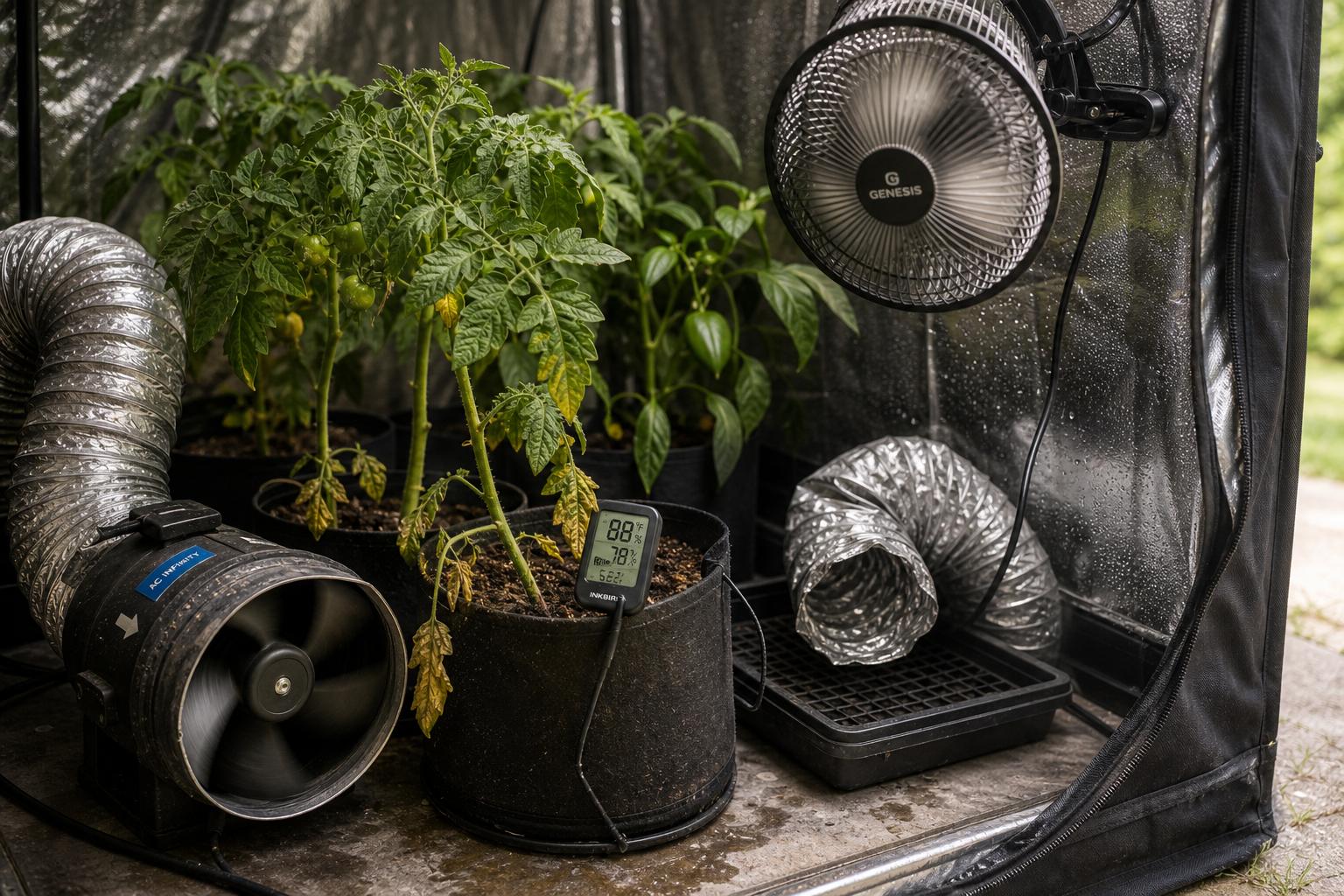
Summer heat changes the way air behaves inside a grow tent, and not in subtle ways. I have noticed that the same fan speed and vent setup that worked perfectly in spring can suddenly struggle in July. Temperatures rise, humidity swings widen, and airflow patterns inside grow tents stop behaving the way you expect.
If you run grow tents year round, hot weather forces you to think differently about airflow. This is not just about getting more air in and out. Rising ambient temperatures alter air density, reduce fan efficiency, and disturb the pressure balance that keeps your grow tent stable. I learned this after chasing temperature spikes for two summers before realizing the problem was not just heat. It was airflow physics shifting inside the tent.
Why Summer Air Moves Differently Inside Grow Tents
Warm air is less dense than cool air. Inside a grow tent, that matters more than most growers realize.
When the room outside your grow tent heats up, the intake air coming into the tent is already light and expanded. Your inline fan must work harder to move the same mass of air. Even if your fan speed is unchanged, the actual cooling effect drops because each cubic foot of hot summer air carries less cooling capacity.
What surprised me most was how this affected negative pressure. In cooler months, I run a moderate exhaust speed and maintain a healthy inward tent wall pull. In summer, with the same fan setting, the tent walls often pull in less. The air is lighter, and resistance inside ducting increases as everything warms up. That subtle shift can weaken odor control and reduce fresh air exchange efficiency.
Heat inside grow tents also exaggerates stratification. Warm air pools at the top much faster. If your exhaust port is mounted high, which it usually is, the exhaust may short cycle that top layer without properly pulling cooler intake air across the canopy. I have seen ten degree differences from canopy level to floor in a four by four grow tent during peak summer afternoons.
The Hidden Ways Heat Changes Fan Performance and Pressure
Most growers assume a six inch inline fan rated at a certain CFM performs consistently. In my experience, that rating means very little in high heat.
As temperatures rise:
- Fan motors run hotter and become slightly less efficient
- Ducting becomes softer and can sag, increasing resistance
- Carbon filters restrict more airflow when humidity climbs
- Room air outside the tent may already be stagnant
One mistake I see often is simply turning the exhaust fan to maximum speed in summer. That sometimes makes things worse. If intake openings are unchanged, the grow tent can become starved for incoming air. The fan pulls hard but cannot draw enough fresh air through passive vents, leading to higher noise, higher motor wear, and surprisingly modest cooling gains.
I made this exact mistake. I assumed more exhaust equals more cooling. Instead, I ended up increasing negative pressure too much, restricting intake, and causing humidity swings during lights off. The system became unstable.
Humidity behaves differently in heat as well. Warm air holds more moisture. During lights on, evapotranspiration increases inside grow tents, especially under strong LEDs. When that moisture hits slightly cooler ducting or the carbon filter, condensation can form in mild amounts, increasing resistance in the airflow path. It is subtle but real.
How to Rebalance Your Grow Tent for Hot Weather
I treat summer as a seasonal reset for my grow tent ventilation. Not an upgrade. A recalibration.
1. Increase Intake Capacity Before Increasing Exhaust
Instead of cranking the exhaust immediately, I open additional passive intake flaps or add a small booster intake fan. The goal is to maintain balanced negative pressure, not extreme vacuum. In my experience, slightly stronger intake support improves actual cooling efficiency more than simply increasing exhaust speed.
I prefer adding a controlled intake fan over relying only on passive vents. Passive works in mild conditions, but in peak heat the system becomes too sensitive.
2. Shorten and Straighten Duct Runs
Every bend in ducting matters more in summer. I remove unnecessary curves and shorten duct length where possible inside my grow tent setup. If ducting feels soft from heat, I replace it or reinforce it to prevent sagging.
This alone has given me noticeable airflow improvement without increasing fan speed.
3. Reposition Internal Circulation Fans
Inside grow tents, summer requires more active air mixing. I angle one circulation fan slightly upward to break the hot layer near the ceiling. Another stays at canopy level for leaf movement.
I eventually realized that without vertical mixing, exhaust pulls mostly from the hottest pocket at the top, leaving the middle canopy less refreshed. Balanced mixing creates more uniform temperature and humidity distribution.
4. Check Negative Pressure Visually
Your grow tent walls should pull inward slightly but not aggressively collapse. In summer, I watch the tent during lights on at peak heat. If the walls are barely moving, I know intake may be too restricted or exhaust too weak for the conditions.
If walls are bowing in excessively, I reduce exhaust or expand intake area. Stability matters more than maximum airflow numbers.
5. Upgrade Fan Controller Strategy
I prefer temperature based fan controllers in summer rather than static speed settings. A dynamic controller allows the grow tent to respond to heat spikes throughout the day.
Some growers run constant max speed all summer. I find that approach loud, inefficient, and hard on equipment. A responsive controller keeps pressure balance more stable across temperature swings.
A Simple Summer Airflow Reset Checklist
When outside temperatures begin consistently exceeding your usual indoor baseline, run through this inside your grow tent:
- Inspect and tighten all duct connections
- Straighten ducting and remove sharp bends
- Open or enlarge intake pathways
- Confirm carbon filter is not saturated or overly restrictive
- Measure temperature at canopy and near tent ceiling
- Observe tent wall pressure during peak heat
- Test airflow at exhaust port with hand or airflow meter
This takes less than thirty minutes but often reveals hidden inefficiencies that only show up in summer.
Troubleshooting Common Summer Airflow Problems in Grow Tents
The Tent Is Hot Even at Maximum Exhaust
If your grow tent remains excessively warm despite full fan speed, check the temperature of the intake air. In my experience, many growers forget that you cannot cool a tent below the temperature of the air feeding it. If the lung room is hot, ventilation alone cannot solve the problem.
Improve the cooling of the intake room first or adjust lighting intensity temporarily. I prefer dimming lights slightly during extreme heat over overstressing ventilation systems.
Humidity Spikes at Lights Off in Summer
Warm days followed by slightly cooler nights can cause moisture buildup inside grow tents. If your exhaust slows too much at lights off, moisture accumulates quickly.
I keep a minimum exhaust baseline even during the dark cycle in summer. A full shutdown may save electricity but causes unstable humidity patterns.
Loss of Smell Control During Heat Waves
If odor escapes during peak summer heat, weak negative pressure is often the reason. Recheck intake balance and ensure your exhaust system maintains consistent inward pull even when temperatures rise.
A struggling carbon filter in high humidity may require replacement sooner than expected. I replace mine a bit earlier when running through hot, humid seasons.
The Tradeoff Most Growers Ignore
Higher airflow increases environmental stability but also increases drying stress on plants inside grow tents. There is a balance.
In my opinion, stable pressure and consistent air exchange are more important than chasing the lowest possible temperature. I would rather run a grow tent at a slightly elevated but stable temperature with strong airflow than fight for cooler numbers while creating pressure imbalance and humidity swings.
Summer does not just heat your grow tent. It changes how air behaves inside it. Once you start adjusting intake, pressure, ducting, and circulation as a system rather than simply turning up a fan, summer airflow becomes predictable instead of frustrating.


