
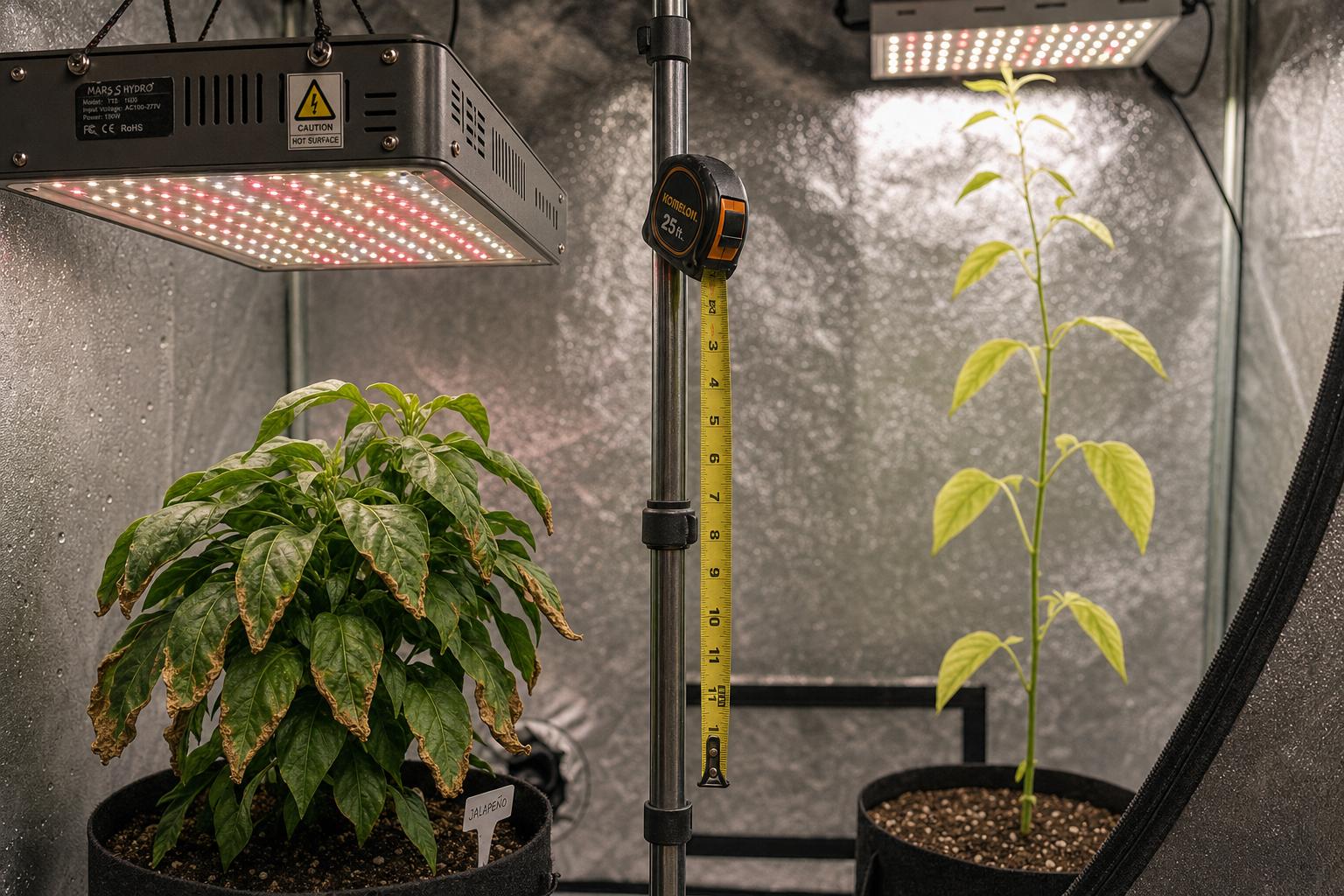
Most lighting problems inside a grow tent are blamed on wattage, spectrum, or brand. In my experience, the real issue is usually height. Inside grow tents, light intensity changes dramatically with just a few inches of adjustment, and small positioning errors show up in plant structure faster than most growers expect.
I have noticed that two identical lights in two different grow tents can produce very different results simply because of how high they are mounted above the canopy. When you are working in a reflective, enclosed space, distance is everything. If you get it wrong, you see uneven growth, stressed tops, stretched lower branches, and wasted energy within days.
Why Light Height Errors Show Up Faster in Grow Tents
A grow tent is not an open room. The reflective walls bounce photons back into the canopy. The ceiling limits how high you can raise the fixture. The footprint is fixed. All of that magnifies the impact of light positioning.
Inside grow tents, the difference between 12 inches and 18 inches above the canopy can mean a dramatic swing in light intensity. Because the space is enclosed, there is very little forgiveness. Outdoors or in open rooms, light spreads and dissipates. In a grow tent, it stacks.
What surprised me most when I first started using grow tents was how quickly plants reacted to poor height. I once fried the top colas of a healthy plant in less than four days simply because I lowered the fixture without adjusting output. The leaves did not bleach immediately. They first clawed slightly and then turned rigid and pale. I learned quickly that height is not something you set once and forget.
The Most Common Light Height Mistakes and What They Cause
1. Setting Height Based on Manufacturer Charts Alone
One mistake I see often is growers following the recommended hanging height on the box without considering their specific grow tent setup. Those charts rarely account for reflective walls or canopy density.
In a small grow tent with highly reflective inner lining, the effective intensity can be higher than the chart suggests. If you blindly set your fixture at the minimum recommended height in a compact tent, you risk light stress even if the power level seems reasonable.
I prefer to start slightly higher than recommended and gradually lower the fixture while observing plant response.
2. Letting the Center of the Tent Dictate Height
Grow tents tend to concentrate light intensity in the center. Many growers measure distance from the tallest central cola and ignore what is happening at the edges.
This creates a problem. When the light is too low to optimize the corners, the center becomes overexposed. You get praying leaves in the middle and stretching at the perimeter.
In my grow tents, I set height based on average canopy level, not the single tallest shoot. I will often gently bend or train that tallest top rather than lowering the entire fixture and stressing the rest of the canopy.
3. Forgetting Vertical Stretch During Transition
Inside grow tents with limited vertical space, one of the most common mistakes is failing to anticipate stretch during the flowering transition. Growers set the light height perfectly for late vegetative growth, flip the cycle, and then two weeks later the canopy has moved six inches closer to the fixture.
I learned this after running out of vertical room in a 4 by 4 grow tent. I had to super crop aggressively because I did not leave enough buffer between canopy and light.
Inside a grow tent, always leave headroom before the stretch phase. I aim to keep a safety buffer that allows for upward growth without forcing daily emergency adjustments.
4. Chasing Leaf Posture Instead of Measuring Distance
It is common advice to watch whether leaves are praying. That works to a point, but inside grow tents light intensity builds quickly.
Praying leaves can also occur under slightly excessive light combined with strong airflow. If you only look at leaf angle, you can misread the signal. I eventually realized that consistent measurement from canopy to fixture is more reliable than reading posture alone.
I keep a simple measuring tape clipped inside the tent pole. Every time I adjust the ratchet hangers, I measure. Guessing is what causes problems.
A Practical Method to Dial In Light Height Without Guesswork
This is the method I use in my own grow tents when setting up a new light or new strain.
Step 1: Start High and Moderate Power
Mount the fixture slightly higher than you think necessary. Use moderate output rather than maximum power. This reduces the risk of immediate stress.
Step 2: Measure From the True Canopy
Do not measure from the pot rim or tent floor. Measure from the average canopy height. In a grow tent, the canopy plane is what matters because light intensity drops quickly with distance.
Step 3: Lower in Small Increments
Lower the fixture in small steps every few days while watching new growth. Inside grow tents, I adjust by one to two inches at a time. Large adjustments often overshoot the sweet spot.
Step 4: Check for Uneven Response
Look for differences between center and edges. If the middle is tightening internode spacing drastically while outer branches stretch, the fixture is too low for uniform coverage.
In that case, I prefer slightly higher uniform coverage over maximum central intensity. Even growth across the canopy produces better results in a grow tent than blasting the center.
How to Adjust Light Height as Your Canopy Changes
Light height in grow tents is not a one time decision. It is an ongoing process tied directly to canopy management.
During Vegetative Growth
As plants push upward, I check height every few days. Early vegetative plants can handle slightly more distance because the canopy is not yet dense. I focus on encouraging lateral spread rather than compressing internodes too tightly.
During Stretch
This is when careful adjustment matters most in a grow tent. I often raise the light preemptively before the biggest stretch days. It is easier to lower the fixture later than to fix light burn on the top colas.
Late Flower
Once vertical growth slows, the goal shifts to maintaining consistent intensity across the entire canopy. In my experience, late flower plants are less forgiving of sudden height changes. I make smaller, slower adjustments and avoid aggressive repositioning.
Troubleshooting Light Height Problems in a Grow Tent
Upper leaves are bleaching but temperature is stable
Inside a grow tent, if tops bleach while tent temperature is steady, the fixture is probably too close. Raise the light a few inches and observe new growth rather than damaged leaves.
Lower branches are stretching despite strong light specs
If lower growth stretches even with a powerful LED in your grow tent, the fixture may be too low and creating a hotspot. Raise it slightly to improve spread.
Plants look healthy but yield is disappointing
I have seen this often. The canopy looks fine, but the light was kept too high the entire cycle. Inside grow tents, wasted vertical space equals wasted intensity. Gradually lower the fixture earlier in the next run while monitoring response.
The Tradeoff Most Growers Ignore
The real tradeoff inside grow tents is between peak intensity and uniform coverage. You can run a light very close to the canopy and maximize center intensity, or you can raise it slightly and create even distribution.
I recommend prioritizing even coverage in a grow tent. Uniform development across all tops consistently outperforms a single overpowered center. Alternatives that chase maximum intensity usually create more management work and higher stress risk.
If you dial in light height carefully and adjust as the canopy evolves, you stop fighting your grow tent and start using it properly. Positioning is not secondary to power. In a grow tent, positioning is the system.


