
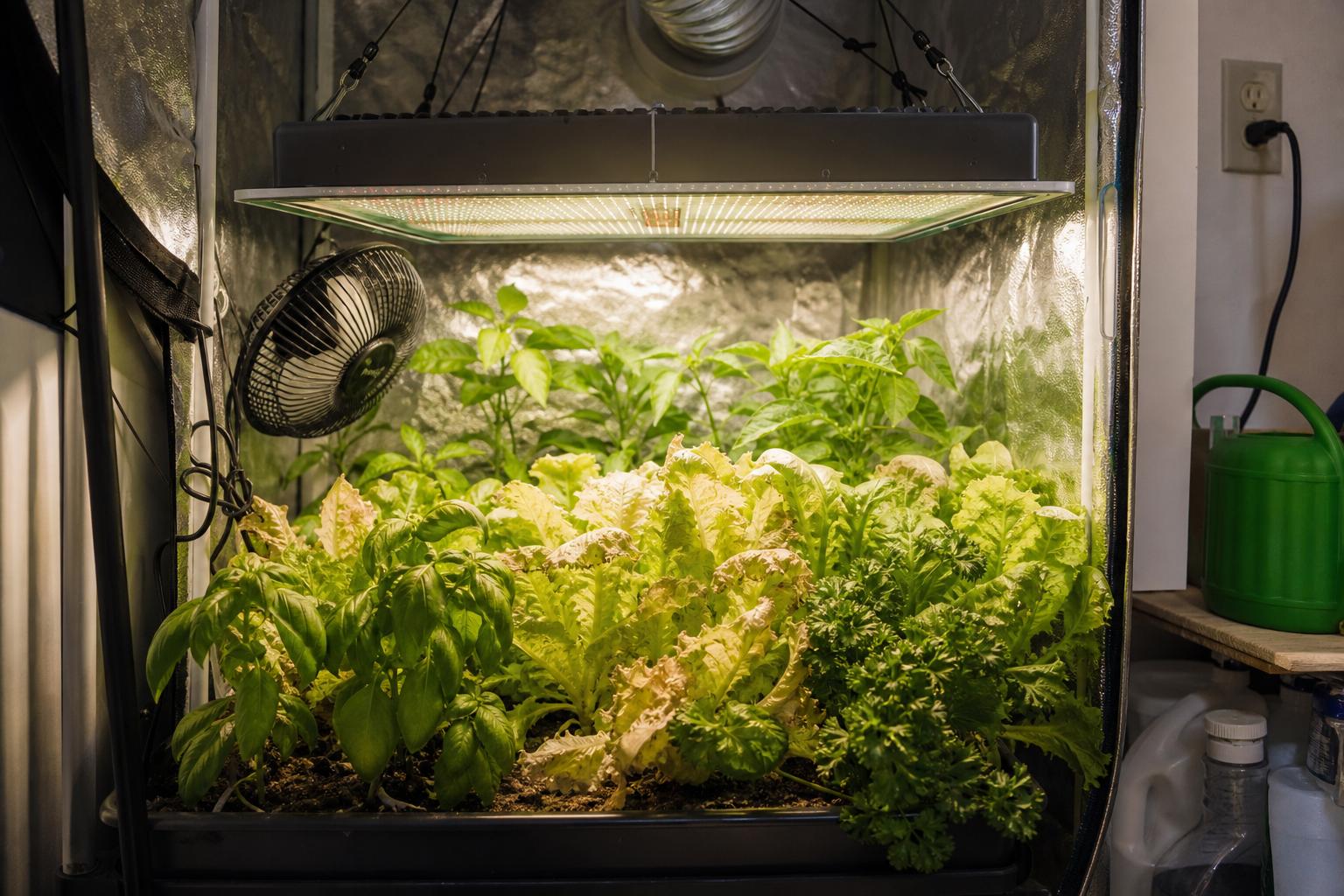
It is easy to assume that a stronger grow light will produce more food. Inside a grow tent, that idea often leads to stressed lettuce, thirsty peppers, excess heat, and an exhaust fan that seems to run constantly.
I made this mistake early on by treating maximum light power as a goal. What worked better was treating the dimmer as an environmental control. A grow tent light should provide enough energy for the vegetables being grown without creating more heat and water demand than the rest of the tent can manage.
What Excess Light Looks Like Inside a Grow Tent
Too much light does not always look like obvious burning. The first signs inside a grow tent are often subtle. Upper leaves may become pale, curl upward at the edges, or feel dry even when lower growth looks normal. Lettuce can develop firm, bitter leaves instead of the soft growth most people want.
I have noticed that basil exposed to excessive light often grows compact at first, which can look like success. A little later, the upper leaves become lighter and less tender. The plant is still growing, but the usable quality is getting worse.
Peppers and tomatoes may droop during the brightest part of the light cycle even though their growing medium is moist. They can also develop curled upper leaves or flowers that fail to set. Strong light raises leaf temperature and increases water loss. If the roots cannot keep up, the plant closes its leaf pores and growth slows.
Look for a pattern before changing fertilizer. Light stress is usually strongest directly under the fixture and near the top of the grow tent canopy. A nutrient problem is more likely to appear according to leaf age or across several plants regardless of their position under the light.
A Quick Excess Light Checklist
- Upper leaves are noticeably paler than shaded leaves.
- Leaf edges curl upward toward the grow light.
- Plants droop while the growing medium is still moist.
- Lettuce and herbs feel tougher or taste more bitter.
- The grow tent temperature climbs quickly when the light turns on.
- Plants directly under the center struggle more than plants near the sides.
- Water use rises without a matching improvement in growth.
One symptom alone does not prove excess light. Several symptoms concentrated near the top and center of the grow tent are a much stronger clue.
Why Fixture Power Does Not Determine Plant Growth
Watts tell you how much electricity a fixture uses. They do not tell you exactly how much useful light reaches a particular leaf. Fixture efficiency, hanging height, light spread, reflective tent walls, and canopy shape all affect the result.
A powerful fixture hung high and dimmed can provide even coverage. A smaller fixture placed very close to the canopy can create an intense central area with weak edges. This is why choosing a grow light by wattage alone is unreliable.
Plants also need to use the light they receive. Inside a grow tent, that depends on leaf temperature, available water, root health, nutrients, and carbon dioxide from ordinary room air. Once one of those becomes limiting, adding more light mainly adds heat and stress.
For an ordinary home grower, I do not think adding bottled carbon dioxide to justify extreme light levels is practical. It adds cost, complexity, and another system to monitor in a small home. I would rather dim the fixture, reduce room heat, and grow healthy vegetables consistently.
Nearly all electricity used by grow tent equipment eventually becomes heat in the room. A stronger light can therefore mean a louder exhaust fan, faster water use, and a warmer apartment. Those costs matter even when the leaves are not visibly damaged.
Match the Light to What You Are Growing
The useful measurement for canopy intensity is PPFD, usually expressed as micromoles per square meter per second. A dedicated meter is convenient, but many home growers can get a workable estimate from a phone light meter application designed for grow lights. It may not be perfectly accurate, but it is far more useful than guessing from fixture wattage.
For seedlings inside a grow tent, I generally aim for about 100 to 250 PPFD. Young plants need enough light to stay compact, but they do not need the intensity intended for mature peppers.
Lettuce, spinach, arugula, and many leafy greens usually perform well around 200 to 350 PPFD. Basil, parsley, cilantro, and similar herbs can often use about 250 to 400 PPFD. These crops usually reward even coverage more than a powerful bright spot in the center.
Mature peppers and compact tomatoes can use approximately 400 to 700 PPFD when their roots, watering, temperature, and nutrition are all in good condition. I normally start near the lower part of that range and increase only when the plants are actively growing without curling or drooping.
These are practical starting ranges, not rigid limits. Light duration matters too. Many vegetables and herbs inside grow tents do well with 14 to 16 hours of light followed by a consistent dark period. A moderate intensity applied for an appropriate number of hours is usually easier to manage than extreme intensity over a shorter period.
A Practical Grow Tent Lighting Adjustment Process
Check the Canopy Before Touching the Dimmer
Inspect the plants near the center, edges, and corners of the grow tent. Compare upper leaves with lower leaves. Also check whether taller plants are shading shorter ones. Sometimes the fixture is not too powerful overall. The canopy is simply uneven.
Raise short pots on stable platforms or train taller tomatoes and peppers away from the fixture. Creating a level canopy often solves more than another equipment purchase.
Measure at Leaf Height
Take light readings where the leaves actually sit, not on the grow tent floor. Check the center and several outer points. If the center reading is much higher, raise the fixture slightly to improve spread. Then use the dimmer to bring the average intensity back to the range your crop needs.
In small grow tents, I prefer raising and dimming over running a close fixture at full power. The coverage is usually more even, leaf hot spots are reduced, and the tent is easier to cool.
Change One Thing and Wait
Reduce intensity by a modest amount or raise the fixture a few inches. Do not change light, watering, fertilizer, and ventilation on the same day. Give leafy greens several days to respond. Fruiting vegetables may need longer before the improvement is obvious.
Damaged leaves will not always become green again. Judge the adjustment by new growth, daytime posture, water use, and the appearance of fresh leaves.
Watch Temperature and Water Demand
Record the grow tent temperature before the light turns on and again during the middle of the light cycle. If dimming produces a meaningful temperature drop and the plants stop drooping, the previous setting was probably creating more demand than they could handle.
Do not respond to light driven wilting by automatically watering more. If the root zone is already wet, extra water removes oxygen and creates a second problem. Lower the light stress first and let the growing medium move through a normal wet and dry cycle.
What I Would Change First
If vegetables are struggling under a powerful grow light, I would first measure intensity at the highest leaves and compare the center with the corners. I would then raise the fixture for better coverage and dim it to suit the least light hungry crop sharing the grow tent.
That may feel like leaving growth on the table, but healthy lettuce, herbs, peppers, and tomatoes use moderate light better than stressed plants use maximum power. Start with a comfortable intensity, observe new growth, and increase slowly only when the plants show they can use it.


