
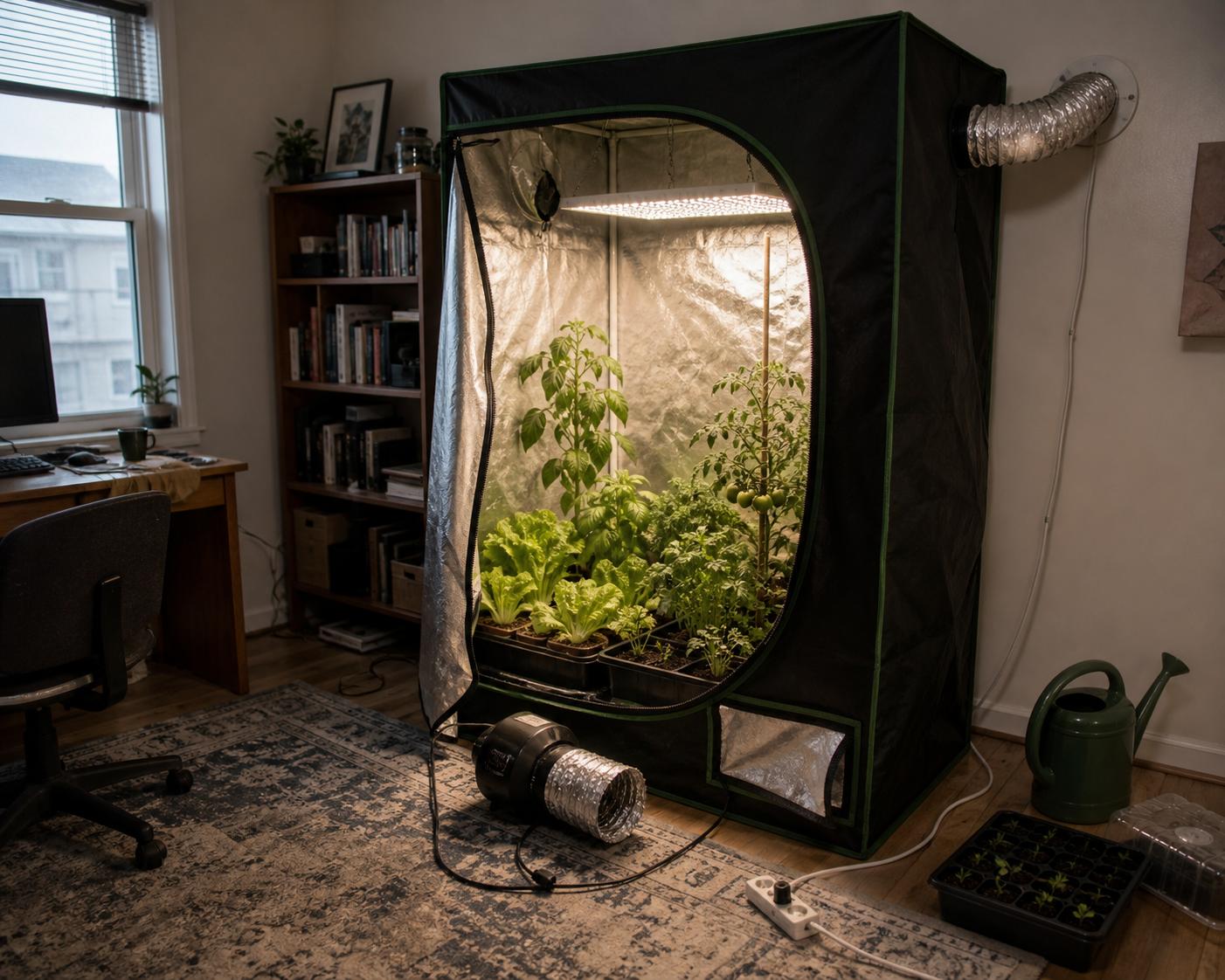
It is easy to assume every grow tent needs two powered fans: one pushing air in and another pulling air out. In most small grow tents used for herbs, leafy greens, peppers, and compact tomatoes, that is more equipment than you actually need.
A properly sized exhaust fan can pull fresh room air into a grow tent through open vents without help from an intake fan. This is called passive intake, but the name makes it sound less effective than it is. When the vents are large enough and the exhaust path is not overly restricted, passive intake is usually the quieter, simpler choice.
I prefer to start with passive intake because it saves floor space, electricity, and another source of noise inside the home. The important part is checking whether it is genuinely working rather than assuming that an open vent automatically supplies enough air.
Why Passive Intake Works in More Grow Tents Than You Might Expect
An exhaust fan creates slightly lower air pressure inside the grow tent. Room air then moves through the passive vents to replace what the fan removes. You do not need a second fan to make that happen.
Healthy negative pressure is easy to see. The sides of the grow tent should pull inward slightly when the exhaust fan is running. This gentle inward movement tells you air is leaving through the exhaust and entering through the available vents.
Slight inward movement is good. Tent walls collapsing sharply toward the plants are not. Severe suction means the exhaust fan is trying to move more air than the intake openings can comfortably provide.
I have run small grow tents full of lettuce, basil, parsley, and young pepper plants using only passive intake. What surprised me early on was that adding another fan did not necessarily make the plants healthier. It often added noise while making temperature control more complicated.
The circulation fans inside a grow tent serve a different purpose. They move air around leaves and reduce stagnant pockets, but they do not bring in meaningful fresh air. You still need an exhaust path and an intake path even if the leaves are gently moving.
Signs Your Exhaust Fan Is Not Getting Enough Intake Air
The quickest diagnostic test is to observe the grow tent with the door closed, then open the zipper a few inches. Let the exhaust fan run at its normal setting during both parts of the test.
Look for these signs of restricted intake:
- The tent walls pull inward dramatically.
- The zipper becomes unusually difficult to open.
- The exhaust fan sounds strained or changes pitch.
- Airflow from the exhaust duct feels weaker than expected.
- Temperature or humidity falls noticeably when you crack open the door.
If the exhaust airflow becomes much stronger as soon as the door opens, the fan was starved for intake air. The first solution is not necessarily another fan. Open more passive vent area and repeat the test.
One mistake I made early on was turning up the exhaust fan whenever a grow tent felt warm. The walls pulled in harder, but the temperature barely improved. The fan could not move its rated airflow because I had left only one small screened intake open.
A stronger exhaust setting cannot compensate for an undersized air opening.
Also check what happens with the grow light on. Lettuce and herbs under a modest light may remain comfortable during the first hour, then gradually warm the grow tent as heat accumulates. Peppers and tomatoes under more powerful lights make an intake restriction show up faster.
If opening the door does not improve temperature or exhaust airflow, intake restriction may not be the main problem. The room supplying the grow tent may already be warm or humid. A grow tent cannot exhaust its way to a lower temperature than the air entering it without air conditioning.
How to Set Up Passive Intake for Reliable Ventilation
Place the passive intake near the bottom of the grow tent and the exhaust near the top. Warm air naturally collects higher in the tent, so this arrangement pulls cooler room air past the plants before removing warmer air.
I usually open a lower vent on the side opposite the exhaust. This creates a longer path through the grow tent instead of allowing fresh air to enter and immediately disappear up the exhaust duct.
- Open one or more lower screened vents.
- Close unused upper ports that could create a shortcut to the exhaust.
- Run the light and exhaust fan at their normal settings.
- Check wall movement, leaf movement, temperature, and humidity after the tent settles.
- Crack the door and compare the exhaust airflow again.
As a practical starting point, provide passive vent area equal to about three times the area of the exhaust opening. More may be needed when the vent uses dense mesh, a dust filter, or a light blocking cover. Those materials add resistance even when the opening looks large.
A small strip of tissue held near the intake is useful. It should be pulled steadily toward the grow tent. If it barely moves while the tent walls are deeply collapsed, the available opening is too restrictive.
Be thoughtful about where the intake air comes from. Pulling air from an air conditioned living room usually works better than drawing it from a hot utility closet. In an apartment, I also avoid pointing an open intake directly at dusty floors or a heating vent.
Filters can keep pet hair and dust away from leafy greens, but there is a tradeoff. A fine filter reduces airflow and needs regular cleaning. I prefer a washable coarse filter with generous surface area rather than a small dense filter that quietly chokes the exhaust system.
When an Active Intake Fan Is Worth Adding
An active intake fan becomes useful when you have already opened adequate vent area and the exhaust still cannot get enough replacement air. This is more common in larger grow tents, heavily filtered setups, or tents receiving air through a long intake duct.
It can also make sense when passive vents must remain mostly closed to control light escaping into a room. For many people growing food in a bedroom or shared apartment, that convenience may justify the extra noise and cost.
Consider active intake when:
- The grow tent needs air pulled through a long or bent duct.
- Light blocking covers severely restrict the passive vents.
- A large tent has powerful lights and consistently high heat.
- Opening more vent area is not practical in the available room.
If you add an intake fan, size or control it so it moves slightly less air than the exhaust fan. You still want gentle negative pressure inside the grow tent. An intake fan that overpowers the exhaust can inflate the walls and push warm, humid air through every seam.
For an ordinary home grower, my recommendation is to avoid buying the intake fan first. Open enough lower vent area, clean the screens, check for crushed ducting, and perform the cracked door test. If airflow improves with the door open but you cannot provide a larger passive opening, then add a quiet adjustable intake fan.
My first move would be to enlarge the passive intake and test again with the grow light running. That simple change solves the problem in many small grow tents without adding more wiring, noise, maintenance, or electricity use.


