
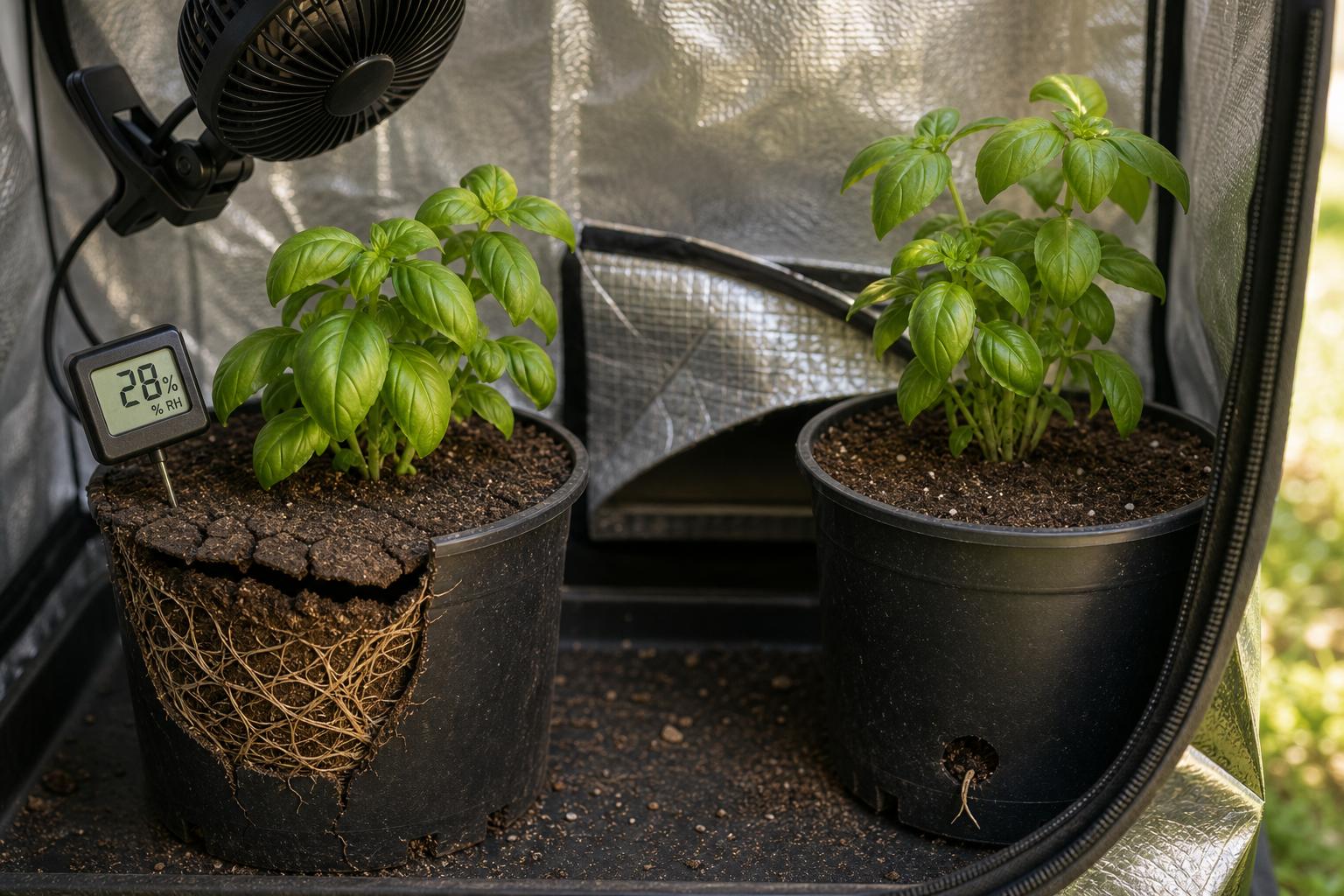
Slow root growth inside a grow tent is one of the most frustrating problems you can face. Leaves look pale, stems stay thin, and everyone immediately blames nutrients or genetics. In my experience, that is rarely the real issue. Inside grow tents, root problems are usually caused by environmental imbalance at the container level.
Grow tents create controlled environments, but control does not always mean balance. The same airflow that keeps your canopy strong can quietly dry one side of your containers. The same exhaust system that stabilizes humidity can increase evaporation inside your pots. I have noticed that when roots stall in grow tents, the cause is often microclimate stress around the container, not a feeding mistake.
Why Slow Root Growth in Grow Tents Is Rarely a Nutrient Problem
When roots slow down, the first reaction is to add more nutrients. I learned this after overcorrecting a perfectly good feeding schedule and making the problem worse. Inside a grow tent, nutrient uptake depends entirely on root health. If the root environment is unstable, adding more fertilizer just increases stress.
In a sealed or semi sealed grow tent, air movement and evaporation are artificially concentrated. A plant growing outdoors can compensate for uneven moisture in soil. In grow tents, containers dry unevenly and roots respond by shrinking away from dry pockets. That stalling effect often looks like deficiency above the soil line.
One mistake I see often is growers chasing feeding charts when the real problem is that one side of the pot is drying twice as fast as the other. Roots do not expand into inconsistent moisture zones. They hesitate.
How Airflow and Evaporation Patterns Quietly Stress the Root Zone
Direct Fan Pressure on Containers
Oscillating fans are essential in grow tents, but they often hit the container walls directly. I have noticed that fabric pots nearest a fan dry out dramatically faster on the wind facing side. When you lift the pot, one half feels light and the other feels heavy.
This creates a split root system. Roots cluster where moisture remains and avoid the dry side. Growth above the canopy slows because the root system never fully colonizes the container.
Exhaust Placement and Negative Pressure
Most grow tents operate under negative pressure. That constant draw of air pulls moisture upward through the container. If your exhaust is strong, the surface layer dries quickly, especially in smaller tents where airflow volume cycles rapidly.
What surprised me most was how much faster small containers emptied when I upgraded my inline fan. The environment readings looked perfect, but root growth stalled for weeks. The increased air exchange rate was pulling moisture out faster than roots could expand into new media.
Container Placement on Tent Floors
The floor of a grow tent is another overlooked factor. Thermal mats, cold concrete underneath, or uneven tray drainage create microclimates around the base of the container.
I eventually realized that pots sitting directly on a cold basement floor inside my grow tent had slower root expansion compared to pots elevated on risers. Roots seek stable warmth. Even a few degrees difference at the base can limit downward growth.
A Diagnostic Checklist for Identifying Root Zone Imbalance in Your Grow Tent
Before changing nutrients, run through this checklist inside your grow tent:
1. Lift and Rotate Test
Lift your container and feel the weight from different sides. Rotate it 180 degrees. Is one side consistently lighter? That indicates uneven airflow drying.
2. Surface Inspection Under Grow Lights
Turn off oscillating fans briefly and examine the soil surface. In grow tents with strong air movement, you may see one quadrant crusting or pulling away from the container wall.
3. Check Container Temperature
Place your hand against different parts of the pot. Are areas facing intake vents cooler? Temperature inconsistencies in grow tents directly influence root expansion speed.
4. Evaluate Drainage Runoff Pattern
When watering inside a grow tent, observe how runoff exits. If water channels down one side, roots are likely concentrated there. Balanced drainage usually means balanced root development.
5. Compare Edge Plants vs Center Plants
Plants near tent walls often show slower root growth than plants centered under lighting. Tent wall condensation and airflow rebound can create unpredictable evaporation zones.
If two plants with identical feeding behave differently but occupy different positions in the grow tent, suspect environmental imbalance first.
Resetting the Root Environment Without Overcorrecting
When you confirm imbalance, resist the urge to overhaul everything. Root systems respond poorly to dramatic swings inside grow tents.
Step 1: Reposition Airflow
Redirect fans so they move air above the canopy rather than directly across containers. I prefer indirect circulation that brushes leaves but leaves container walls relatively calm. Alternatives like reducing fan speed entirely are less effective because stagnant air invites other problems.
Step 2: Elevate Containers
Use risers or pot elevators inside your grow tent. Air should circulate under the container base. This stabilizes moisture distribution and equalizes temperature. In my experience, simply lifting pots off the tent floor can restart stalled root growth within a week.
Step 3: Standardize Watering Rhythm
Inside grow tents with high airflow, smaller but more evenly distributed water applications outperform large infrequent soakings. Large soakings tend to exaggerate channeling in unevenly dried pots. I recommend watering slowly in two passes rather than flooding once.
Step 4: Rotate Plants Weekly
This is simple but highly effective. Rotate each container within the grow tent to neutralize directional airflow bias. I used to ignore this and consistently saw one sided root development. Regular rotation keeps expansion symmetrical.
Step 5: Moderate Exhaust if Necessary
If evaporation remains aggressive, slightly reducing exhaust speed can help. The tradeoff is that humidity may climb. I prefer adjusting exhaust in small increments instead of adding humidifiers. Introducing more equipment often complicates airflow patterns further.
Troubleshooting: When Roots Still Refuse to Expand
Should I transplant immediately?
Only if the container is truly root bound. Transplanting from a stressed root zone inside a grow tent can amplify shock. Fix airflow and evaporation first.
Should I add root stimulants?
Most of the time, no. In controlled grow tents, environmental correction delivers better results than additives. Roots will expand when conditions feel consistent.
What if only one plant is struggling?
Swap its position within the grow tent with a healthier plant. If growth improves, the issue was placement rather than genetics or feeding.
Does container type matter?
Yes, especially in grow tents with strong airflow. Fabric pots dry faster and respond dramatically to fan placement. Plastic containers hold moisture longer but can develop temperature gradients. Choose deliberately based on how aggressive your tent airflow is.
After years of working inside grow tents, I no longer panic when roots slow down. I look at airflow direction, container placement, evaporation rate, and floor temperature before I touch my nutrient schedule. Nine times out of ten, the problem is that the roots do not feel stable in their environment. Once the root zone feels balanced again, growth resumes quietly and consistently.


