
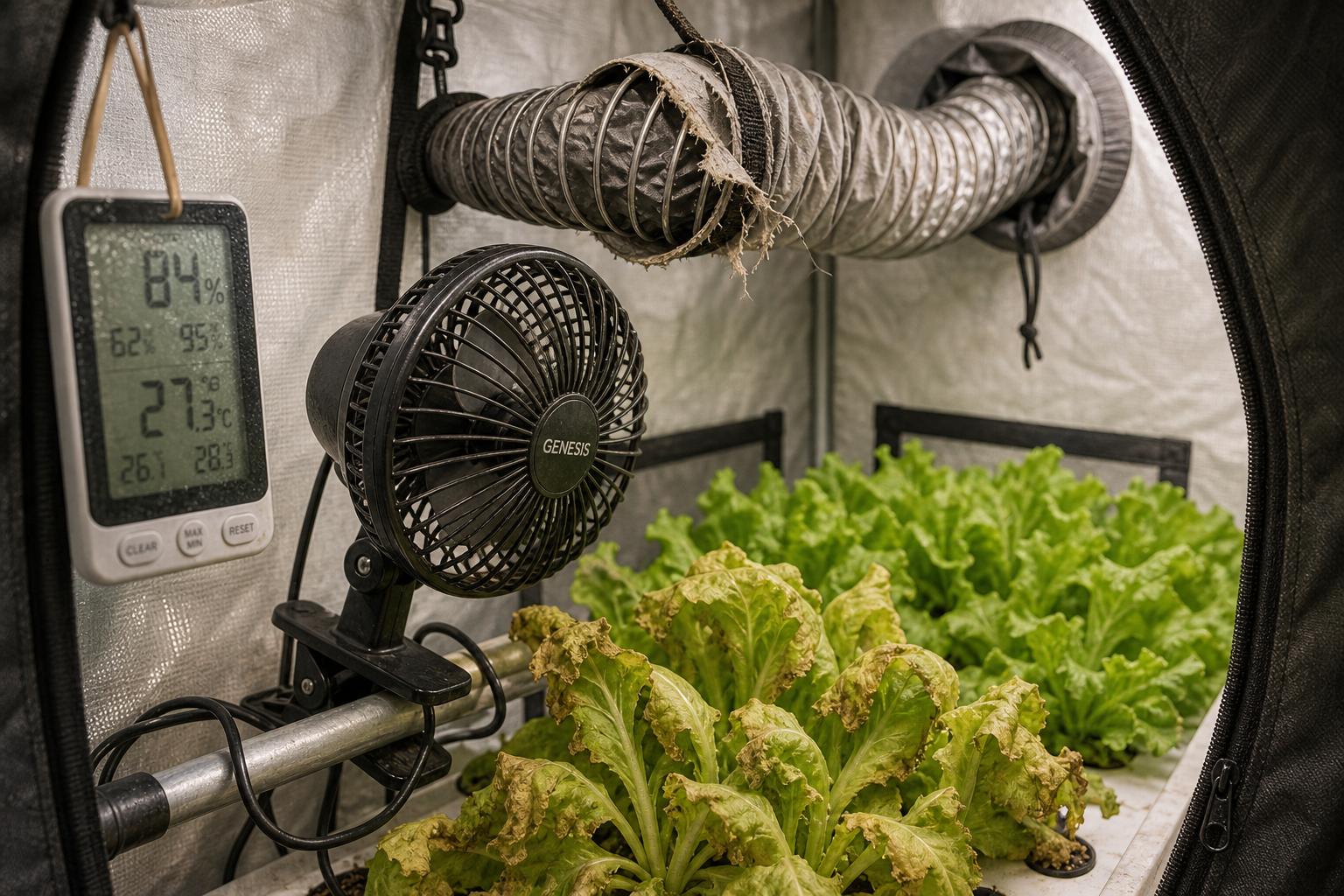
If you run a grow tent long enough, you have probably found yourself adjusting fan speeds every time the temperature or humidity shifts a few points. I have done it. Most growers I know have done it. And almost every time, the constant tweaking inside the grow tent makes the environment less stable instead of more stable.
Grow tents are small controlled systems. A small adjustment to exhaust speed or circulation can create a larger ripple effect than you expect. When you keep reacting to minor swings, you build instability into the system. The real solution is not more adjustment. It is controlled restraint and structured monitoring.
Why Constant Fan Adjustments Create Bigger Problems
Inside a grow tent, airflow is tied directly to temperature, humidity, and pressure balance. When you raise exhaust speed, you are not just lowering heat. You are also reducing humidity retention and changing negative pressure. When you slow it down, you increase moisture buildup and reduce fresh air exchange.
I have noticed that growers often increase fan speed every time canopy temperature rises one or two degrees. Then when humidity drops too low, they slow it back down. Over several days, the environment becomes unpredictable because the baseline keeps shifting.
One mistake I see often is constantly adjusting inline fan controllers throughout the day. Morning settings are different from afternoon settings. Night settings are adjusted again. Instead of allowing the grow tent to reach equilibrium, the grower keeps interrupting the stabilization process.
In my experience, grow tents perform best when exhaust speed is treated as a baseline setting, not a reactive knob.
The Difference Between Natural Variation and True Airflow Failure
Not every swing inside a grow tent means something is wrong. Lights cycle. Plants transpire more at certain growth stages. Lung room temperatures shift. A few degrees of fluctuation is normal system behavior.
What surprised me most when I started tracking data weekly was how consistent healthy tents actually are over time, even when daily readings vary slightly. Small fluctuations that feel dramatic in the moment usually balance out across the full light cycle.
True airflow failure inside a grow tent looks different:
Signs of real airflow problems
- Persistent leaf edges curling despite stable irrigation
- Condensation on tent walls during lights off
- Noticeable stagnant air pockets in canopy corners
- Weak negative pressure where tent walls stop pulling inward
- Humidity climbing steadily each day without stabilizing
If you do not see these patterns, you likely do not have an airflow failure. You have natural environmental drift.
I eventually realized that chasing minor humidity swings of three to five percent was creating more plant stress than leaving the system alone.
A Simple Reset Plan to Stabilize Your Grow Tent Airflow
When a grow tent feels unstable because of constant adjustment, I use a structured reset. This has worked consistently better for me than adding more circulation fans or rerouting ducting immediately.
Step 1: Return to a Fixed Baseline
Set your inline exhaust fan to a moderate constant speed. Not maximum and not barely running. If your controller has numbers from one to ten, choose a middle value that maintains gentle negative pressure.
Do not touch it for forty eight hours.
This is the hardest step for growers who like to tweak settings. But without a stable baseline, you cannot evaluate cause and effect inside the grow tent.
Step 2: Simplify Circulation
Many growers respond to perceived airflow issues by adding extra clip fans. More fans are not always better inside a grow tent. Too much cross breeze can increase transpiration unevenly and dry the canopy surface while roots remain saturated.
I run enough circulation to gently move leaves across the entire canopy. No aggressive leaf flutter. No constant shaking.
If you have more than two internal fans in a small grow tent under four by four feet, remove one during the reset period unless you clearly have stagnant air pockets.
Step 3: Inspect Duct Stability
Inside a grow tent, loose or sagging ducting reduces airflow efficiency. Before increasing fan speed, check that duct runs are straight, sealed, and supported. Gentle curves are fine. Sharp bends restrict performance.
I learned this after replacing a struggling fan that turned out to be perfectly fine. The real issue was a partial duct collapse behind the tent.
Step 4: Observe Full Light Cycles
Monitor temperature and humidity at three points. Early lights on, mid cycle, and just before lights off. Do this for three consecutive days without adjusting equipment.
You will likely notice that what felt unstable is actually a predictable curve. That predictability is what you want inside a grow tent.
What to Monitor Weekly So You Stop Chasing Small Swings
The key to avoiding overcorrection inside grow tents is focusing on trends, not momentary readings.
Track These Weekly Metrics
- Average temperature across lights on period
- Average humidity across lights on period
- Maximum and minimum daily range
- Negative pressure consistency
If weekly averages are stable, do not adjust airflow.
In my experience, growers who log weekly averages make fewer reactive changes and have steadier plant development inside their grow tent.
A Tradeoff Most Growers Ignore
There is a tradeoff between perfect numbers and system stability.
You can chase an ideal humidity target every hour, or you can maintain a slightly imperfect but stable environment inside your grow tent. I strongly prefer stability. Plants respond better to consistent conditions than to a constantly shifting attempt at technical perfection.
Some advice suggests installing fully automated controllers that dynamically adjust exhaust speed minute by minute. I understand the appeal. But unless the system is tuned carefully, automation can amplify the same overcorrection behavior humans create manually.
A steady baseline with limited intervention has produced more predictable results for me than aggressive real time fan modulation.
Troubleshooting: When Should You Actually Adjust Airflow?
If humidity climbs during lights off
Increase exhaust speed slightly during the dark cycle only. Then leave it alone for several days and evaluate the weekly average rather than the first night result.
If upper canopy feels dry but lower growth feels stagnant
Reposition internal circulation fans before changing exhaust speed. Air distribution problems inside a grow tent are often directional, not volume related.
If tent walls stop drawing inward
Check intake obstructions and duct joints before raising fan power. Pressure balance issues are frequently mechanical rather than strength related.
If temperature spikes quickly after lights turn on
Verify that the lung room temperature feeding the grow tent has not changed. Increasing exhaust inside the tent will not solve a hot intake source.
The Discipline of Leaving It Alone
The biggest improvement I ever made to airflow management inside my grow tent was simply reducing how often I touched the controls.
I stopped reacting to every small meter fluctuation. I started looking at patterns over days instead of moments. And I learned that a balanced grow tent feels calm. Fans hum consistently. Leaves move gently. Numbers shift within predictable ranges.
If you find yourself adjusting settings daily, you are probably overcorrecting. Set a baseline. Give the system time. Let the grow tent do what it was designed to do, which is operate as a small stable environment.
Most airflow problems are not caused by too little equipment. They are caused by too much interference.


