
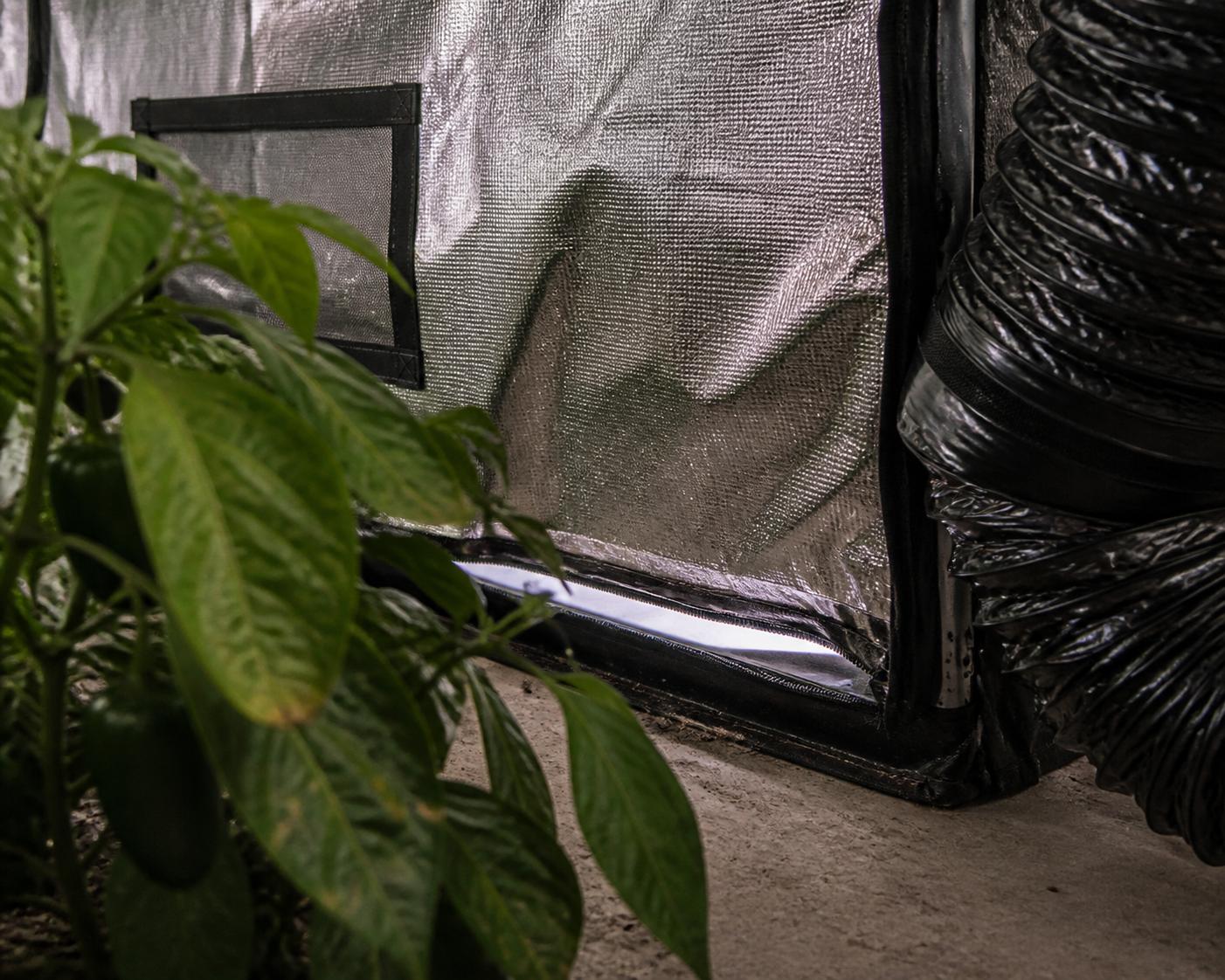
If you have ever walked past your grow tent and caught a faint but unmistakable smell, even though your carbon filter is brand new, you are not alone. I have dealt with odor leaks in grow tents that had top tier filters, powerful inline fans, and carefully sealed seams. The problem was not the filter. It was the airflow inside the grow tent.
Odor control in grow tents is not just about scrubbing air. It is about controlling pressure. Once I truly understood how negative pressure works inside a sealed grow tent environment, odor issues became predictable and fixable. Before that, I replaced perfectly good equipment chasing a problem that was really airflow routing all along.
Why Odor Control in Grow Tents Depends on Pressure, Not Just Filters
In a properly configured grow tent, the exhaust fan and carbon filter should create consistent negative pressure. That means the grow tent walls slightly suck inward. All air entering the grow tent should come through passive intake flaps or controlled intake ports, and all air leaving should pass through the carbon filter.
If any air escapes the grow tent without being pulled through the filter, odor leaks happen. It does not matter how expensive the filter is.
In my experience, many growers focus on air scrubbing power but ignore pressure balance. They assume if the fan is strong and the filter is clean, the job is done. What surprised me most when I first chased an odor issue was discovering that even a tiny positive pressure shift inside the grow tent can push untreated air out through zippers, stitching, cable ports, and duct seams.
Once the air pressure inside the grow tent becomes slightly higher than the room outside, smell will find the smallest escape path.
The Common Airflow Routing Mistake That Lets Smell Escape
One mistake I see often is improper placement of intake and circulation fans inside grow tents. Growers will add extra booster fans or active intake fans to increase airflow, but they forget to confirm that exhaust is still dominant.
Here is the most common scenario:
- An inline fan pulls air through a carbon filter and exhausts outside the grow tent.
- An additional inline or booster fan pushes fresh air into the tent through an intake port.
- The intake fan is equal to or stronger than the exhaust fan.
This setup creates positive pressure inside the grow tent. As a result, unfiltered air escapes through weak points.
I learned this after installing a powerful intake fan to improve temperature control. Within days, odor started leaking even with a brand new carbon filter. The intake airflow was overwhelming the exhaust. The filter was working perfectly. The system pressure was not.
Another airflow routing issue happens when duct runs are too long or overly bent. Each bend reduces effective airflow from the exhaust fan. Even though the fan rating looks strong on paper, real world performance inside the grow tent drops. If intake airflow stays the same but exhaust airflow decreases, pressure balance shifts.
I eventually realized that the grow tent system has to be treated as one loop. Fans, filter, ducting, passive vents, and even oscillating fans all interact.
Warning Signs Your Grow Tent Is Not Maintaining Proper Negative Pressure
You can diagnose pressure imbalance in a grow tent without fancy tools.
1. Tent Walls Are Not Sucking Inward
A healthy grow tent under negative pressure visibly pulls its fabric inward. If the walls are flat or slightly bulging, you likely have neutral or positive pressure.
2. Zippers Leak Smell First
If odor seems strongest near zippers or lower seams, air is being pushed out through those gaps instead of pulled inward.
3. Smell Increases When Lights Turn On
When lights switch on, heat increases. Air expands and can disrupt marginal pressure balance inside the grow tent. If odor appears only during lights on periods, your system is operating too close to neutral pressure.
4. Opening a Passive Vent Reduces Smell
If you open an additional passive intake flap and odor decreases, your grow tent was starved for intake air under proper negative pressure. That means airflow routing needs adjustment rather than more filtration.
A Simple Reset Plan to Seal Odor Leaks Without Replacing Equipment
Before you buy a new carbon filter, reset your grow tent airflow.
Step 1 Reduce or Eliminate Active Intake Fans
In most grow tents, passive intake is enough. I strongly prefer relying on negative pressure to draw air in rather than pushing air in. Active intake fans add complexity and frequently create pressure imbalance.
If you insist on using an intake fan, it must be weaker than your exhaust fan after accounting for duct losses.
Step 2 Shorten and Simplify Exhaust Ducting
Keep the exhaust duct inside your grow tent as straight and short as possible. Each sharp bend reduces effective airflow. I avoid more than two gentle bends whenever possible.
If your fan is outside the grow tent pulling air through the filter, confirm all connections are airtight. Small leaks before the filter defeat the entire system.
Step 3 Confirm Proper Filter Mounting Inside the Grow Tent
The safest configuration in my experience is filter mounted inside the grow tent, fan attached directly to it, pulling air through the filter and then exhausting out. This ensures all exhausted air is scrubbed before leaving the tent.
Some growers push air through a filter located outside the grow tent. It can work, but it leaves more room for leakage at duct joints inside the tent. I prefer pulling through the filter first because it creates cleaner negative pressure dynamics.
Step 4 Perform a Smoke Test
Once everything is running, use incense or a smoke pen near zippers and ports outside the grow tent. Smoke should always be drawn inward. If it blows away from the tent, you still have positive pressure.
This simple test reveals airflow direction instantly.
Troubleshooting Checklist for Persistent Grow Tent Odor
- Are the tent walls visibly pulled inward
- Is exhaust airflow stronger than intake airflow in real conditions
- Are duct runs short and mostly straight
- Are all unused ports tightly sealed
- Is the carbon filter inside the grow tent rather than after long duct runs
- Has fan speed been increased to create stronger negative pressure
If you can check every box and still have odor, then it may be time to evaluate filter age or humidity saturation. High humidity inside a grow tent reduces carbon efficiency. But in my experience, pressure imbalance is far more common than carbon failure.
The Tradeoff Most Growers Ignore
Strong negative pressure can slightly reduce maximum temperature and humidity control efficiency because more conditioned air is constantly being pulled out of the grow tent. Some growers try to balance comfort and odor control too tightly and end up drifting toward neutral pressure.
I choose stronger negative pressure every time. I would rather compensate with environmental controls than deal with odor leaks. In closed indoor settings, containment matters more than marginal efficiency gains.
Once your grow tent maintains steady inward pull, odor issues become predictable and rare. Filters last longer. Small leaks stop mattering. And most importantly, you stop chasing equipment upgrades that were never the real problem.


