
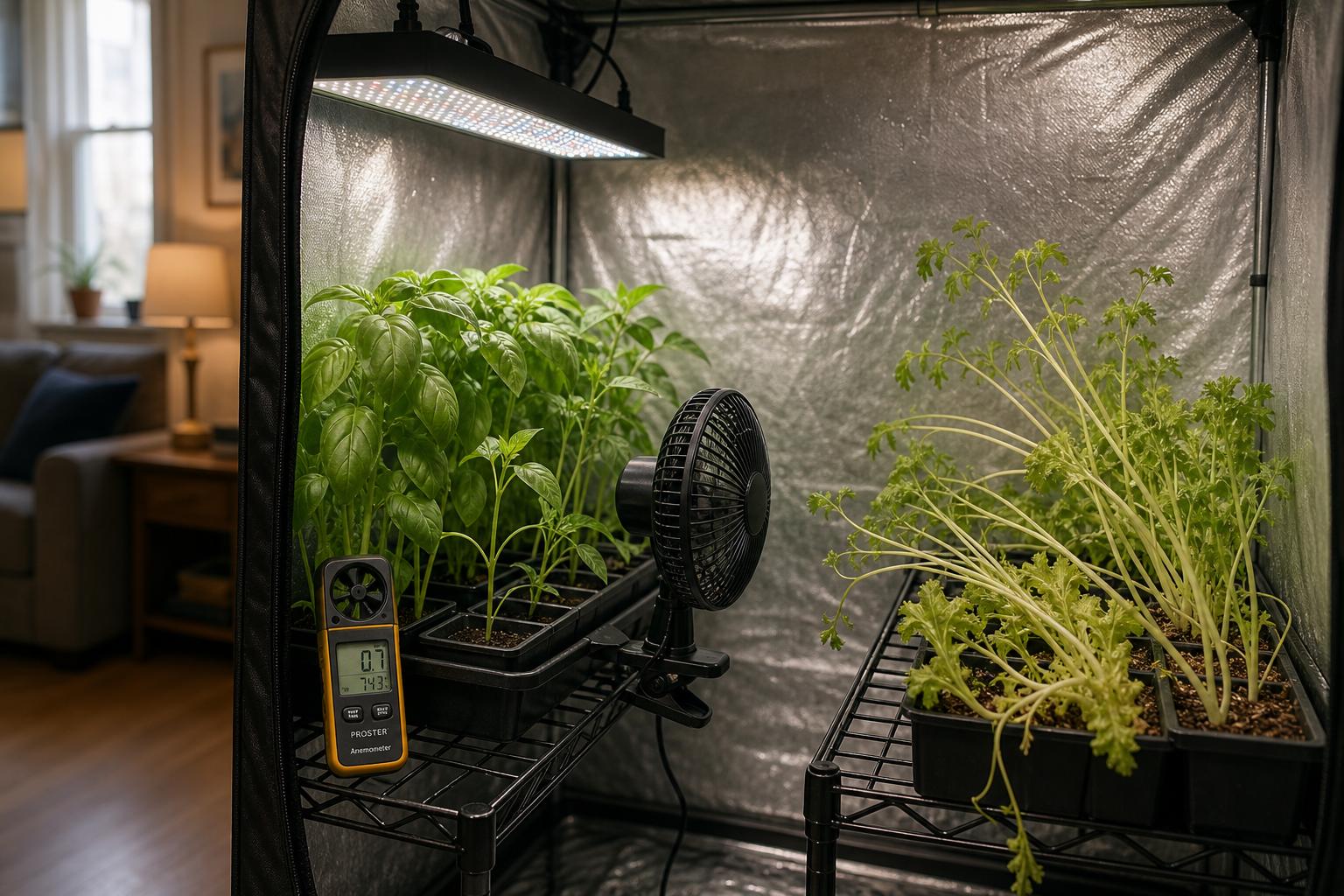
Most people running a grow tent focus on the numbers. Temperature looks good. Humidity is in range. The exhaust fan is running. On paper, everything seems fine.
But inside grow tents, pockets of still air can quietly weaken plant structure even when your environment monitor says everything is perfect. I have seen basil flop, lettuce develop soft stems, and young pepper plants struggle to stand upright, all because of airflow dead zones that were not obvious at first glance.
If your plants look healthy in color but lack strength, there is a good chance your grow tent has one or two stagnant areas that need attention.
The Subtle Plant Clues That Point to Airflow Dead Zones
Dead zones rarely scream for attention. They show up through small clues.
Stems That Stay Thin and Flexible
Inside a grow tent, plants rely on moving air to stimulate stronger stems. Without gentle movement, they have no reason to thicken up.
I have noticed this most with herbs like basil and cilantro. When the air is moving properly, the stems firm up within a couple of weeks. When a section of the canopy sits in still air, those stems stay soft and bend too easily.
One Side of the Tent Looks Stronger
If the plants closest to your oscillating fan look sturdy but the ones in the back corner look weaker, that is a classic airflow imbalance.
In a small apartment grow tent, it is common to mount one clip fan and assume it is enough. Often it is for half the space, but not the entire footprint.
Leaves That Hardly Move
This one sounds obvious, but many people miss it. In a properly balanced grow tent, leaves should have a gentle, occasional flutter. Not constant shaking. Not still like cardboard. Just light, irregular movement.
If you open your tent and see whole sections of the canopy perfectly still while other areas are dancing, you have a dead zone.
Why Dead Zones Form Even When Fans Seem Adequate
One mistake I made early on was assuming airflow was about total fan power. If the exhaust fan exchanged air fast enough, I thought that was all that mattered.
But exhaust systems in grow tents are designed for air exchange and odor control, not canopy level circulation. They pull air out from one location. They do not guarantee even movement through every plant.
Plant Density Changes Everything
When I first set up a tent with small lettuce seedlings, airflow felt fine. A month later, once the canopy filled in, the same fan setup created stagnant pockets under the leaves and in back corners.
As vegetables mature inside a grow tent, they create their own wind barriers. Broad leaves from spinach or Swiss chard can block circulation more than you expect.
Corner Geometry and Fabric Walls
Grow tents have tight corners and soft walls. Air hits a corner and slows down. In a bedroom or spare room setup where space is limited, tents are often placed close to a wall, which can further disrupt passive airflow around intake areas.
Even with an oscillating fan, the far lower corner of a 4 by 4 foot tent can stay noticeably stagnant.
How Weak Air Movement Affects Stem Strength and Growth Patterns
Plants grown inside a grow tent do not deal with natural wind, so we have to simulate it.
Light air movement triggers subtle mechanical stress in the stem. That stress signals the plant to reinforce its structure. Without it, stems elongate without thickening.
Leggy Growth Under Strong Lights
This combination surprises people. They think leggy plants are always a light issue. Sometimes it is airflow.
I have grown compact lettuce under strong LED panels that still developed longer, weaker stems in one section of the tent. The light was evenly distributed. The airflow was not.
Peppers and Tomatoes That Need Too Much Support
Inside a grow tent, fruiting plants like peppers and dwarf tomatoes especially benefit from steady airflow. When grown in a stagnant pocket, they often need staking much earlier than expected.
In my experience, when airflow is balanced, the main stem feels noticeably firmer when you gently pinch it between your fingers. It is a small difference, but it matters once fruit starts forming.
How I Diagnose Dead Zones Without Overcomplicating the System
You do not need smoke machines or expensive airflow meters.
Step 1: Use the Leaf Test
Stand in front of your open grow tent and simply watch the canopy with all fans running.
Look for:
- Sections that barely move at all.
- Leaves that never flutter unless you manually disturb them.
- Areas where humidity feels heavier when you put your hand between plants.
If part of the canopy looks inactive compared to the rest, that is your starting point.
Step 2: Feel for Temperature Differences
Reach your hand into different parts of the grow tent at plant height. In dead zones, the air often feels slightly warmer and more humid.
I learned this after noticing that powdery mildew kept appearing in the same back corner of a tent. The overall humidity reading looked fine. That corner was not.
Step 3: Adjust Fan Angles Before Adding More Equipment
Most people respond by buying another fan. Sometimes that is necessary. Often it is not.
What worked better for me was adjusting the vertical angle of my existing clip fan so it skimmed across the canopy rather than blasting directly at one row of plants.
Aiming airflow to bounce off the tent wall can create more diffuse circulation. It is quieter and uses no extra electricity, which matters in a small apartment where constant fan noise can get irritating.
Step 4: Add a Second Small Fan Only If Needed
If repositioning does not fix the stagnant areas, then add a second small circulation fan rather than upgrading to a high powered unit.
I prefer two lower speed fans at opposite corners over one aggressive fan in the center. The airflow becomes more even and less stressful on delicate herbs like parsley or baby greens.
The tradeoff is slightly more wiring inside the grow tent, which can make watering a bit more awkward. For me, stronger stems and fewer disease issues are worth that inconvenience.
Common Mistake: Confusing Strong Air With Good Airflow
Blasting plants constantly is not the goal.
I once set a fan too high thinking more movement meant stronger stems. Instead, my lettuce developed dry leaf edges and the top layer of grow medium dried out too quickly.
Inside a grow tent, you are looking for gentle, consistent air movement across the entire canopy. Not a wind tunnel.
What I Would Check First in Your Grow Tent
If you suspect hidden dead zones, do this tonight.
Turn on your grow lights and all fans. Open the tent. Watch the leaves for two full minutes without touching anything. Then reach into the back corners and under the canopy and feel the air.
If you find one stagnant pocket, start by redirecting your existing fan so airflow travels across that area rather than directly at the center of your plants.
In most home grow tents, especially in tight apartment spaces, better direction solves more problems than adding more power. Stronger stems, sturdier herbs, and more resilient vegetables usually follow within a couple of weeks once air is moving the way it should.
The numbers on your monitor matter. But how the air actually moves inside your grow tent matters even more.


