
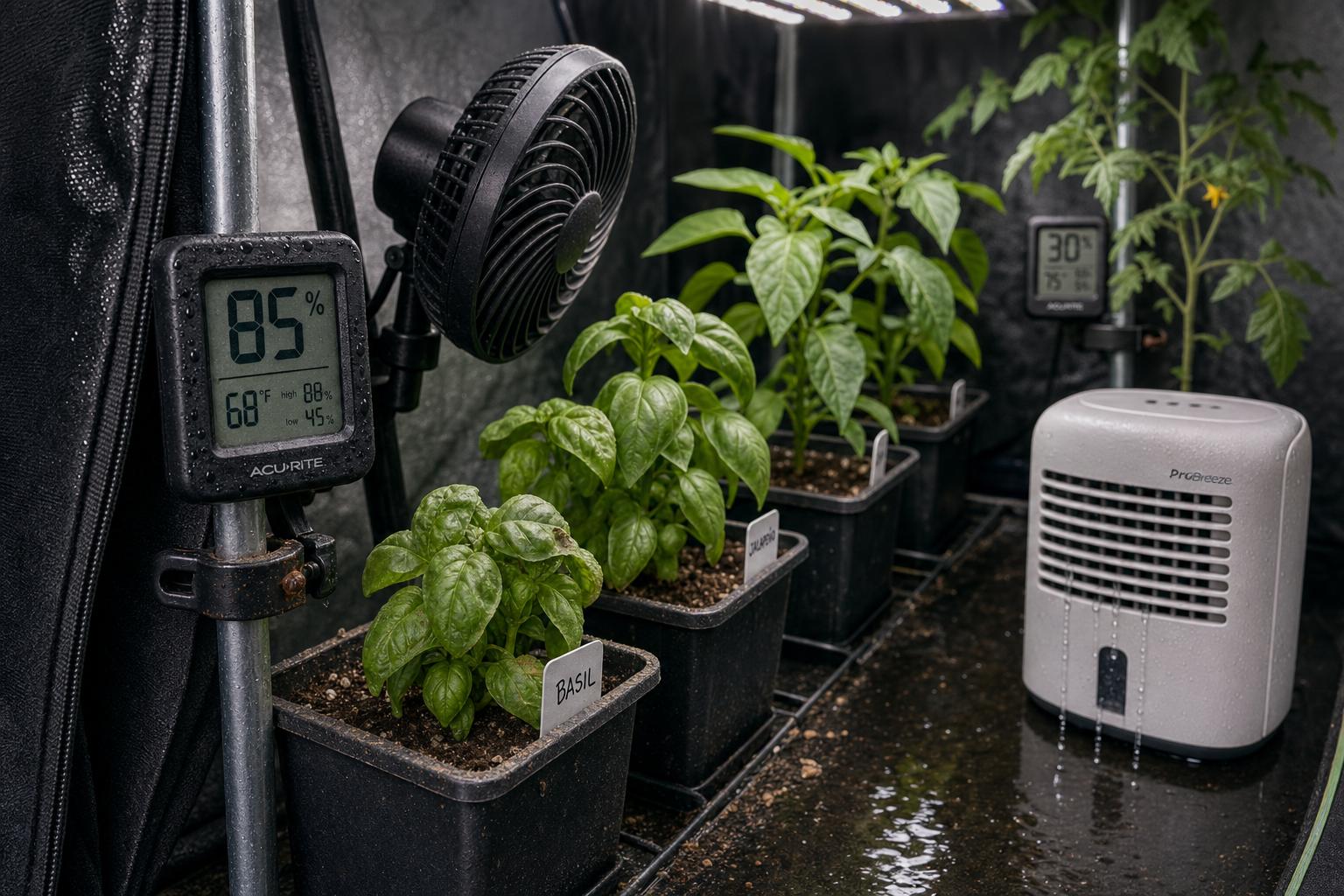
If your grow tent feels like it cannot decide whether it is a rainforest or a desert, you are not alone. I have worked with dozens of grow tents over the years, and unstable humidity is one of the most common system problems I see.
Inside a grow tent, humidity should move gradually as lights cycle and plants transpire. When it swings hard from too dry to too humid, that tells you the environment is not balanced. The issue is almost never just a bad humidifier or dehumidifier. It is usually a system imbalance between airflow, plant transpiration, and how your control equipment reacts.
The Pattern Behind Humidity Swings in Grow Tents
Before changing equipment in your grow tent, look at the pattern.
In my experience, most unstable grow tents follow one of these patterns:
- Humidity spikes hard after lights turn off, then crashes when lights turn on.
- Humidity drops too low during the day, then overshoots when a humidifier kicks in.
- Humidity stays stable for hours, then suddenly swings 15 percent or more within 30 minutes.
These patterns matter because they tell you whether your grow tent is over ventilated, under ventilated, or reacting too aggressively to environmental changes.
What surprised me most years ago was realizing that humidity instability in a grow tent is usually caused by equipment working too hard rather than not working enough.
Three Hidden System Imbalances That Cause Instability
1. Exhaust Fan Speed Out of Sync With Plant Transpiration
Your inline fan controls how fast humid air leaves the grow tent. If it ramps up aggressively every time humidity rises slightly, it strips moisture too quickly. Then the humidifier overcompensates. The cycle repeats.
I see this often in grow tents connected to smart controllers set with tight humidity thresholds. Growers try to hold 60 percent exactly. The fan turns on at 61 percent. It shuts off at 59 percent. That tiny range creates constant swings.
Inside a grow tent, plants transpire gradually. Your exhaust control should respond gradually too.
2. Poor Air Mixing Inside the Grow Tent
Another issue I have noticed is uneven air movement. In many grow tents, humidity collects in upper corners or behind dense canopy areas. The sensor might be in a dry airflow path while stagnant air pools elsewhere.
When circulation fans are weak or poorly positioned inside a grow tent, the exhaust fan reads inaccurate averages. It reacts late. By the time it activates strongly, the moisture level is already high, causing a sharp correction.
I learned this after chasing phantom humidity spikes that were really just poor air mixing.
3. Equipment Oversized for the Grow Tent
One mistake I see often is installing a powerful humidifier or dehumidifier designed for a room inside a small grow tent. A large ultrasonic unit can raise humidity by 10 percent in minutes inside a compact tent.
The result is constant overshoot. The grow tent becomes a battle between machines rather than a stable system.
I eventually realized that smaller, slower adjustments create more stable grow tents than powerful rapid corrections.
A Diagnostic Checklist to Find the Real Cause
Instead of guessing, run through this checklist inside your grow tent.
Step 1: Observe a Full Light Cycle
Do not adjust anything for 24 hours. Watch how humidity changes from lights on to lights off inside the grow tent. Write down the peak and lowest readings and when they happen.
If swings are strongest right after lights change, the issue is likely airflow reaction speed rather than equipment capacity.
Step 2: Check Sensor Placement
Place your hygrometer at canopy height in the center of the grow tent, not near an intake vent, humidifier mist stream, or exhaust fan.
I have fixed entire humidity problems in grow tents simply by moving the sensor away from direct airflow.
Step 3: Lower Exhaust Fan Reactivity
If your controller allows it, widen the humidity tolerance range inside the grow tent. Instead of 60 to 61 percent, try 55 to 63 percent.
If the fan runs constantly during lights on, reduce minimum fan speed slightly. If humidity only spikes at lights off, increase baseline airflow during the last hour of lights on.
You are smoothing transitions, not chasing exact numbers.
Step 4: Evaluate Air Circulation Inside the Grow Tent
Add or reposition oscillating fans so air moves above and below the canopy. You should see gentle leaf movement everywhere inside the grow tent.
If you feel pockets of still air in corners, your humidity readings are likely unreliable.
Step 5: Measure Equipment Impact
Turn your humidifier on manually for five minutes in the grow tent. Record how much humidity rises. If it jumps more than 5 percent quickly, it is too strong for the space or placed poorly.
Slow and steady changes create stability.
How to Stabilize Humidity Without Adding More Equipment
Most growers assume they need more gear. In my experience, stability inside a grow tent usually comes from tuning what you already have.
Balance Exhaust Before Adding Moisture
I recommend dialing in your exhaust system first. A stable baseline humidity inside the grow tent should sit slightly below your target. Then allow plants to naturally raise it during lights on.
Using plant transpiration as part of the system reduces reliance on machines. The tradeoff is that numbers will not look perfectly flat. They will gently curve instead. That is healthy.
Reduce On Off Cycling
If your humidifier inside the grow tent only runs in hard bursts, plug it into a controller that supports variable output or use a lower power setting.
Frequent hard cycling creates instability, excess condensation, and unnecessary wear on equipment.
Anticipate Lights Off Humidity Rise
Inside grow tents, humidity almost always rises when lights turn off because leaf temperature drops and evaporation slows.
One practical fix is increasing exhaust speed slightly 30 minutes before lights off. This prevents excess moisture buildup instead of reacting after it happens.
I prefer proactive airflow adjustments over installing a dehumidifier inside a small grow tent. Dehumidifiers add heat and consume space. In many compact setups, proper airflow management solves the same issue more elegantly.
Troubleshooting Quick Answers
Why does my grow tent swing 20 percent every day?
Most likely your exhaust fan is too reactive or your humidifier is oversized. Check tolerance ranges and measure how quickly equipment changes humidity inside the grow tent.
Is it normal for humidity to rise at night in a grow tent?
Yes. Some rise is normal. Large spikes are not. Stabilize airflow before lights off to keep the increase controlled.
Should I add a dehumidifier inside my grow tent?
Only if airflow adjustments cannot prevent sustained high humidity. In small grow tents, I prefer balancing exhaust and circulation first. Adding more equipment should be the last step, not the first.
The Real Goal Inside a Grow Tent
You are not trying to freeze humidity at a perfect number inside your grow tent. You are trying to create slow, predictable movement.
When airflow, plant transpiration, and equipment response are balanced, humidity shifts become gentle transitions rather than violent swings. That stability reduces plant stress, improves nutrient uptake, and keeps condensation away from surfaces inside the grow tent.
If your grow tent swings between too dry and too humid, resist the urge to buy more gear. Watch the pattern. Adjust airflow first. Slow everything down.
Stable grow tents are rarely built with more equipment. They are built with better balance.


