
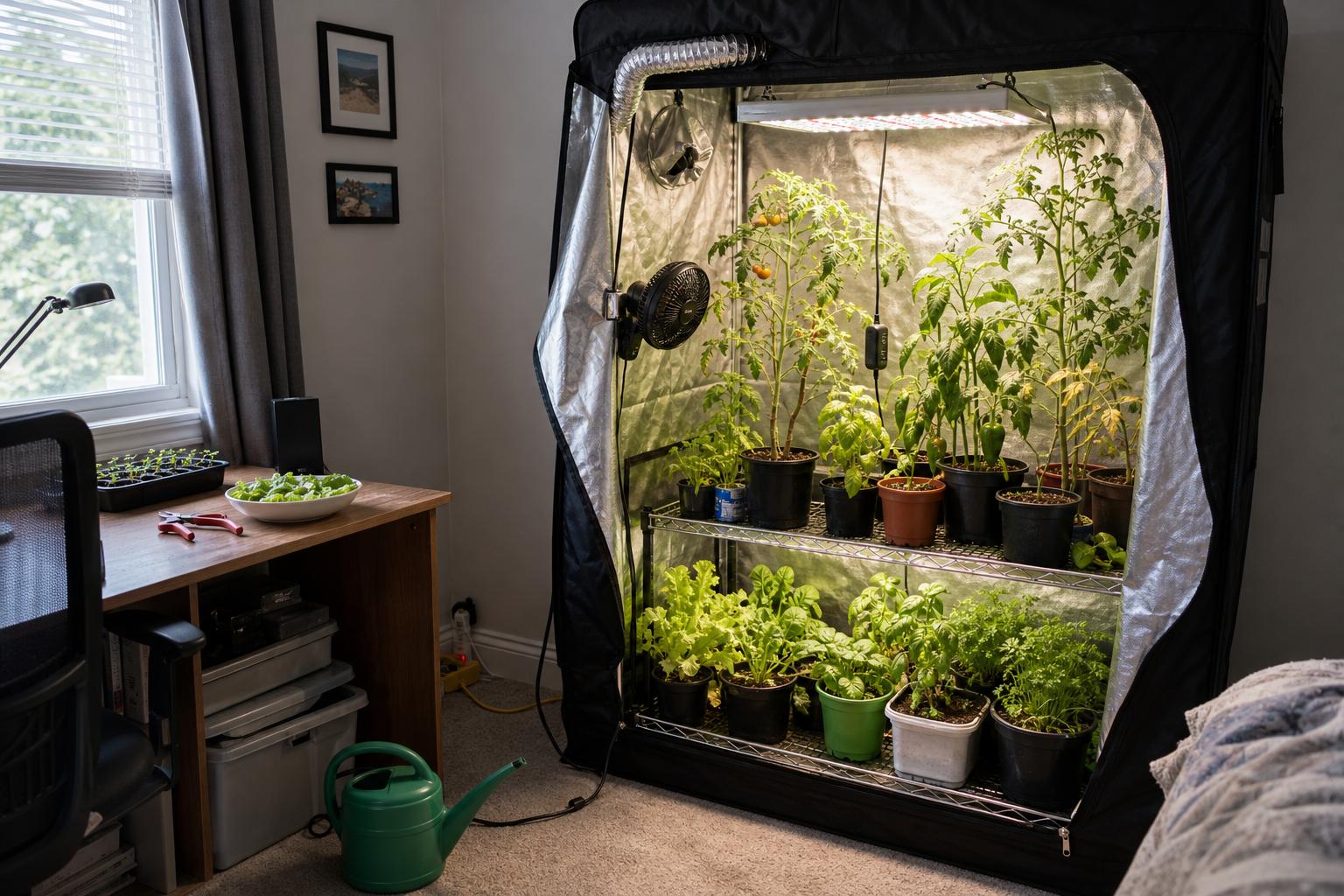
A mixed grow tent creates a temperature problem that is easy to overlook. Lettuce may be happiest in cool air, basil wants more warmth, and peppers often grow slowly if the space stays cool for too long. Put them under the same light and suddenly there is no perfect thermostat setting.
I have run into this more than once inside grow tents containing leafy greens, herbs, and a few fruiting vegetables. Trying to provide every plant with its ideal temperature usually leads to constant fan adjustments, extra equipment, and readings that still do not agree. A stable compromise is usually more useful than a perfect number that keeps changing.
Why One Perfect Temperature Does Not Exist
Temperature recommendations often look precise on a seed packet or chart. The problem is that each recommendation usually assumes the plant has its own growing area. Inside a shared grow tent, the plants experience the same general air but not necessarily the same amount of heat.
A lettuce plant directly beneath a light can have warmer leaves than a parsley plant near the tent wall. A pepper sitting above a warm driver may experience a different root temperature than basil on a lower shelf. Even though one sensor says 74°F, the plants are not all living at exactly 74°F.
Do not choose a grow tent temperature by averaging every ideal range you find. Instead, choose a range that prevents serious stress in the most sensitive plants while still allowing the others to grow reasonably well.
For a mixed edible grow tent, my preferred starting point is:
- 72°F to 76°F with the lights on
- 66°F to 70°F with the lights off
- No sudden change greater than about 10°F
This range is warm enough for basil, tomatoes, and peppers to keep growing, but not so warm that lettuce and many other leafy greens immediately become unhappy. It is a compromise, not an ideal setting for every crop.
How Common Edible Plants Respond
Leafy greens
Lettuce, spinach, arugula, kale, and many Asian greens generally prefer the cooler side of a grow tent. Lettuce is often the first plant to show that the shared space is too warm. It may stretch, develop softer growth, taste more bitter, or start preparing to flower.
I have noticed that lettuce can tolerate a warm afternoon better than it tolerates a grow tent that remains warm all night. A cooler lights off period gives leafy greens some relief, even when peppers and tomatoes occupy the same space.
Spinach is less forgiving. If spinach is an important crop, I would place it near a lower intake or grow it during a cooler room season rather than forcing the entire tent to match its preference.
Herbs
Basil enjoys warmth and can become sluggish in a tent held in the low 60s. Parsley, cilantro, mint, and chives are usually more comfortable at moderate temperatures. Cilantro, like lettuce, may flower early when it stays too warm.
In a mixed grow tent, put basil in the warmer upper area and place cilantro or parsley lower down or closer to incoming air. This small amount of plant placement often solves more than another controller does.
Tomatoes and peppers
Compact tomatoes and peppers generally prefer warmer conditions than leafy greens. They can still grow around 72°F to 76°F, although peppers may grow more slowly than they would in a warmer dedicated tent.
That is a tradeoff I accept. Raising the whole grow tent to suit peppers can reduce lettuce quality, increase water use, add heat to the room, and make the exhaust fan run louder. In an apartment or small home, slightly slower peppers are often more practical than an overheated tent and room.
Once tomatoes or peppers begin flowering, try to avoid cold nights. A lights off temperature below about 60°F can slow growth and interfere with reliable flowering, especially for peppers.
Your Sensor May Be Reporting the Wrong Temperature
One mistake I made early on was hanging a temperature sensor near the top of the grow tent because it was easy to see. The number looked useful, but it told me more about the warm air near the exhaust than the conditions around the leaves.
Measure where the active leaves are.
Place the main sensor around canopy height, near the center of the growing area, but not directly under the light. Shade the sensor from intense light if needed. Light can warm the sensor casing and produce a reading higher than the surrounding air.
Also keep the sensor away from:
- The direct stream of a circulation fan
- The cool air entering through an intake opening
- The tent wall, especially beside a cold window or warm appliance
- A humidifier outlet
- The warm exhaust area at the top of the tent
If the grow tent has upper and lower shelves, a second inexpensive sensor is worthwhile. I have seen several degrees of difference between shelves in a compact tent, even with a circulation fan running. That difference can be used intentionally, with warm loving basil above and cool loving greens below.
Lights and Airflow Can Hide the Real Problem
LED fixtures release less radiant heat than older grow lights, but they still warm a closed grow tent. Drivers mounted inside the tent add more heat. A reading taken just before the lights turn on will not tell you what the plants experience late in the light period.
Check the grow tent temperature at three useful times:
- About one hour after the lights turn on
- During the final few hours of the light period
- Near the end of the lights off period
This reveals the daily high, the nightly low, and the size of the swing. The pattern matters more than one convenient reading.
Airflow also changes what the sensor sees. A fan can make leaves lose heat and moisture faster, but it does not necessarily lower the air temperature. If a sensor sits directly in the fan stream, it may suggest that the tent is cooler and more stable than the sheltered foliage actually is.
Use a circulation fan to create gentle leaf movement throughout the grow tent. Do not blast the nearest lettuce plants in an attempt to cool the entire space. For actual heat removal, the exhaust system must exchange warm tent air with cooler room air.
Choose Stability Before Adding More Equipment
Where do most growers go wrong? They react to every temperature change at once. The exhaust speed goes up, the intake opens wider, the light gets dimmed, and the thermostat setting changes. Then there is no clear way to know which adjustment helped.
I prefer this simple process:
- Place the sensor correctly at canopy height and out of direct light.
- Record the lights on high and lights off low for two or three days.
- Set the exhaust to keep most lights on readings between 72°F and 76°F.
- Move cool loving crops toward the lower or incoming air side of the grow tent.
- Watch new growth before changing anything else.
If leafy greens still stretch or become bitter, lower the lights on target by two or three degrees, shorten their stay in the tent by harvesting younger, or separate them from mature fruiting plants. If peppers remain slow but healthy, give them time before raising the temperature for the entire grow tent.
Plant stage should influence the compromise. Seedlings need stability and should not sit in the hottest upper area. Established leafy greens can be harvested before large tomatoes create a crowded, humid canopy. Flowering peppers benefit from the warmer position closest to the light, provided their leaves are not overheating.
My practical next step would be to move the main sensor to shaded canopy height tonight, then record the highest lights on reading and lowest lights off reading for three days. If the grow tent stays near 72°F to 76°F by day and 66°F to 70°F at night, I would leave the controls alone and adjust plant placement first. Stable, acceptable conditions will grow more food than constant pursuit of a perfect temperature.


