
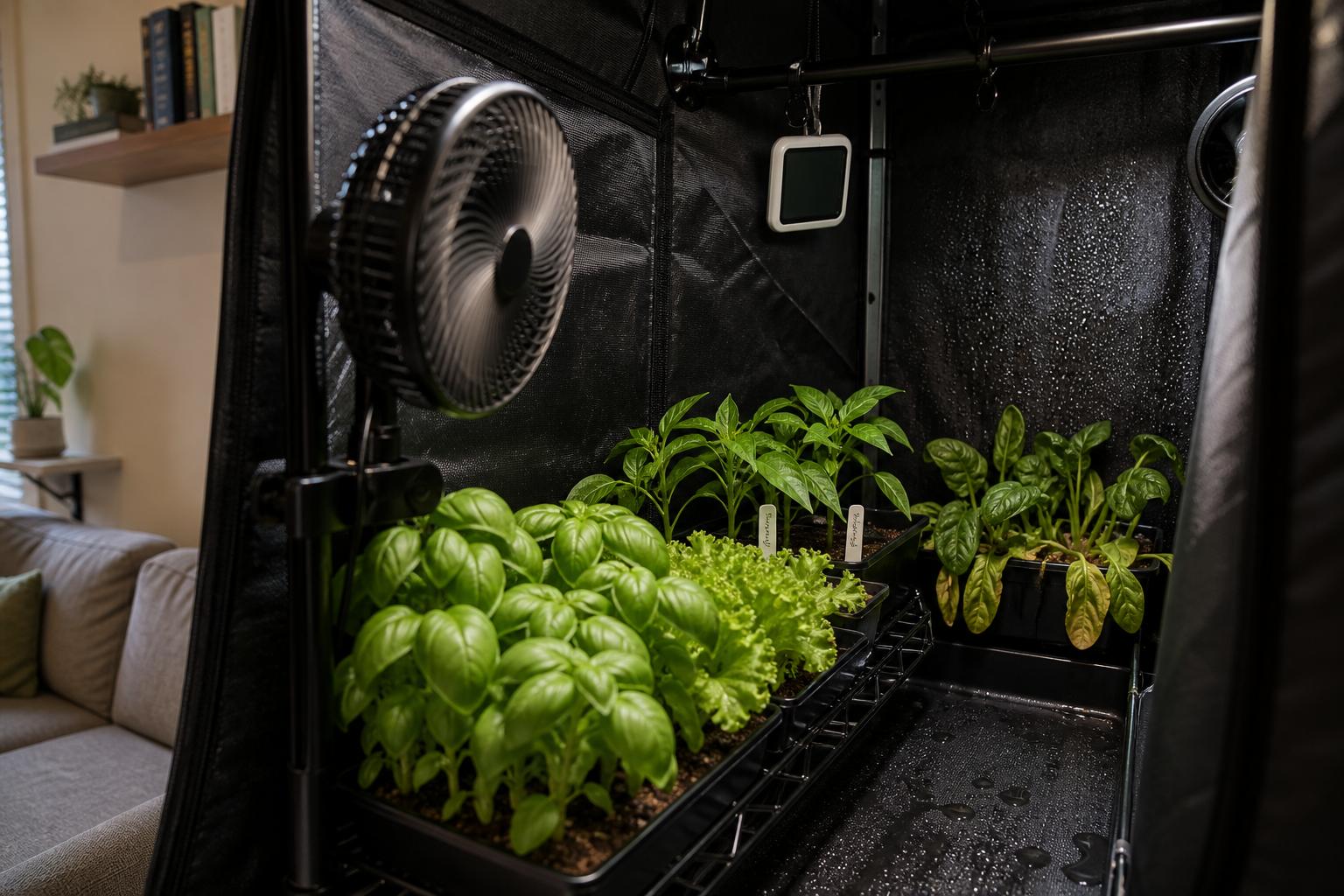
If you have ever opened your grow tent and felt good airflow near the center but stale heavy air in the back corners, you are not imagining it. I have had lettuce thrive in the middle of a grow tent while the outer spinach leaves in the corners stayed damp and slightly limp even though my fans were clearly running.
Grow tents create very specific airflow patterns. Even with an exhaust fan and two clip on circulation fans, it is surprisingly easy for the corners of a grow tent to become dead zones. The fix is usually not more power. It is better airflow direction.
What Is Actually Happening in the Corners of Your Grow Tent
Inside a grow tent, air rarely moves in straight lines. Your exhaust fan pulls air out from one point, usually near the top. Passive intake vents allow air in near the bottom. Circulation fans push air across the canopy.
That sounds like full coverage, but in reality most of the airflow forms circular loops. Air shoots across the center, hits the tent wall, rolls upward, and heads toward the exhaust. Meanwhile, the very corners of the tent can sit outside that main loop.
I first noticed this when I kept getting small patches of powdery mildew on basil leaves that sat in the back left corner of my grow tent. The rest of the plants were healthy. Humidity readings in the middle looked fine. But a small hygrometer I temporarily placed in that corner showed consistently higher humidity. The air simply was not moving there.
The grow tent walls make this worse. Unlike a room with furniture and open space, a grow tent is a tight fabric box. When airflow hits the wall, it tends to slide along it instead of pushing firmly into the corner seam. That seam becomes a pocket where moist warm air can sit.
The Most Common Fan Placement Mistakes That Create Corner Stagnation
Over the years I have made most of these mistakes myself.
Pointing All Fans Across the Center
This is the most common setup. One or two clip fans pointing straight over the plant canopy from opposite sides. It feels logical because you see leaves moving.
The problem is that the airflow collides in the middle and then rises. Very little of that air is redirected sharply into the bottom corners. You get strong movement where you can see it and still air where you cannot.
Aiming Fans Parallel to the Tent Walls
I used to mount a fan high and aim it straight along the side wall of the grow tent. It sounded good in theory. Sweep the warm air toward the exhaust.
What actually happened was a smooth stream of air hugging the wall and skipping right past the lower corner. My herb trays near that corner would dry slowly and stay slightly cooler. Not dramatic enough to cause failure, but enough to weaken growth over time.
Letting Dense Plants Block Air
This one shows up when tomatoes or peppers fill most of the grow tent. Large leaf canopies act like solid barriers. The fans may be moving air, but the lower leaves and the corners behind those plants are shielded.
I have seen mild tip burn on corner lettuce simply because the nearby pepper plant blocked airflow to that area.
How to Diagnose Corner Dead Air Without Special Equipment
You do not need smoke machines or expensive monitors. Here are practical ways I check inside a grow tent.
Use Your Hand
After the fans have been running for at least ten minutes, slide your hand into each corner at plant level. Not near the top. Down where leaves are sitting.
If your skin barely feels movement, that is a stagnant zone.
Watch Leaf Behavior
Healthy circulation produces a gentle continuous leaf movement. Not violent shaking. Just a slight flutter.
If leaves in the center of your grow tent are swaying but corner leaves are perfectly still, airflow is uneven.
Check Dry Down Speed
When watering leafy greens in containers, notice which pots stay wet longest. If the back corners dry a full day slower than the center, that often signals less airflow.
I learned this after overwatering a corner tray of arugula several times. I thought I had a drainage issue. The real issue was stagnant air slowing evaporation.
Practical Fixes That Eliminate Stagnant Corners Without Adding More Power
Most people assume they need a bigger exhaust fan. In a small apartment, more power usually means more noise and more heat pulled through the tent. That is rarely necessary.
Angle One Fan Into a Corner on Purpose
Instead of pointing all fans across the center, dedicate one small clip fan to a problem corner. Aim it diagonally so the airflow hits the corner seam and bounces back into the tent.
What worked better for me was placing a fan slightly below canopy level and angling it upward into the back corner. That disrupted the stagnant pocket and blended it into the main airflow loop.
Stagger Fan Heights
If both fans sit at the same height, you create one strong horizontal stream.
Try placing one fan at canopy level and another lower, closer to the pots. In grow tents packed with leafy greens, this helps move humid air that sits near the soil surface into circulation.
This small change improved airflow around my lower kale leaves without increasing fan speed.
Create a Gentle Circular Pattern
Instead of opposing fans blasting toward each other, aim them so they encourage a slow circular motion around the perimeter.
Think of it as guiding air along the edges of the grow tent, not just across the center. The goal is even mixing, not maximum wind.
Open Lower Growth Strategically
With tomatoes, peppers, or large basil plants, thin a few inner leaves that press against tent walls. You do not need heavy pruning. Just prevent dense leaf mats from sealing off corners.
This is especially important in smaller grow tents where space is tight and plants naturally crowd the fabric walls.
Rotate Plants Periodically
In compact grow tents, airflow patterns stay consistent day after day. I rotate leafy green trays every week or two so no single crop lives permanently in a weaker airflow zone.
It is a simple habit that reduces subtle stress differences.
A Practical Tradeoff to Keep in Mind
Stronger airflow lowers humidity and reduces disease, but too much direct wind can stress tender greens. I prefer solving corner stagnation with smarter positioning rather than higher fan speed.
In my experience, a moderate exhaust speed combined with thoughtful circulation placement produces healthier herbs and lettuce than blasting everything at maximum power. It keeps noise reasonable for apartment living and avoids drying out leaf edges.
What I Would Check First in Your Grow Tent
If you suspect stagnant corners, do one thing tonight. Open your grow tent, let everything run for ten minutes, and put your hand deep into each lower corner at plant level.
If you feel almost nothing, do not touch the exhaust fan. Reposition one circulation fan so it directly disrupts that space. Angle it into the corner instead of across the middle.
That single adjustment solves the vast majority of corner airflow problems I see in home grow tents, and it does it without adding noise, heat, or extra equipment.
Healthy airflow is not about force. It is about coverage. Once every corner of your grow tent has some gentle movement, your vegetables and herbs respond quickly.


