
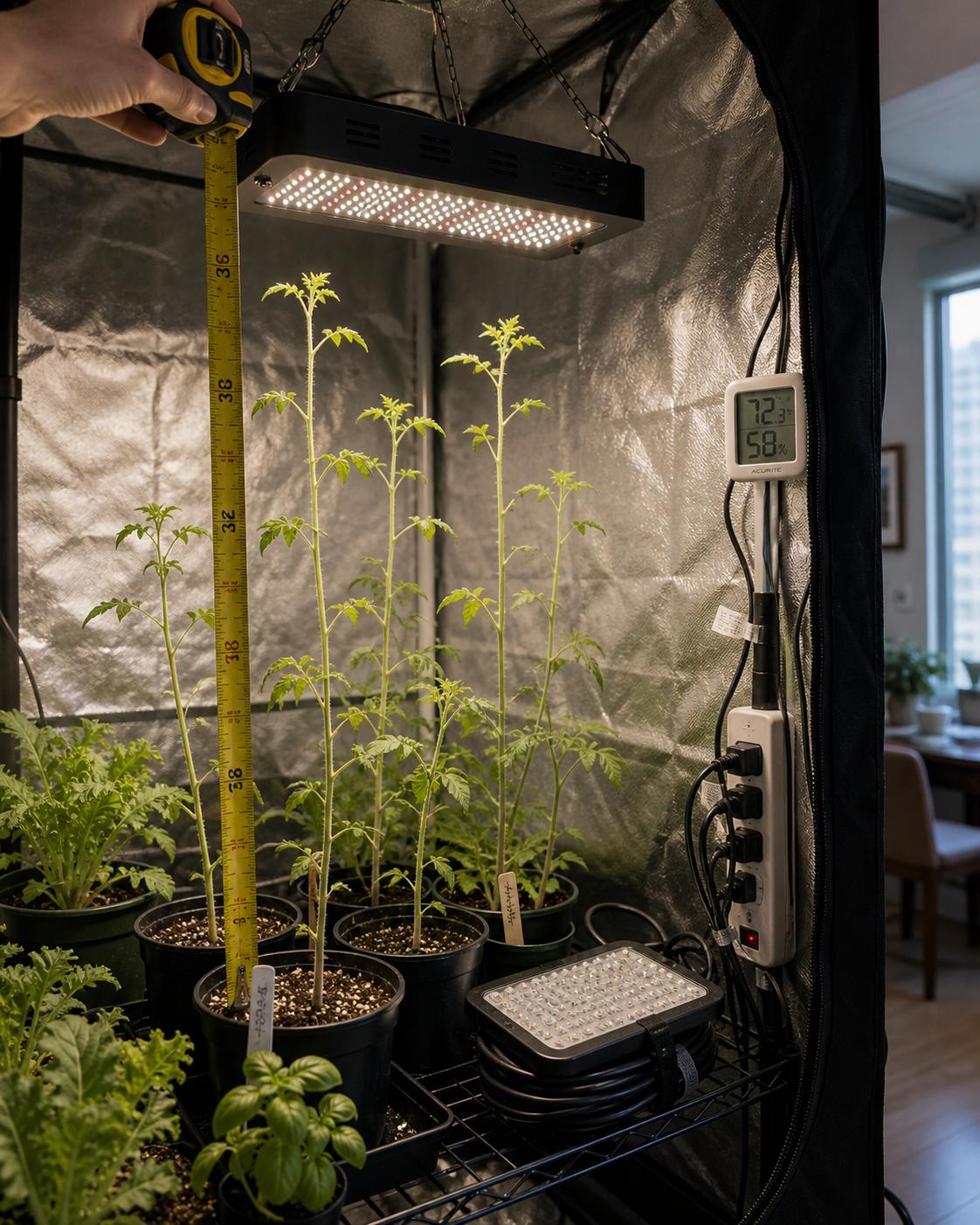
You set up a powerful light in your grow tent. The wattage looks more than enough for lettuce, peppers, or herbs. The packaging promises full spectrum coverage. Yet your plants are still stretching tall and thin like they are reaching for something.
If you are growing inside grow tents in an apartment or small home, this can be frustrating. You are already working with limited vertical space. When tomatoes or basil start stretching, they quickly outgrow your usable height and become harder to manage. In my experience, the issue is rarely a lack of total power. It is almost always about how that light is positioned and distributed over the canopy.
Why Stretching Happens in a Fully Lit Grow Tent
When plants stretch inside a grow tent, they are reacting to light intensity at leaf level, not the number printed on the box.
Stretching is simply a plant trying to get closer to what it thinks is better light. I have seen this happen even under high wattage LED panels because the top leaves were receiving strong light while the lower canopy sat in relative shade.
In a grow tent environment, light behaves differently than people expect. The reflective walls help, yes, but reflective fabric does not magically fix uneven distribution. If most of the intensity is concentrated in the center of the tent, plants near the edges or lower in the canopy may stretch upward toward that brighter zone.
Lettuce will grow taller and looser. Basil will space out its nodes. Pepper seedlings will become spindly instead of stocky. It is not about total brightness in the tent. It is about even, consistent intensity where the leaves actually live.
The Hidden Role of Fixture Height and Light Distribution
Fixture height inside a grow tent changes more than people realize.
One mistake I made early on was hanging my LED panel too high because I was worried about heat and leaf burn. The tent looked bright to my eyes. The plants still stretched. It took me a while to realize that raising the fixture reduced intensity dramatically at canopy level.
When a light is too high in a grow tent, three things happen:
1. Intensity drops at the canopy
Even a strong light loses usable intensity as you increase the distance. Your plants respond by reaching upward.
2. The center gets strong light, the edges do not
In smaller grow tents, especially 2 by 2 or 2 by 4 spaces, a single fixture often creates a hotspot in the middle. Plants near the walls receive less direct light even with reflective fabric.
3. The lower canopy is shaded by upper growth
Inside a tent, vertical stacking happens fast. Once tomatoes or peppers start stretching, the top leaves block light from lower growth, which encourages even more stretching upward.
Lowering the light slightly often produces shorter, sturdier growth almost immediately. You can usually see the difference in new growth within a week.
Common Lighting Mistakes That Encourage Weak Vertical Growth
I see a pattern in grow tent setups where plants stretch despite having strong lights. It usually comes down to one of these.
Hanging the Light Based on Fear Instead of Observation
People are afraid of leaf burn, so they hang the fixture high. In reality, most modern full spectrum LEDs designed for vegetables and herbs can sit closer than beginners think, especially during vegetative growth.
If your lettuce leaves are pale and thin and your basil stems are long and flexible, your light is probably too far away, not too close.
Using One Small Fixture to Cover the Whole Tent
In larger grow tents like 4 by 4, relying on a single compact fixture often leads to uneven coverage. The center thrives. The corners stretch.
In my experience, two smaller fixtures spaced evenly give better results than one powerful light in the middle. The distribution is smoother, and plants grow more uniformly across the entire canopy.
Letting Plants Grow at Different Heights
This is a big one in mixed vegetable tents. If you grow leafy greens next to peppers or tomatoes, the taller plants will eventually shade the shorter ones. The shaded plants respond by stretching.
I learned this after trying to grow cilantro, lettuce, and indeterminate cherry tomatoes in the same grow tent without managing height. The tomatoes won. Everything else leaned and stretched toward whatever light slipped through.
How I Stabilize Canopy Height and Light Intensity for Compact Growth
Over time, I stopped chasing higher wattage lights and started focusing on canopy control inside my grow tents.
Step 1: Adjust the Light to the Plants, Not the Tent
I keep my LEDs closer during early growth than I used to. Not extremely close, but closer than the conservative charts often suggest.
If I see tight node spacing and sturdy stems, I know the distance is right. If I see vertical stretching, I lower the fixture slightly and monitor new growth. Small changes make a noticeable difference.
Step 2: Create an Even Canopy
This matters more inside a grow tent than in an outdoor garden because your light source is fixed overhead.
I use simple plant risers, overturned trays, or sturdy containers to lift shorter plants up so the canopy is relatively flat. For tomatoes and peppers, I prune and train early to prevent them from dominating the entire vertical space.
The goal is to keep most leaf surfaces at a similar distance from the light. When the canopy is even, plants stop competing vertically.
Step 3: Spread the Light Instead of Overpowering It
If your budget and space allow, consider multiple moderate fixtures instead of one intense center panel.
In a small apartment grow tent, this approach also spreads heat more evenly. That keeps leaf temperature stable and reduces the need to run fans at higher speeds, which helps with noise in a living space.
I prefer balanced coverage over maximum intensity. Compact growth comes from consistency, not extremes.
Step 4: Watch New Growth, Not Old Stretch
Once a stem stretches, it will not shrink back. Focus on how new leaves and internodes develop after you adjust the setup.
If basil starts producing tighter clusters of leaves and your lettuce heads begin forming denser centers, you fixed the real problem inside your grow tent.
What I Would Check First in Your Grow Tent
If your vegetables or herbs are stretching even though your light seems strong, here is where I would start.
First, lower the fixture a small amount and observe new growth for seven to ten days.
Second, look at your canopy from the side. Is it flat, or are some plants towering over others? Level it out using risers or pruning.
Third, check the edges of your grow tent. If plants near the walls are consistently taller and thinner, your light spread is uneven. Adjust fixture placement or add supplemental lighting rather than just increasing power.
Most of the time, stretching inside grow tents is not a lack of light. It is a lack of well distributed, properly positioned light at the canopy.
If I had to choose one action to take today, I would start by lowering the light slightly and evening out the canopy. Those two changes alone have fixed more stretching problems in my grow tents than buying a more powerful fixture ever did.


