
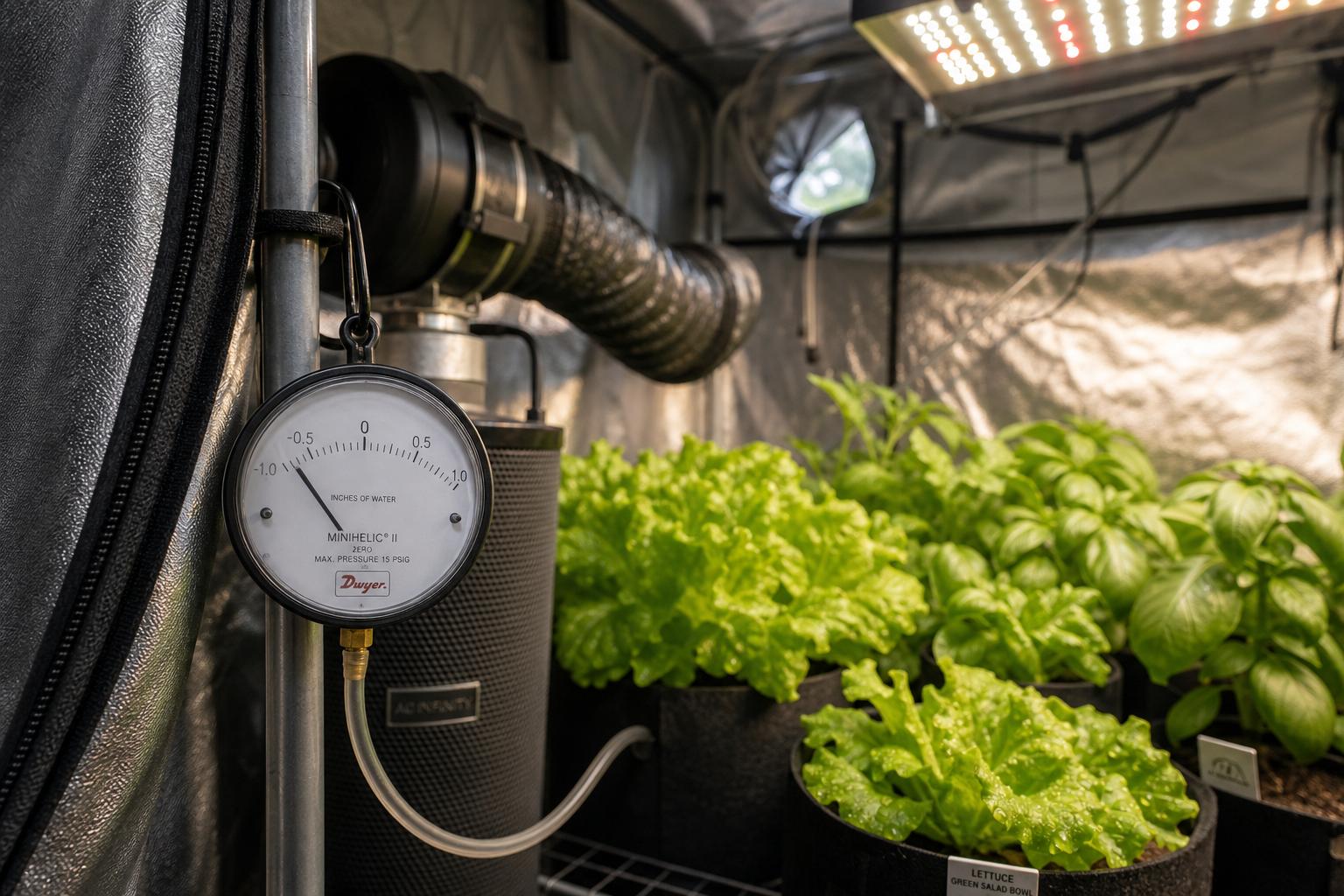
If your grow tent suddenly balloons outward with lights off or sucks inward harder when lights turn on, you are not alone. Pressure instability inside grow tents almost always shows up during light transitions, and it confuses a lot of growers because nothing about the fan setup changed. Or at least it seems that way.
In reality, your grow tent changes more during a light cycle than most people realize. The air behaves differently. The heat load shifts. The density of the air changes. And that directly affects how your inline fan pulls and maintains negative pressure.
I have noticed over the years that growers tend to blame fans first. They upgrade exhaust systems, add booster fans, or seal every possible opening. Most of the time, the real issue is not fan power. It is how heat inside the grow tent quietly changes airflow behavior.
What Actually Changes Inside Your Grow Tent When Lights Switch On
When your lights turn on inside a grow tent, you are not just adding brightness. You are adding thermal load. Even efficient LEDs raise the air temperature several degrees within minutes.
As air warms, it becomes less dense. Less dense air behaves differently when being pulled through ducting and carbon filters. Your exhaust fan is rated at a certain cubic feet per minute under specific conditions. Those ratings assume a certain air density. When the air heats up, the resistance profile shifts.
What surprised me most when I first started testing this was how quickly pressure changes. Within ten minutes of lights on, my tent walls would pull inward more aggressively. Same fan speed. Same intake ports. The only difference was heat.
Now reverse that. When lights shut off, the air cools fast. Cooler air is denser. Denser air changes how easily your fan can move it. Often, negative pressure weakens slightly. In some setups, the grow tent can even lose that slightly sucked in wall appearance.
This is not random. It is physics interacting with your ventilation system.
How Heat Load Quietly Disrupts Negative Pressure
Negative pressure inside a grow tent depends on one simple rule. You must remove slightly more air than you allow in.
But heat converts that simple rule into a moving target.
When lights are on:
- Air expands and becomes lighter
- Hot air rises toward the top of the grow tent
- Exhaust systems mounted high pull warmer air more aggressively
- Passive intake openings may not keep up evenly
When lights are off:
- Air cools and contracts
- Air density increases
- Airflow slows slightly through carbon filters
- Negative pressure may soften
In my experience, the biggest pressure swings happen in grow tents where the exhaust fan runs on a temperature controller. When heat rises, the fan ramps up. When temperature drops, it ramps down. That automatic adjustment sounds ideal, but it often creates inconsistent negative pressure.
One mistake I see often is growers tuning their grow tent airflow during lights on, getting perfect negative pressure, then ignoring what happens when lights turn off. If odor control matters, that is a problem.
A Simple Diagnostic Flow to Confirm Pressure Instability
Before adjusting anything, confirm that your pressure instability truly connects to light cycles.
Step 1. Observe Wall Behavior
Close your grow tent completely. Watch the tent walls during lights on for at least thirty minutes. Then observe again thirty minutes after lights off. If wall tension visibly changes, you have heat driven airflow shifts.
Step 2. Check Fan Speed Consistency
If you use a controller, verify whether the exhaust fan changes speed between cycles. Many growers forget their controller is compensating for temperature swings. I learned this after chasing what I thought was a leak in my grow tent fabric. It was just the fan ramping down at night.
Step 3. Test With Manual Constant Speed
Run your grow tent exhaust at a fixed speed for a full light cycle. If pressure becomes more stable, your issue is not airflow capacity. It is automatic fluctuation.
Step 4. Inspect Passive Intake Behavior
Look at your lower intake flaps or mesh ports. When lights are on and the tent heats up, do they pull wide and steady? Or do they flutter? Fluttering usually signals inconsistent pressure balance inside the grow tent.
Stabilizing Pressure Without Adding More Fans
I rarely recommend adding more equipment to fix this problem. In most grow tents, stability comes from balance, not brute force.
1. Set a Baseline Constant Exhaust Speed
If odor control and pressure consistency matter, I prefer running the exhaust fan at a steady minimum speed twenty four hours a day. Instead of letting temperature spikes dictate speed changes, I set a speed that maintains stable negative pressure even during lights off.
The tradeoff is slightly higher energy use. But the consistency is worth it. Stable pressure equals stable odor control.
2. Adjust Passive Intake Area
Instead of increasing exhaust power, experiment with intake size. Slightly enlarging passive intake openings can reduce dramatic inward wall pull during lights on while preserving negative pressure.
I eventually realized that overly restricted intakes amplify pressure swings inside a grow tent. Heat increases exhaust effectiveness, but restricted intake cannot compensate smoothly.
3. Keep Duct Runs Short and Straight
This matters more when air density changes. Longer or sharply bent ducting increases resistance. When lights turn off and air becomes denser, that resistance has a more noticeable effect. Shortening duct runs can make airflow more predictable across temperature shifts.
4. Avoid Overreacting to Slight Wall Movement
Not every shift is a problem. Grow tents are flexible structures. Minor wall movement between cycles is normal. I only intervene when pressure visibly collapses or balloons outward.
Common Grow Tent Mistakes That Make This Worse
Chasing Temperature Instead of Pressure
Some growers prioritize perfect temperature tracking and let their exhaust constantly fluctuate. That creates unstable negative pressure inside the grow tent. Slight temperature swings are less harmful than inconsistent ventilation balance.
Oversizing the Exhaust Fan
An oversized fan running at very low variable speeds often exaggerates pressure swings. A properly sized fan running at consistent moderate speed is smoother.
Sealing Every Intake Completely
I have seen growers tape shut lower vents thinking it increases odor control. In reality, it forces air to enter unpredictably through zipper seams or micro gaps, especially when air density changes at lights off.
FAQ About Grow Tent Pressure and Light Cycles
Should negative pressure look identical during lights on and off?
No. Small visual differences are normal because heat changes air properties inside the grow tent. Focus on stability, not identical appearance.
Does adding an intake fan fix pressure instability?
Usually not. Active intake can complicate balance unless carefully matched to exhaust flow. I only use intake fans in larger grow tents where passive intake area is insufficient.
Is this problem worse in small grow tents?
Yes. Smaller grow tents change temperature faster when lights switch. Faster thermal swings mean faster airflow shifts.
Once you understand that heat load is directly influencing airflow behavior inside your grow tent, the problem feels much less mysterious. Instead of adding equipment, focus on consistency. Stable exhaust speed, balanced intake area, and reasonable expectations will keep your grow tent pressure steady through every light cycle.


