
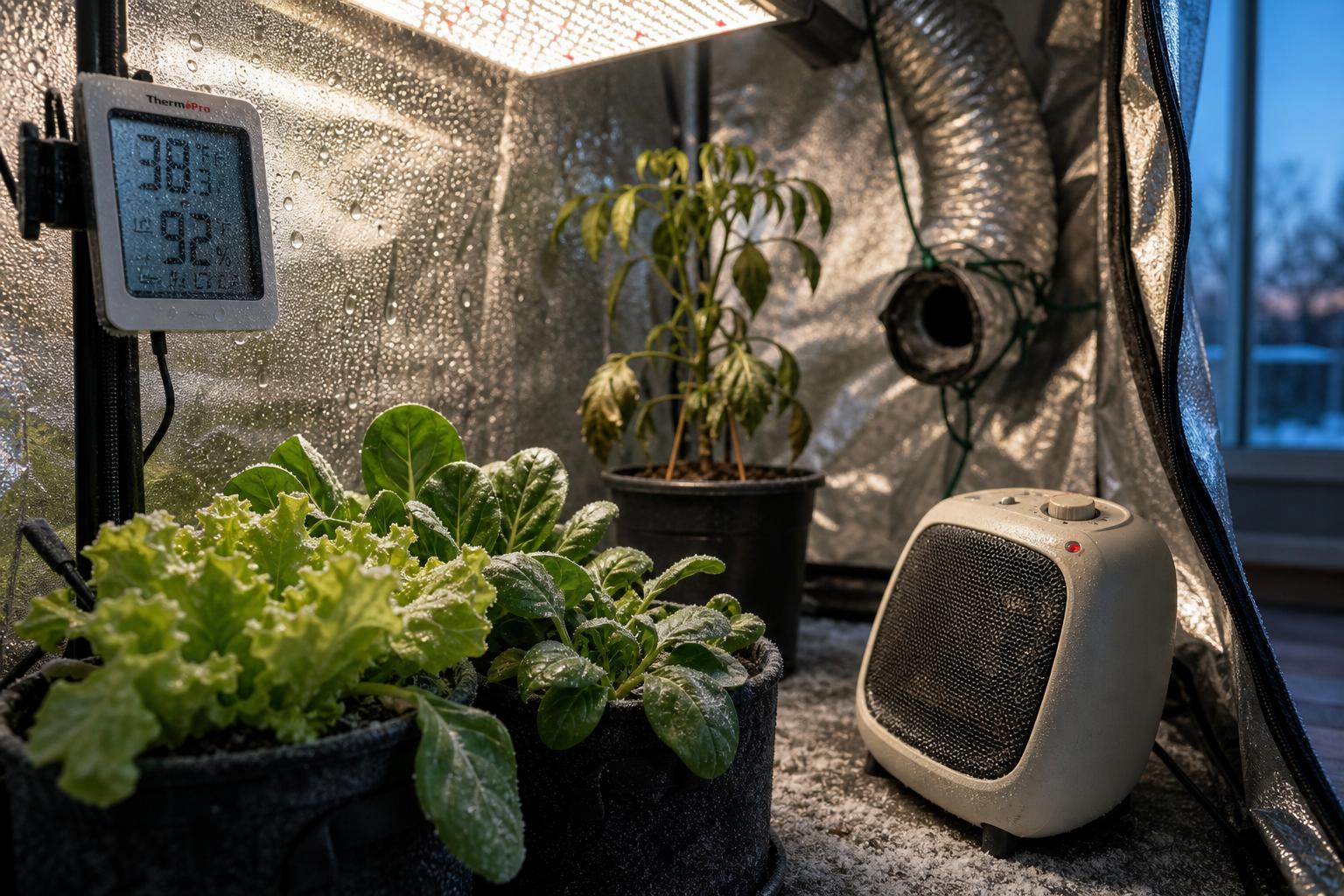
If you run a grow tent year round, winter will test your setup in ways summer never did. I have noticed that the same configuration that felt perfectly stable in October suddenly behaves unpredictably in January. Humidity drops faster. Pressure feels inconsistent. Temperature swings widen even when your equipment has not changed.
The most important thing to understand is that a grow tent does not exist in isolation. It is constantly reacting to the room it pulls air from. In winter, that room changes dramatically. Cold intake air, indoor heating systems, and subtle pressure shifts all combine to make your grow tent behave differently than you expect.
The Hidden Winter Variables Most Growers Do Not Account For
Inside grow tents, we focus heavily on temperature and relative humidity readings. What we forget is that winter air carries less moisture and behaves differently under pressure. When your grow tent pulls in air from a heated house, that air has usually been dried out by the heating system long before it reaches your intake.
In my experience, the biggest surprise for growers is how aggressively humidity collapses when lights turn on in winter. In summer, you might see a gentle drop. In winter, I have seen a grow tent fall from 60 percent to 40 percent in under an hour.
Another overlooked variable is how often HVAC systems cycle. When your home furnace turns on, it can slightly alter room pressure. Your grow tent exhaust fan reacts immediately, even if you cannot feel anything in the room.
How Cold Intake Air Disrupts Humidity and Pressure Balance
Cold air entering a grow tent during winter does two things at once. First, it lowers the overall moisture carrying capacity of the environment. Second, once that cold air warms inside the grow tent under your lights, relative humidity drops sharply.
One mistake I see often is growers turning up their humidifier aggressively to compensate. The result is a constant spike and crash pattern. The humidifier overshoots when lights are off, then underperforms when lights are on.
I learned this after overcorrecting one winter. I increased humidifier output to maintain 55 percent humidity with lights on. At night, humidity inside my grow tent climbed into the high 70s because the air temperature fell but moisture remained. That created condensation risk on tent walls and ducting.
Instead of increasing output dramatically, I now do three things inside my grow tent:
- Lower exhaust fan speed slightly during lights on to reduce dry air exchange.
- Use a humidifier with stable continuous output instead of mist bursts.
- Match intake airflow more precisely so negative pressure is present but not excessive.
The goal is controlled exchange, not maximum exchange. In winter, too much airflow is usually the hidden problem inside grow tents.
The Stack Effect Inside a Grow Tent During Winter
What surprised me most the first winter I ran larger grow tents was temperature layering. Warm air rises quickly inside an enclosed space. In summer this effect is mild because intake air is closer to grow tent temperature. In winter the intake air is much colder, which exaggerates vertical gradients.
I have measured a 6 degree difference between canopy height and floor level inside a grow tent during winter. That difference was only 2 degrees during summer using the same equipment.
This happens because cold intake air pools near the bottom while lights heat the upper zone. Your exhaust fan pulls from the top, so it removes the warmest air first. The lower zone never fully stabilizes.
Inside grow tents, this layering can cause root zone cooling even when canopy temperatures look fine. If your sensor sits too high, you will never see the imbalance.
The solution is not simply increasing heater output. That often makes the top of the grow tent hotter while the bottom stays cool.
Instead:
- Place one temperature probe at canopy level and one closer to pot height.
- Increase internal air circulation with an additional clip fan aimed across the lower third of the grow tent.
- If needed, pre warm intake air slightly by drawing it from a warmer part of the room rather than directly from near a cold window or floor.
In my experience, improving internal mixing solves stratification more effectively than adding more heat.
A Simple Winter Stabilization Plan That Actually Works
After several winters adjusting grow tents, I eventually realized that stability comes from smaller changes, not stronger equipment. Here is the winter reset plan I now follow.
Step 1 Reduce Exhaust to the Minimum Effective Level
Inside grow tents during winter, continuous high exhaust rates create unnecessary dryness and pressure volatility. Dial the fan down until negative pressure is just visible on the tent walls. Do not aim for maximum air exchange unless odor control demands it.
Step 2 Stabilize Humidity Before Raising Temperature
Dry air amplifies every other fluctuation. I set my humidifier to maintain a moderate steady level during lights on and accept a slight rise during lights off. Trying to maintain identical readings day and night inside a grow tent often leads to overcorrection.
Step 3 Improve Air Mixing Inside the Grow Tent
Add internal circulation before adding heaters. Most winter instability inside grow tents is a mixing problem disguised as a heating problem.
Step 4 Evaluate Intake Location
If your grow tent pulls air from near a drafty window or directly above a cold floor, relocate the intake source within the room. I have seen a simple change in duct position eliminate repeated temperature dips.
Troubleshooting Winter Instability in a Grow Tent
Humidity Drops Fast When Lights Turn On
Check exhaust speed first. If humidity crashes within thirty minutes, intake air is likely too dry and exchange rate too high. Reduce airflow before increasing humidification.
Condensation on Tent Walls at Night
This usually means daytime humidification is too aggressive. Dial back output and allow a slightly lower daytime target. Inside grow tents, preventing moisture buildup is more important than chasing exact numbers.
Top of Grow Tent Warm Bottom Cool
Add lower level air circulation. Verify with two sensors at different heights. Increasing heater power alone rarely fixes vertical imbalance.
Pressure Fluctuates When Home Heating Turns On
This indicates your grow tent is sensitive to room pressure changes. Slightly reducing exhaust speed often smooths these fluctuations. Some growers add intake fans, but in my opinion that complicates tuning during winter.
A Final Perspective From Years of Winter Growing
I prefer running slightly lower airflow inside grow tents during winter rather than trying to overpower dry air with larger humidifiers. The tradeoff is that odor control margins shrink slightly, but environmental stability improves significantly.
Winter does not require a completely different grow tent system. It requires understanding that the air feeding your tent behaves differently. Once you manage intake dryness, slow your exhaust, and improve internal mixing, most winter issues settle down without drastic equipment upgrades.
The key lesson I learned is this. In winter, instability inside a grow tent is usually caused by overcorrection. Slow the system down, balance it carefully, and let small adjustments do the work.


