
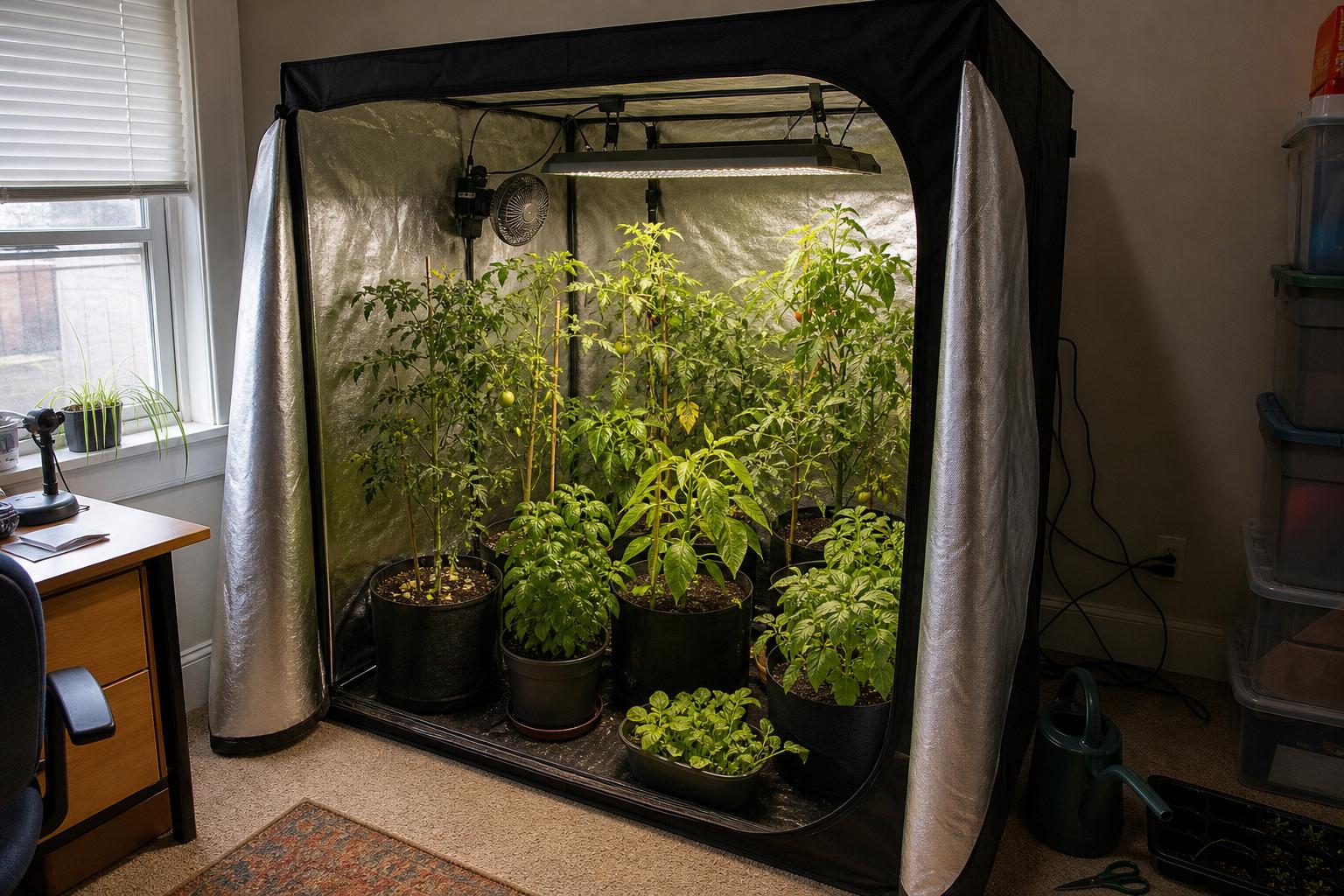
A 4 x 4 grow tent gives you 16 square feet of floor space, but that does not mean you have 16 square feet available for vegetable plants. Pots, fans, tent walls, watering access, and uneven light all take a share.
I learned this after filling an early grow tent with as many containers as I could physically place on the floor. Everything fit when the plants were young. A few weeks later, pepper branches were pressed against the walls, lettuce was shaded, and reaching the back pots required moving half the tent. The problem was not the tent size. I had counted containers instead of mature plants.
Why Floor Space Gives You the Wrong Plant Count
A four by four floor can hold plenty of small nursery pots. That is not a useful measure of growing capacity because the leaves above those pots will eventually spread much farther than the containers.
The mature canopy is the space that matters most. A pepper in a small container may still develop a canopy close to two feet across. An indeterminate tomato can occupy half the grow tent even when trained vertically. Basil can turn into a small shrub under consistent indoor lighting.
The tent edges are not always fully usable either. Leaves touching the fabric collect moisture and restrict air movement. Corner plants may receive less light, particularly if the fixture has a bright center and weaker edges. I usually treat the outer few inches as breathing room rather than productive canopy.
Equipment reduces the usable area further. A floor fan, humidifier, drainage tray, sensor, or intake opening can displace a pot. Packing in another plant often creates more heat and humidity too, which may require faster fans or more dehumidification. In an apartment, that means more noise, electricity use, and heat entering the room.
Calculate Capacity From Mature Plant Size
Start by measuring the area that your grow light covers well at the height you plan to use. Do not rely only on the fixture description. Some lights advertised for a 4 by 4 grow tent provide acceptable edge coverage for leafy growth but struggle to support fruiting peppers or tomatoes around the perimeter.
Next, estimate the mature width of each plant inside your tent. Pruning and training affect this number, so base it on how you actually intend to manage the crop. A regularly pruned pepper might be kept around 18 to 22 inches wide. An untrained one can become considerably broader.
Divide the usable tent width by the planned canopy width, then round down. Do the same for the depth. If you reserve a roughly 40 inch square canopy area and allow about 20 inches per pepper, you can arrange two plants across and two plants deep. That gives you four peppers, not the nine containers that might fit on the floor.
Use the larger of the canopy footprint and container footprint. A wide growing tub may limit capacity even when the crop stays narrow. Include saucers and enough room to lift or rotate a container without scraping neighboring plants.
This calculation is a starting point rather than a promise. Tomatoes and cucumbers can be trained onto a flat trellis, giving each plant a rectangular section of canopy. Lettuce and compact herbs can be placed closer because their leaves remain lower and are harvested before they become large.
Leave Room for Airflow and Maintenance
One mistake I see often is leaving space for a fan but no clear path for its air. When leaves form a solid wall, the fan moves the nearest leaves while the center of the canopy remains still. In my experience, crowded grow tents develop damp pockets around overlapping leaves long before the humidity reading near the tent roof looks alarming.
A little visible space between mature plants is useful. You do not need wide empty aisles, but you should be able to see some separation between canopies and feel gentle air movement below and through the leaves.
Access matters just as much. Many 4 by 4 grow tents have side doors, but those doors may be blocked by a wall, shelf, or furniture in a small home. Plan the layout around the openings you can actually use.
You should be able to reach every pot without bending stems. If the tent only opens from the front, keep taller permanent plants at the back and place smaller containers at the front. Lightweight trays can be lifted out during watering. Avoid putting a large trellis in front of crops that need frequent harvesting.
I prefer growing one or two fewer plants rather than filling every gap. The modest loss in theoretical capacity is usually repaid through easier pruning, better light penetration, faster pest inspections, and fewer spills on the floor.
Practical Layouts for Different Vegetable Crops
Large tomatoes or cucumbers
For indeterminate tomatoes or vigorous cucumbers, plan on two large plants in a 4 by 4 grow tent. Train them vertically and give each plant roughly half the trellis. Four may fit while young, but they require persistent pruning and can quickly create a dense ceiling of leaves under the light.
Compact determinate tomatoes are different. Four compact plants can work if their mature size truly remains controlled and the light reaches all four corners. Check the variety description rather than assuming every plant labeled compact will stay tiny indoors.
Peppers and eggplants
Four pepper plants are my practical preference for this tent size. Four compact eggplants can also work. Six smaller plants may be possible with careful pruning and strong light coverage, but watering and inspection become less convenient. For an ordinary home grower, four healthier plants are usually more productive and less frustrating than six crowded ones.
Lettuce, spinach, and compact herbs
A 4 by 4 grow tent can usually support 12 to 16 heads of lettuce or similarly compact leafy plants, depending on harvest size. Baby leaf crops can be planted more densely in shallow trays because they are harvested early. Full heads need enough separation to avoid forming a wet mass of overlapping leaves.
Parsley, cilantro, and small basil plants can use similar spacing at first, but mature basil needs much more room. I have noticed basil is frequently underestimated because it looks so manageable at the seedling stage. If you plan to keep harvesting the same plant, allow it the space of a small pepper.
A mixed food tent
A useful mixed layout is two peppers or compact tomatoes at the back with six to eight lettuce plants or small herbs in movable containers across the front. The leafy crops can be harvested and replaced while the fruiting plants mature.
Keep an eye on shading. Once the rear plants spread, the front greens may need to move toward the brighter side of the grow tent. This layout produces variety, but it requires more adjustment than growing one crop with one canopy height.
Make the Final Count Before Planting
Place empty containers in the grow tent before starting seeds. Add the fan, drainage trays, trellis, and any other equipment you expect to use. Then check whether you can reach the rear pots, open the tent, and remove runoff without shifting the entire layout.
If the arrangement already feels awkward with empty containers, remove one. That is the first change I would make. Plan for the mature tent, not the exciting first week. For most growers, that means two large vining plants, four medium fruiting plants, or 12 to 16 compact leafy plants in a 4 by 4 grow tent.


