
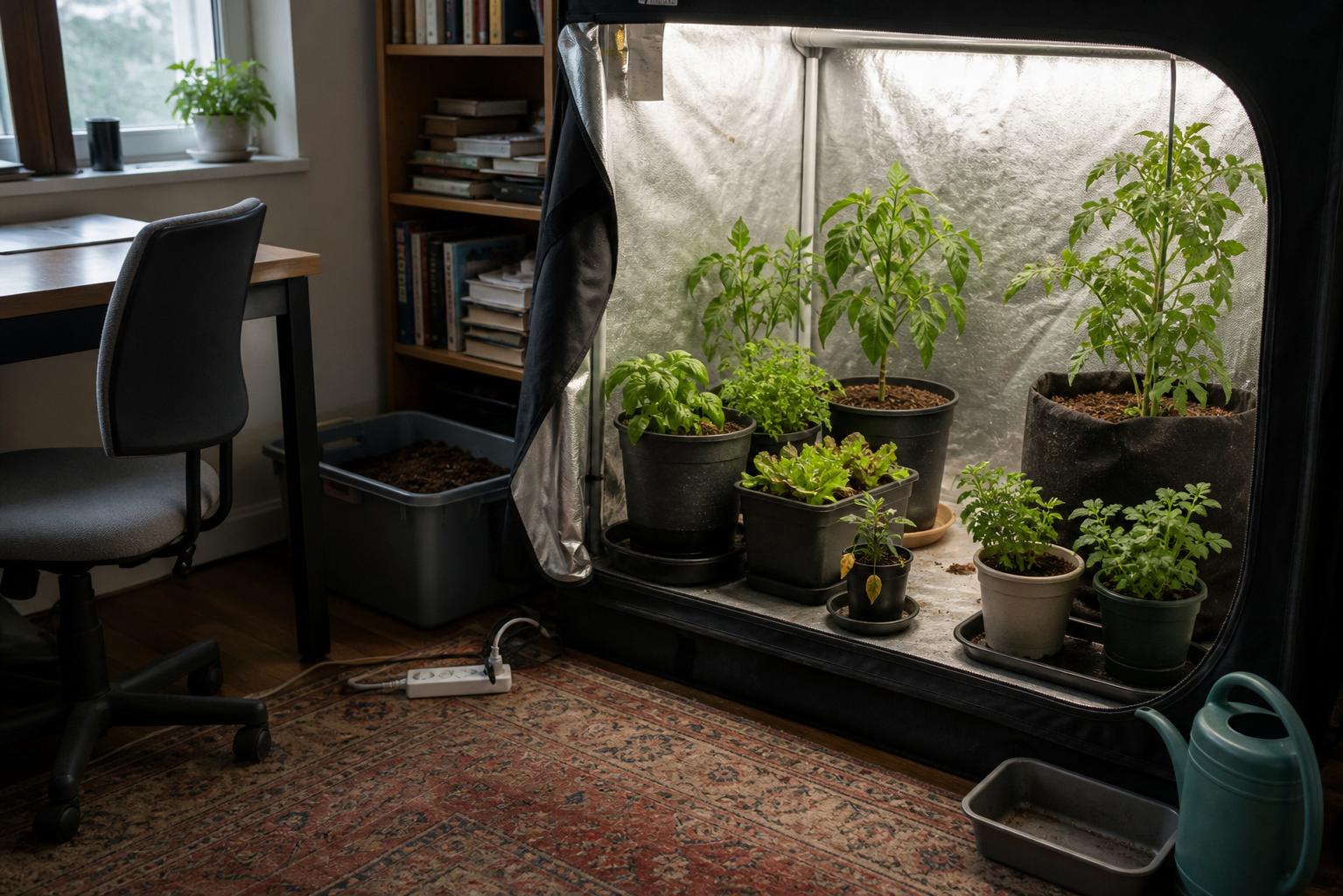
Container size is easy to underestimate inside a grow tent. A pot may look small enough when the seedling goes in, but that same container controls how often you water, how stable the plant becomes, and how much usable tent floor disappears once the canopy fills out.
I used to choose grow tent containers mainly by asking how many I could fit under the light. That approach gave me more plants, but not necessarily more food. Crowded pots were difficult to reach, small containers dried too quickly, and oversized containers stayed wet long enough to attract fungus gnats. More pots did not produce a better grow.
What Container Size Changes Inside a Grow Tent
A container is more than a place to hold growing medium. Inside a grow tent, it acts as a water reserve, nutrient buffer, root anchor, and physical boundary around each plant. Its width also determines whether air can move around the lower leaves and whether you can reach the drainage saucer without moving everything else.
Small containers react quickly. They warm up faster under grow lights, dry faster in moving air, and show nutrient mistakes sooner. Large containers change more slowly, but they occupy valuable floor space and can hold excess moisture for days.
The most useful container is usually not the largest one you can squeeze into the grow tent. It is the smallest size that can support the mature plant without demanding constant attention.
Watering frequency changes first
I have noticed that basil or lettuce in a small pot can look fine in the morning and noticeably limp by evening, especially when the circulation fan moves air directly across the container. A larger volume of growing medium gives the roots a wider moisture buffer.
That does not mean every plant should go into a large pot. An oversized container around a small root system dries unevenly. The center can remain wet while the surface looks dry, tempting you to water again. Inside an enclosed grow tent, that extra moisture also adds to humidity and makes fungus gnat problems more likely.
Roots need stability as well as room
Peppers, compact tomatoes, and bush cucumbers become top heavy under good grow tent lighting. If the pot is too narrow or light, the plant can lean when it is loaded with fruit or when a fan moves the canopy.
Root room and physical stability are connected. A deeper, heavier container gives fruiting plants a better base and leaves enough medium to support steady water and nutrient uptake.
Signs a Grow Tent Container Is the Wrong Size
A plant in a container that is too small usually becomes demanding before it becomes obviously unhealthy. You may find yourself watering repeatedly while nearby plants remain comfortable.
- The pot feels light every day, even when the grow tent temperature is reasonable.
- Lower leaves wilt between waterings but recover quickly afterward.
- Roots circle densely around the bottom or push through several drainage holes.
- Growth slows even though the grow light and feeding routine have not changed.
- A pepper or tomato tips easily as its canopy develops.
One mistake I made early on was treating frequent wilting as a reason to increase fertilizer. The actual problem was that the container held too little growing medium. More nutrients only increased salt buildup in an already stressed root zone.
An oversized container creates a different pattern:
- The growing medium remains heavy and wet for several days.
- New growth looks weak even though the plant has been watered.
- Fungus gnats gather around the surface.
- The grow tent smells damp after the lights turn off.
- Large pots block access to plants, saucers, or intake vents.
Check moisture below the surface before blaming the light or nutrient mix. I prefer lifting smaller pots and using a wooden skewer in larger ones. The surface alone is not a reliable guide inside a grow tent with fans running.
Matching Pot Size to Edible Crops
Pot recommendations are not exact rules. Plant variety, growing medium, pruning, and the length of the grow all matter. Still, these sizes are practical starting points for a typical home grow tent.
Leafy greens and compact herbs
Lettuce, spinach, parsley, cilantro, and smaller basil plants usually do well in containers holding about one gallon per plant. A wider container is often more useful than a deep narrow pot because these crops build relatively shallow root systems.
For several small greens, I prefer a shared rectangular planter. It uses grow tent floor space efficiently and leaves fewer individual saucers to empty. Just group crops with similar watering needs. Thirsty basil and slower growing rosemary are poor container partners.
Peppers
Compact pepper plants can grow in three gallon containers, but five gallons is my practical preference for most mature peppers inside a grow tent. The extra medium makes watering less urgent and helps stabilize plants carrying fruit.
If the grow tent is very small, I would rather grow two peppers well in five gallon pots than force four peppers into undersized containers. The larger plants are easier to maintain, and their leaves are less likely to form one crowded wall that traps moisture.
Compact tomatoes and bush cucumbers
Use at least five gallons for a compact tomato, with seven gallons providing a more forgiving moisture reserve. Bush cucumbers also benefit from about five gallons because they drink heavily once flowering and fruiting begin.
These crops need more than root volume. Their pots must leave room for supports, drainage trays, and your hands. A container that technically fits may still be too large if you cannot reach behind it to inspect leaves or clean spilled water.
Radishes and other quick roots
Radishes do not require huge pots, but they need enough depth for the selected variety and enough spacing to form clean roots. A shallow rectangular grow tent planter around six to eight inches deep works better than several small round pots. Carrots need deeper containers, so shorter varieties are more practical under limited tent height.
A Practical Container Plan for Limited Tent Space
Before buying pots, measure the actual inside floor of the grow tent. Then subtract the space used by a humidifier, fan stand, heater, reservoir, or duct opening. Equipment always takes more room than it appears to take in a product photo.
- Choose the main fruiting plants first and assign their mature container sizes.
- Place those pots where the mature canopy will receive good light without blocking access.
- Reserve roughly one fifth of the floor for airflow, drainage trays, and maintenance.
- Use remaining edges for one gallon herbs or a compact rectangular planter.
- Confirm that every pot can be watered and lifted without removing another plant.
For a small grow tent, my preference is a mixed plan with one or two larger fruiting plants and a few shallow rooted greens. It produces a useful variety of food without turning every watering session into furniture rearrangement.
Fabric pots can improve drainage, but they also dry faster and release more moisture into the grow tent air. For growers who cannot check plants every day, rigid plastic pots with generous drainage holes are often more convenient. They are also easier to slide out for inspection and less likely to leak through a worn saucer.
Do not fill every visible gap.
The best next step is to open your grow tent and count how many pots you can reach without moving another one. Check which containers dry in a single day and which remain wet for several days. I would resize those problem containers first, then leave the tempting empty spaces alone until the existing plants reach their mature canopy size.


