
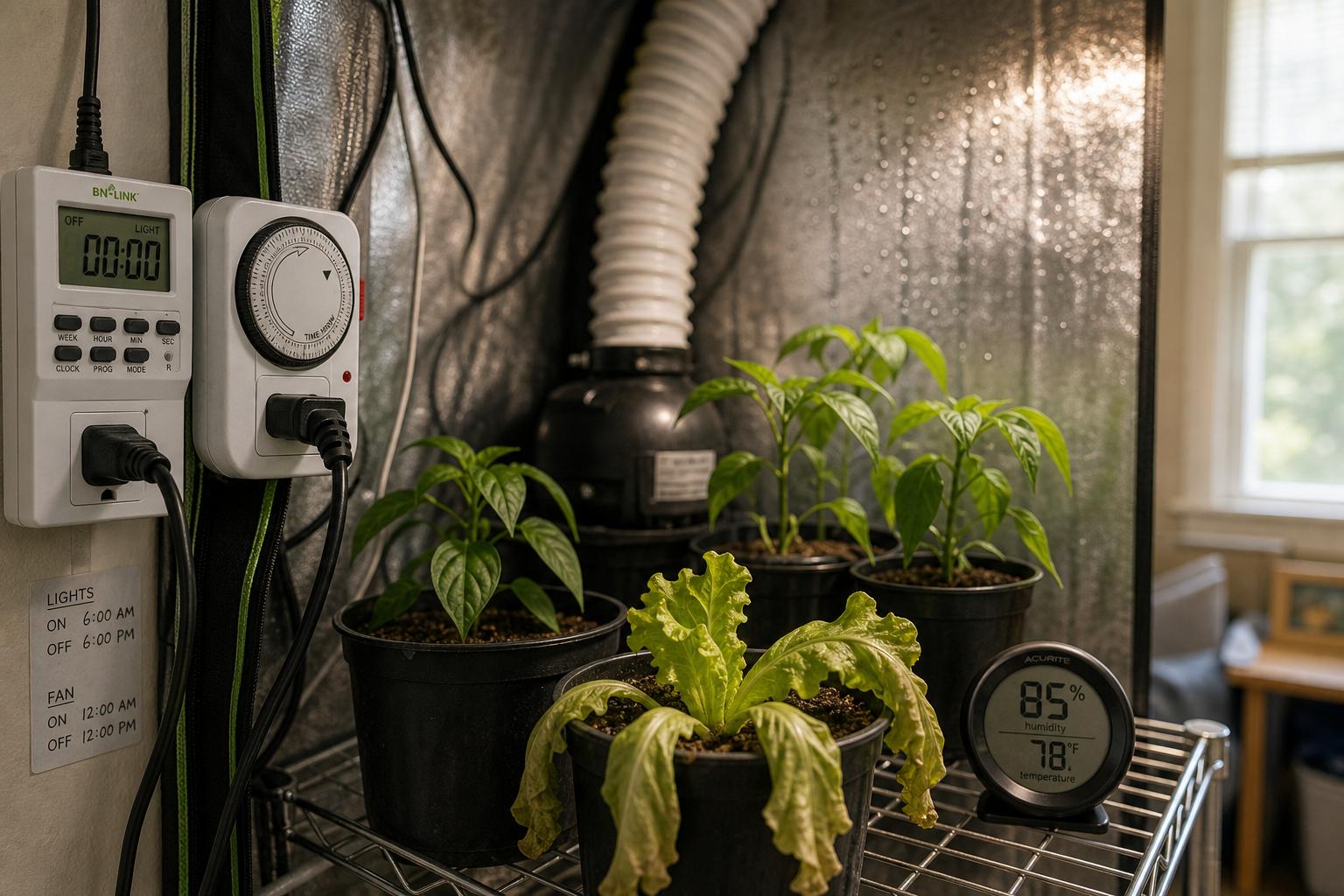
Most problems inside a grow tent get blamed on cheap equipment, weak exhaust fans, or underpowered humidifiers. In my experience, that is usually not the real issue. The real culprit is poor timer coordination.
I have set up dozens of grow tents over the years, and the most common mistake I see is everything turning on at the exact same time. Lights, inline fan boosts, circulation fans, even supplemental CO2 systems all kick on together. Inside a sealed grow tent, that creates a chain reaction of heat spikes, pressure swings, and humidity surges that feel like equipment failure but are really just bad sequencing.
Why Most Grow Tent Timer Setups Create Instability Without You Realizing It
When growers first configure a grow tent, they usually focus on light cycles. Eighteen hours on, six off. Or twelve and twelve for flowering. Then they plug everything else into timers that follow the same schedule.
On paper, that sounds logical.
Inside a grow tent, it is not.
Here is what typically happens at lights on:
1. Grow lights fire up and immediately begin producing heat.
2. Leaf surface temperature starts rising within minutes.
3. Humidity initially climbs as transpiration increases while the tent air is still relatively stagnant.
4. Exhaust fan ramps up only after temperature crosses its trigger threshold.
5. Negative pressure suddenly increases as the fan catches up.
All of that occurs in the first ten to fifteen minutes of the cycle. That is a massive environmental swing in a very small grow tent volume.
I learned this after chasing random humidity spikes in one of my 4×4 grow tents. I upgraded sensors. I replaced a perfectly good inline fan. The instability remained. Eventually I realized every major component was synchronized to the exact same minute.
The grow tent was not unstable because of weak gear. It was unstable because everything reacted at the same time.
The Chain Reaction Inside a Grow Tent
1. Temperature Surge
When lights switch on in a grow tent, heat builds faster than most people expect. Even efficient LED fixtures radiate enough energy to raise canopy temperature several degrees in minutes. If the exhaust fan waits for a thermostat trigger, the grow tent briefly overheats before air exchange catches up.
That initial spike stresses plants far more than a slightly elevated but stable temperature would.
2. Humidity Shock
As leaf temperature rises inside the grow tent, transpiration increases. Moisture output accelerates before fresh air movement stabilizes it. Relative humidity often climbs sharply, then drops quickly once the exhaust fan ramps up. That swing can be ten percent or more in smaller grow tents.
What surprised me most is that growers often blame their humidifier or dehumidifier for this. In reality, the timing structure caused the swing.
3. Pressure Swings
Negative pressure is critical in grow tents to control odor and maintain proper airflow patterns. When exhaust ramps up suddenly instead of gradually, the tent walls visibly suck inward. That sudden shift changes how air moves across the canopy.
I have noticed that inconsistent leaf movement often traces back to uneven pressure caused by mistimed exhaust activation.
A Simple Sequencing Framework That Stabilizes Grow Tents
You do not need new hardware. You need better sequencing.
This is the framework I recommend and personally use in my grow tents:
Step 1. Start Exhaust Before Lights
Set your primary exhaust fan to activate five to ten minutes before the grow light turns on. This establishes airflow and stable negative pressure inside the grow tent first.
By the time heat production begins, air exchange is already active. That eliminates the early spike.
I prefer constant low speed exhaust during the entire light cycle rather than thermostat only control. Reactive control inevitably creates swings. A steady baseline is more stable.
Step 2. Delay High Intensity Add Ons
If you run supplemental CO2, UV bars, or additional side lighting in your grow tent, stagger them five to fifteen minutes after the main light has been running. This prevents stacking heat sources all at once.
One mistake I see often is growers adding side lighting on the same timer as the main fixture. In a confined grow tent, that compounds the initial temperature surge.
Step 3. Coordinate Humidity Equipment Separately
Your humidifier or dehumidifier inside a grow tent should not follow the same timer as lighting. It should respond to environmental readings only.
However, I recommend setting a short startup delay for dehumidifiers if your system allows it. Let airflow stabilize first. Otherwise you get a brief humidity peak, then aggressive overcorrection.
Step 4. Lights Off Sequencing Matters Too
Most growers only focus on lights on. Lights off can be just as disruptive in a grow tent.
When lights shut off, transpiration slows but residual heat remains in the fixture and tent air. If your exhaust fan shuts off at the same moment, humidity spikes rapidly.
I run my exhaust fan at baseline speed for at least ten to fifteen minutes after lights out in every grow tent. This clears stored heat and moisture before night mode conditions settle in.
My Preferred Approach and Why I Avoid One Alternative
Some growers recommend putting everything on smart controllers that react in real time to temperature and humidity. While those systems can work, I have found fully reactive setups inside grow tents constantly chase fluctuations.
I prefer a proactive sequencing approach. Establish airflow first. Then introduce heat. Then layer additional demand.
Reactive only systems tend to overcorrect. In a small enclosed grow tent volume, overcorrection creates more instability than the initial swing.
Diagnostic Checklist for Timer Caused Instability
If your grow tent environment feels inconsistent, walk through this checklist:
1. Do lights and exhaust activate at the exact same minute?
2. Does humidity spike within ten minutes of lights on?
3. Do tent walls visibly pull inward suddenly after lights start?
4. Does humidity jump sharply right after lights turn off?
5. Are multiple high draw devices stacked on a single timer?
If you answered yes to two or more, your grow tent likely has a sequencing issue rather than an equipment limitation.
Troubleshooting Sequence If Swings Continue
If you adjust timers and still see instability inside your grow tent, take these steps:
First, monitor temperature and humidity at one minute intervals during the first thirty minutes after lights on. Look for sharp vertical jumps rather than gradual transitions.
Second, reduce exhaust fan ramp variability. If your controller allows variable speed curves, flatten them. Sudden high speed bursts destabilize pressure.
Third, confirm that intake paths are unobstructed. A grow tent that struggles to draw air smoothly will exaggerate timer mistakes.
In my experience, once sequencing is corrected, most grow tents run noticeably calmer. Leaves move consistently. Temperature increases gradually instead of spiking. Humidity transitions feel controlled rather than chaotic.
Timer coordination seems like a minor detail, but inside a grow tent it controls the rhythm of the entire system. Stabilize that rhythm first before replacing equipment that is probably not the real problem.


