
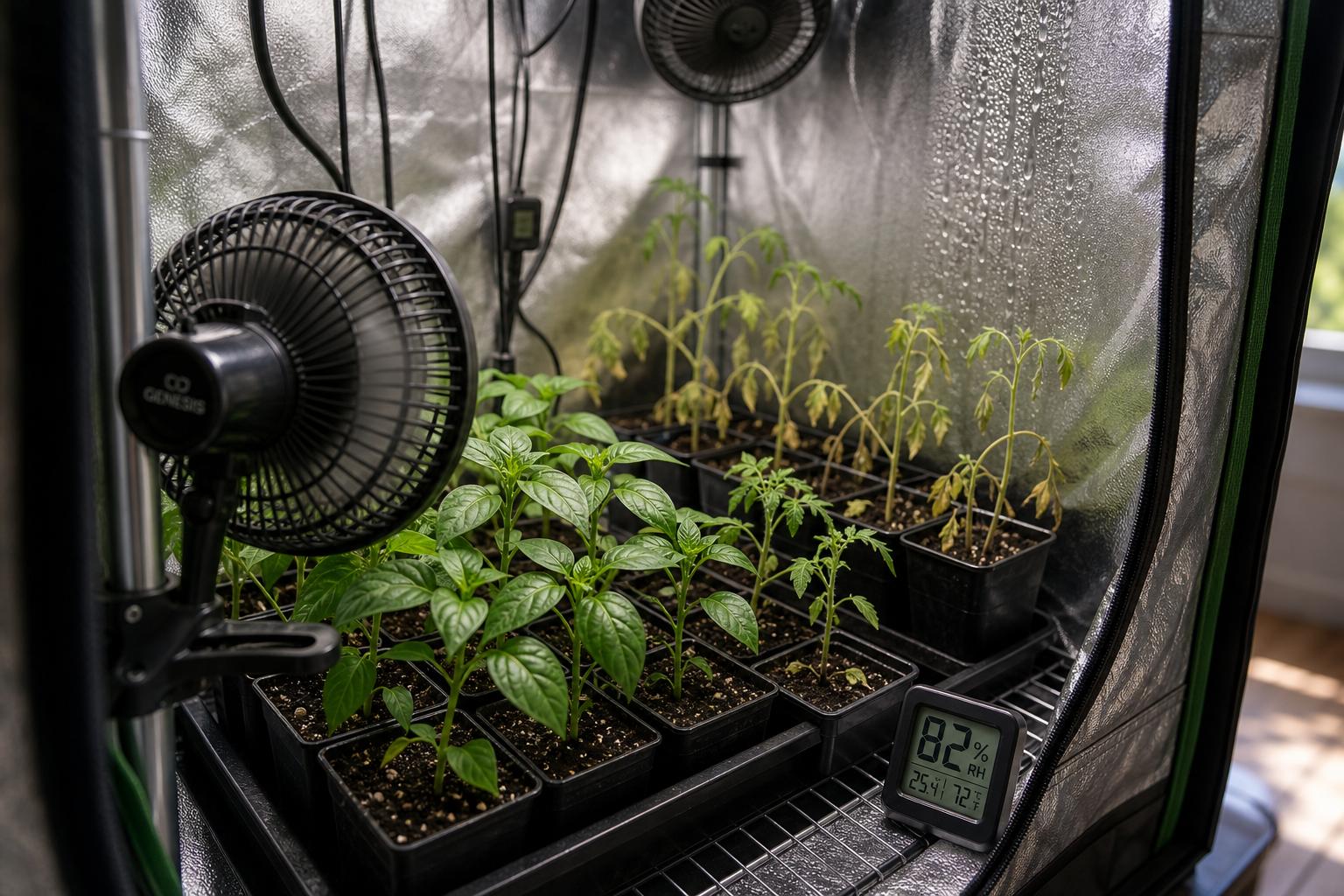
If your grow tent has weak stems, humid corners, or heat building up under the lights, the first instinct is usually to add another fan. I have done it myself more than once. Most indoor growers assume more airflow equals healthier plants. Inside a grow tent, that is not always true.
Grow tents are enclosed systems. Every intake, exhaust, oscillating fan, and light creates a pressure pattern. When you add more fans to a grow tent without understanding that pattern, you often make the environment less stable, not more. Before you spend money or punch another clip fan into the side pole, it is worth checking how your circulation is actually moving.
Why More Fans Often Make a Grow Tent Less Stable
A grow tent is a small fabric box with rigid boundaries. Air has limited ways to enter and exit. When you increase internal air movement without adjusting exhaust balance, you create turbulence.
In my experience, too many fans inside a grow tent cause three common problems:
1. Competing Cross Currents
When two fans point across each other in a grow tent, they create a chaotic swirl instead of a steady circular flow. Plants shake, but dead air still forms behind pots and in upper corners. I have seen leaves whip around while humidity sensors still read high in one back corner.
2. Short Circuiting the Exhaust Path
Your exhaust fan defines the primary direction of air movement in a grow tent. If an internal fan pushes air away from the exhaust port, you weaken the negative pressure and reduce efficient exchange. I once added a high speed clip fan near the roof of my grow tent thinking it would remove heat faster. It actually redirected warm air sideways instead of toward the carbon filter.
3. Leaf Stress Instead of Structural Strength
Plants in a grow tent need gentle, consistent movement. Too many fans create sharp bursts of airflow. The leaves curl slightly and stomata close more often. I learned this after noticing that my stems were not getting thicker despite blasting constant air across the canopy.
More fans increase movement, but they do not guarantee better circulation structure.
Signs Your Airflow Pattern Is the Real Problem
Before you add equipment, look for pattern issues inside your grow tent. These clues tell you the issue is layout rather than fan quantity.
- One side of the grow tent dries faster than the other
- A hygrometer in the back corner reads higher humidity than the center
- Leaves closest to fans show wind stress while shaded interior leaves barely move
- Heat builds up above the light even with strong exhaust running
A balanced grow tent should feel like a slow rotating column of air. Intake from the bottom area, smooth upward movement through the canopy, then a clear pull toward the exhaust port near the top. If you cannot visualize that pathway, your setup needs restructuring.
A Simple Airflow Diagnostic You Can Run in Ten Minutes
You do not need special equipment. Just follow this quick process inside your grow tent.
Step 1: Turn Off Oscillating Fans
Leave only your exhaust system running. Let the grow tent settle for a few minutes.
Step 2: Use a Small Puff Test
I use a small puff of water vapor from a humidifier wand or even a quick spray bottle mist. Release a small visible cloud near the floor on the opposite side of your exhaust.
Watch what happens. In a well structured grow tent, the mist should slowly travel upward and toward the exhaust outlet.
If it stalls, drops, or spirals sideways, you have poor directional pull.
Step 3: Check Upper Corners
Release another small puff near the ceiling opposite your exhaust fan. If it hangs there, you likely have a heat cushion forming above the light. This is common in grow tents with large LED panels mounted close to the roof.
Step 4: Reactivate One Fan at a Time
Turn on one circulation fan and repeat the test. Observe how the path changes. Then test with two fans. You will often see that adding a second fan disrupts the smooth path created by the first.
What surprised me most when I began doing this was how often reducing fan speed improved overall airflow direction.
How to Restructure Circulation Without Adding Equipment
Instead of increasing the number of fans in your grow tent, adjust position and speed.
Create a Circular Path
I recommend designing airflow like a slow vertical loop. Place one oscillating fan low on the tent wall angled slightly upward across the canopy. This should assist the natural upward pull of the exhaust rather than fight it.
If you run a second fan, mount it on the opposite wall but slightly higher. Aim it diagonally downward toward the intake side. This encourages rotation rather than cross collision.
Use Lower Speeds
One mistake I see often is running small clip fans at maximum speed inside a grow tent. High velocity air creates turbulence and micro pockets behind branches. I keep most of my grow tents at medium speed and focus on direction instead of force.
Clear Obstructions
Dense foliage blocks airflow more than people realize. In a full grow tent canopy, lower leaves and tight spacing can prevent smooth vertical movement. Strategic pruning to open interior channels improves airflow more effectively than another fan. This adjustment only makes sense inside a confined grow tent where airflow must travel through a compact plant mass.
Confirm Negative Pressure
Your grow tent walls should gently suck inward. If they balloon outward, internal fan force may be overpowering exhaust capacity. Reduce circulation fan speed or increase exhaust slightly until the tent pulls inward again. That pressure difference is what keeps fresh air replacing old air efficiently.
Troubleshooting Quick Answers
Should every corner of my grow tent have a fan?
No. In most grow tents, two well positioned fans outperform four random ones. Focus on coordinated direction rather than coverage.
Why do my stems stay weak even with multiple fans?
Because chaotic airflow does not create consistent resistance. Plants in a grow tent respond better to steady, moderate movement than violent bursts.
Is it ever correct to add another fan?
Yes, but only after you verify that your current layout cannot produce a smooth air loop. In large grow tents over four feet wide, strategic additional circulation may help. Even then, I expand carefully and test patterns immediately.
The Approach I Recommend
My preference is always to optimize layout before increasing equipment inside a grow tent. More hardware adds noise, wiring clutter, power draw, and additional points of failure. Every new fan changes the pressure dynamic.
I would rather run one properly angled oscillating fan with a strong, well matched exhaust system than stack three cheap fans fighting each other. Alternatives may feel safer because you see more movement, but visible movement is not the same as structured circulation.
After years of working inside grow tents, I eventually realized airflow is about choreography, not wind. When the air moves in a predictable loop from intake to canopy to exhaust, humidity stabilizes, stems strengthen naturally, and heat leaves efficiently. That stability is what you are aiming for.
Before you add another fan to your grow tent, test the pattern you already have. Most of the time, the solution is direction, not quantity.


