
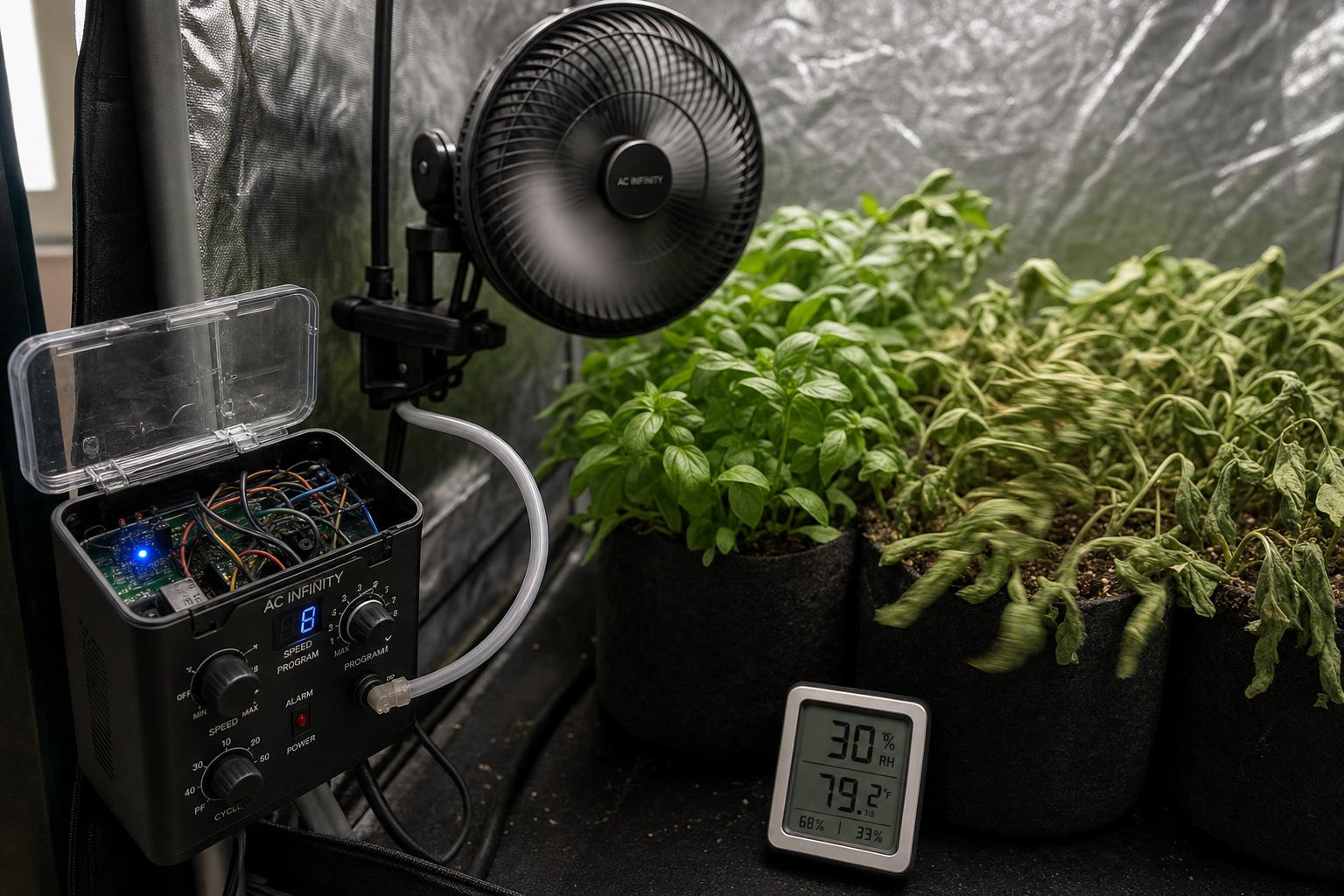
Automatic fan controllers are supposed to make life easier inside a grow tent. You plug in your inline fan, set temperature and humidity thresholds, and expect a perfectly stable environment. But many growers notice something strange after installing one. Their grow tent feels less stable, not more.
Instead of smooth airflow, the exhaust ramps up and down constantly. The tent walls pulse. Temperature swings worsen. Humidity spikes become sharper. The automation inside the grow tent starts fighting the system rather than stabilizing it. In this article I will explain why that happens and how to simplify control so your grow tent runs consistently.
Why Your Grow Tent Feels Less Stable After Adding Automatic Fan Control
Inside a grow tent, airflow is not just about heat removal. It determines negative pressure, carbon filter performance, humidity evacuation, and how quickly fresh air replaces stale air. When fan speed fluctuates aggressively, all of those variables fluctuate with it.
Most automatic controllers rely on threshold triggers. For example, if temperature exceeds 80 degrees, the fan increases to maximum speed. When the temperature drops below 78 degrees, the fan slows down. In a small grow tent, that two degree difference can happen very quickly. The moment the fan ramps up, it rapidly evacuates warm air, overshoots the correction, and cools the space too fast. Then it ramps down. A few minutes later the cycle repeats.
This stop and surge pattern creates pressure waves inside the grow tent. Negative pressure becomes stronger when the fan surges, causing tent walls to pull inward. When the fan slows, pressure relaxes. That constant oscillation affects airflow over leaves, carbon filter efficiency, and humidity exchange at the canopy level.
The problem is not automation itself. The problem is how automated logic interacts with the very small volume of air inside a grow tent.
The Three Automation Mistakes That Create Airflow Swings
1. Narrow Trigger Ranges
The most common mistake is setting tight trigger thresholds. In a grow tent, environmental changes happen quickly because the air volume is small and lighting produces concentrated heat. If your controller has no buffer range, it will constantly chase minor fluctuations.
For example, setting temperature to trigger at 79 degrees with a one degree buffer almost guarantees cycling. Each surge of exhaust pulls in cooler room air, causing an overcorrection. The result is oscillation instead of stability.
Inside a grow tent, stability comes from gentle, continuous exchange rather than dramatic corrections.
2. Sensor Placement in the Wrong Air Zone
Many growers mount the sensor directly in the exhaust airflow path or too close to the light. In a grow tent, there are clear micro zones. The canopy zone, the upper hot air pocket near the light, and the exhaust stream are not the same environment.
If your sensor sits near the top where hot air collects, the controller reacts to the hottest possible reading. The fan turns on aggressively. The moment that hot pocket clears, the reading drops sharply and the fan slows again. This amplifies cycling.
The sensor inside a grow tent should sit at canopy height, shaded from direct light, and away from direct fan blast. This allows the controller to respond to plant level conditions instead of temporary spikes.
3. Prioritizing Multiple Metrics Incorrectly
Modern controllers allow triggers based on temperature and humidity at the same time. In a grow tent, those two variables often move in opposite directions when exhaust speed changes.
When the exhaust ramps up, temperature drops but humidity may also drop rapidly. When exhaust slows, humidity rises quickly due to plant transpiration. If your controller aggressively prioritizes humidity after correcting temperature, it can enter a loop of alternating triggers.
This constant adjustment prevents your grow tent from ever reaching equilibrium. Instead, it exists in a permanent correction cycle.
A Simpler Control Strategy That Keeps Your Grow Tent Consistent
After diagnosing dozens of unstable grow tents, I prefer a simplified approach focused on baseline airflow first and automation second.
Step 1: Establish a Stable Minimum Speed
Set your inline fan to run continuously at a steady minimum speed that maintains gentle negative pressure. The tent walls should pull inward slightly but not collapse. This constant exchange stabilizes the air volume and prevents stagnant pockets.
Do this with automation disabled. Let the grow tent run for several hours with lights on. Observe temperature and humidity patterns. If temperature stays within an acceptable range without aggressive ramping, you are close to the correct base speed.
Step 2: Widen the Control Buffer
Once your baseline speed handles most of the workload, enable automatic control with a wide buffer. Instead of a one degree trigger difference, increase the allowable swing. The goal inside a grow tent is to avoid frequent cycling. A slightly wider temperature band creates fewer large corrections.
This reduces ramp frequency and keeps airflow smooth.
Step 3: Choose One Primary Trigger
In many grow tents, temperature should be the dominant trigger during lights on, while a constant minimum speed handles humidity passively. Avoid configuring aggressive multi condition logic unless your space truly requires it.
Simpler logic produces fewer oscillations.
Step 4: Stabilize the Intake Path
Your grow tent exhaust cannot behave consistently if intake airflow is restricted or inconsistent. Make sure passive intake flaps are fully open and not partially collapsing when negative pressure increases. If using active intake, match it proportionally to exhaust strength so pressure remains stable even during ramp events.
A stable pressure profile reduces sensor bouncing and airflow swings.
Diagnostic Checklist to Know If Automation Is Helping or Hurting
If you suspect your automatic fan control is destabilizing your grow tent, run through this checklist.
Are the Tent Walls Pulsing Every Few Minutes?
Visible inward and outward wall movement is a strong sign of excessive cycling. This indicates the fan is ramping too frequently.
Does the Exhaust Fan Change Speed More Than Six Times Per Hour?
In a properly tuned grow tent, major speed changes should be limited. Constant modulation suggests trigger thresholds are too tight.
Does Temperature Graph Data Show Sharp Peaks and Valleys?
If you log environmental data, look for sawtooth patterns rather than smooth curves. Sharp drops immediately after spikes indicate overcorrection.
Is the Sensor Located Near the Ceiling or Exhaust Duct?
Relocate it to canopy height and retest. Many instability problems inside grow tents are resolved simply by moving the probe.
Does Disabling Automation for One Day Improve Stability?
Temporarily run the grow tent at fixed fan speed for a full light cycle. If conditions appear smoother, your automatic settings need simplification.
Automation in grow tents should smooth the environment, not constantly fight it. In a space this small, dramatic corrections create more destabilization than protection. Establish a reliable baseline airflow, widen your buffers, simplify trigger logic, and let the system breathe steadily. Consistency inside a grow tent comes from controlled moderation, not constant reaction.


